
Strengths-Based Interview Prep: Win Without Sounding Fake
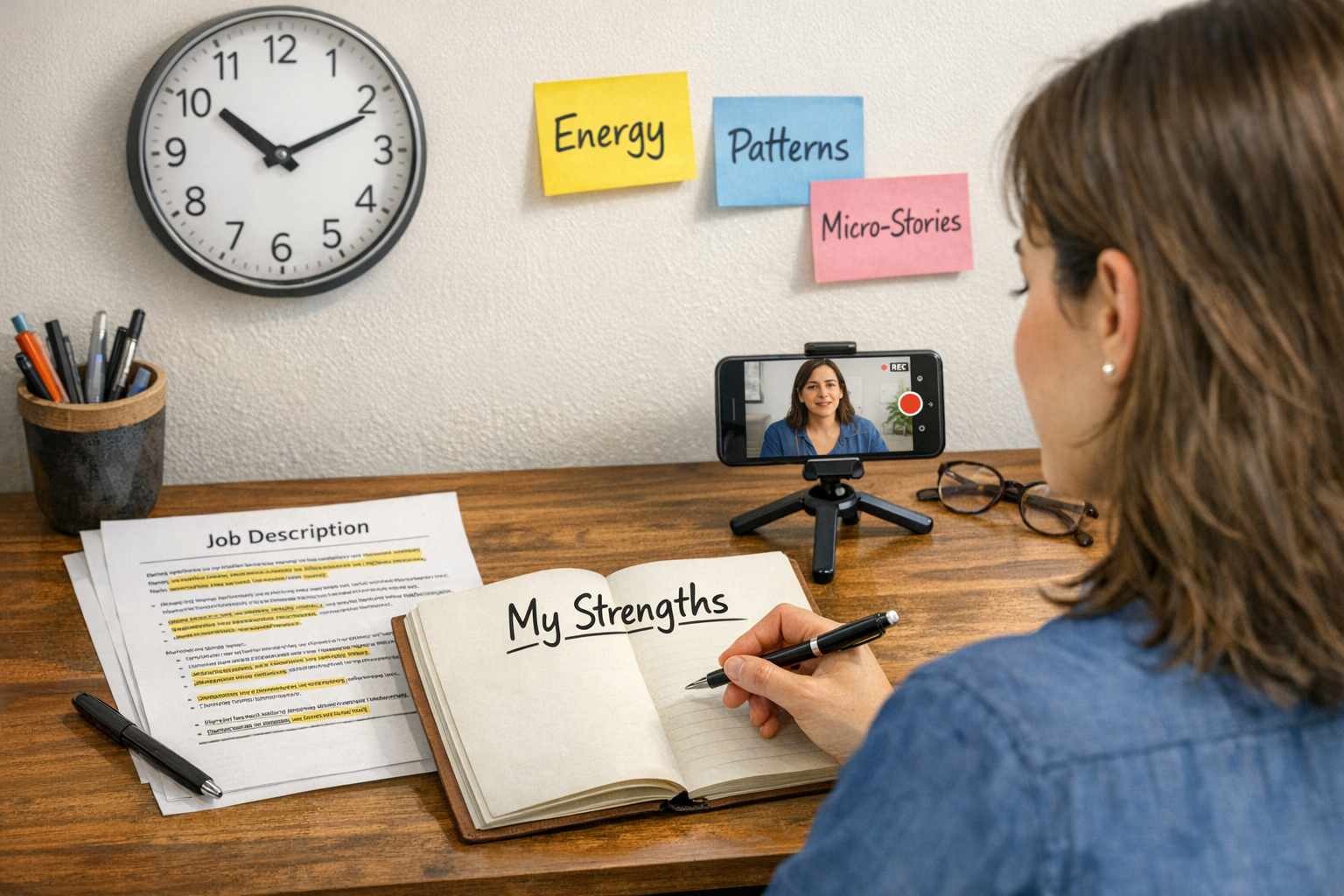
Strengths-based interviews are not “easier”. They are different.
If you think a strengths-based interview is where you can just “be yourself”, relax, and wing it, you are about to get caught out.
A strengths-based interview is designed to bypass your rehearsed competency stories and expose what you actually enjoy doing, how you naturally think, and where you will likely perform best.
That is great for good employers.
It is brutal for candidates who have never done the work of understanding their strengths, proving them, and matching them to the role.
This guide shows you exactly how to prepare for a strengths-based interview, without faking a personality, without rambling, and without sounding like you swallowed a self-help book.
What a strengths-based interview really is (and why employers use them)
A strengths-based interview is a structured way for employers to assess three things:
- What you are naturally good at
- What you genuinely enjoy doing
- Whether that combination fits how the role works day-to-day
Competency interviews focus on “Can you do it?”
Strengths-based interviews focus on “Will you do it well, consistently, and with energy?”
Many employers use them because they are trying to reduce mis-hires and improve performance and retention. This approach is common in early careers hiring, where candidates have limited experience and traditional competency evidence is thin.
The trap: candidates assume strengths means “Tell us what you are good at.”
The truth: strengths means “Show us how you think, what drives you, and whether it matches this job.”
How strengths-based questions are different (so you do not answer them wrong)
Strengths-based questions are usually:
- Short
- Fast
- Repetitive in theme
- Asked with follow-ups that push you off-script
You might be asked:
- “What type of tasks do you most enjoy?”
- “When do you feel most motivated at work or study?”
- “Do you prefer starting tasks or finishing them?”
- “Tell me about a time you had to learn something quickly. What did you do first?”
- “What would your friends say you are good at?”
Notice what is missing.
They are not asking for a polished STAR story every time.
They are listening for patterns.
They are watching your energy.
They are checking for authenticity.
If you answer like a robot, you will fail.
If you waffle like it is a therapy session, you will also fail.
The single biggest mistake: picking strengths you think they want
Most candidates sabotage themselves by choosing “safe” strengths:
- “I am a team player.”
- “I work hard.”
- “I am a perfectionist.”
These are not strengths. They are generic claims.
Even worse, they are not specific enough to match a job.
A real strength is a repeatable pattern of behaviour that:
- produces good outcomes
- feels energising rather than draining
- shows up across different contexts
If you do not know what energises you, the interviewer will work it out faster than you can.
And if your answers sound like you copied them from a graduate careers website, they will assume you are performing.
Step 1: Build your “strengths inventory” in 45 minutes
You need raw material before you craft answers.
Open a doc. Create three headings:
- Activities I enjoy and lose track of time doing
- Activities I am praised for (even when I think they are basic)
- Activities I do well under pressure
Now fill it with evidence from:
- university or college work
- part-time jobs
- volunteering
- caring responsibilities
- sport, clubs, societies
- personal projects
Do not filter. Just list.
Then add one line under each item:
- “What was the outcome?”
- “What did I do specifically?”
- “What part did I enjoy?”
This forces you out of vague adjectives and into observable behaviour.
Example:
- “Helping new staff at my café job”
- Outcome: new starters got up to speed quickly, fewer mistakes
- What I did: broke tasks into steps, demonstrated, checked understanding
- Enjoyed: making things clearer and seeing confidence grow
That is a strength signal.
Step 2: Convert strengths into clear, usable labels (not buzzwords)
Interviewers do not hire “hard-working”. They hire capabilities.
Turn your inventory into 6 to 8 strength statements that follow this format:
- “I am at my best when I am [behaviour] to achieve [outcome] because I enjoy [reason].”
Examples:
- “I am at my best when I am simplifying complex information into clear steps, because I like making things usable.”
- “I am at my best when I am spotting errors and inconsistencies, because I get satisfaction from making work accurate.”
- “I am at my best when I am organising people and tasks into a plan, because I like creating order and momentum.”
Notice the difference.
These are not personality traits. They are work behaviours.
Step 3: Match your strengths to the role, not your ego
Strengths-based interviewing is not about proving you are impressive.
It is about proving fit.
Before the interview, dissect the job description. You are looking for:
- the repeated tasks
- the pressure points
- the pace and environment
- the trade-offs the role demands
Do this:
- Highlight verbs in the job description (analyse, coordinate, persuade, troubleshoot, build, deliver)
- Group them into 4 to 6 “core demands”
- For each demand, pick one of your strength statements that naturally supports it
Example core demands for a customer support role:
- handling high volume queries
- explaining solutions clearly
- staying calm under pressure
- spotting patterns and escalating issues
Now map strengths:
- “I am at my best when I am translating technical information into plain English.”
- “I am at my best when I am staying composed and methodical when others are stressed.”
- “I am at my best when I am noticing recurring issues and documenting them clearly.”
This is how you stop guessing what to say.
Step 4: Prepare “micro-stories”, not long speeches
Strengths interviews move quickly. You need answers that land fast.
Use a micro-story structure:
- Context: one sentence
- Action: two to three sentences on what you did
- Signal: one sentence linking to the strength
- Result: one sentence outcome
Keep it under 45 seconds.
Example:
- Context: “In my final group project, our analysis kept getting stuck because the dataset was messy.”
- Action: “I cleaned the data, created a simple checklist for how we would name and store files, and shared a quick guide with the team.”
- Signal: “I am at my best when I can create structure so people can move faster.”
- Result: “We finished the analysis a week early and used the extra time to improve the write-up.”
That is strong because it is specific, behavioural, and energised.
Step 5: Train your delivery: energy, pace, and clarity
Strengths-based interviews include an unspoken scoring system.
They will score what you say, and how you say it.
You need to sound like you mean it.
Practical training:
- Record yourself answering 10 questions on your phone
- Listen back once for clarity, once for energy
- Cut every filler phrase: “sort of”, “maybe”, “I guess”, “like”
- Replace vague claims with specifics: numbers, frequency, tools used, steps taken
Targets:
- 30 to 60 seconds per answer
- one clear point per answer
- one example or proof point wherever possible
If you sound bored describing your “strength”, it is not your strength. Or you are lying.
Step 6: Prepare for the follow-ups that expose fake strengths
Good interviewers will probe.
Expect follow-ups like:
- “Why do you enjoy that?”
- “What do you do when it goes wrong?”
- “What do you find difficult?”
- “Which part of that task do you like least?”
- “Tell me about a time you did not enjoy it.”
You need honest, controlled answers.
A simple framework:
- Admit the edge
- Show the control
- Bring it back to the role
Example:
“I enjoy accuracy and checking details. The risk is I can spend too long perfecting something. I manage that by timeboxing and agreeing what ‘good enough’ looks like early. In this role, where accuracy matters but deadlines are real, that balance is important.”
That is mature. Not defensive.
Step 7: Know your red flags (what a bad fit looks like)
Strengths interviews are a two-way filter.
If you pretend to love work you hate, you will get hired into misery.
Common mismatch patterns:
- You claim you love high pressure, but you avoid urgent tasks and procrastinate
- You claim you love people, but you hate constant interaction
- You claim you love detail, but you repeatedly make careless errors
- You claim you love ambiguity, but you freeze without instructions
A better approach:
- Identify the environments where you thrive
- Choose roles that match that reality
This is not about lowering ambition.
It is about not sabotaging your first job with a fake persona.
A strengths-based interview question bank (and how to answer each)
“What are your strengths?”
Do not list five adjectives.
Give two strengths maximum, each with:
- a behavioural label
- a micro-story
- a link to the role
Example:
“My first strength is simplifying complex information into clear steps… [micro-story]. My second strength is staying calm and methodical when priorities change… [micro-story]. Both matter here because the role involves handling varied requests at pace.”
“What do you enjoy most?”
Pick a work activity, not a hobby.
- Good: “Turning messy inputs into a clear plan.”
- Weak: “Working with people.”
Then prove it with a micro-story.
“What do you find most difficult?”
Pick something real but manageable.
Avoid:
- core requirements of the role
- anything that signals unreliability (lateness, conflict, dishonesty)
Structure:
- “I used to struggle with X, so I implemented Y, now I do Z.”
“When have you used that strength?”
They are testing repeatability.
Give two contexts quickly:
- “I used it in my retail job when… and again in my coursework when…”
“Do you prefer working alone or in a team?”
Do not guess the “correct” answer.
Answer like a professional:
“I can do both. For deep work like analysis I prefer focused solo time, then I like structured check-ins to align decisions and move quickly.”
“How do you stay motivated?”
They are assessing self-management.
Talk about:
- clear targets
- progress visibility
- feedback loops
- purpose linked to outcomes
Example:
“I stay motivated when I can see progress. I break work into milestones, track them, and get feedback early so I do not waste time.”
How to research strengths-based interviews properly (not lazily)
Do three things before the interview.
1) Read the employer’s website for values and behaviours
You are looking for repeated language: “curious”, “commercial”, “collaborative”, “customer-first”.
2) Search for the employer’s strengths interview format
Some employers publish guidance. Candidates also share experiences. Use it to anticipate question style, not to memorise scripts.
3) Translate role tasks into strengths
If the role says “build relationships with stakeholders”, the strengths underneath might be:
- listening
- persuasion
- resilience
- clarity of communication
Your job is to show you have them, with evidence.
A brief implementation plan you can follow this week
Day 1: Build your strengths inventory (45 minutes)
- List 15 to 25 activities across study, work, and life
- Write outcome, action, enjoyment for each
Day 2: Write your 6 to 8 strength statements (30 minutes)
- Use the “I am at my best when…” format
- Remove vague words
Day 3: Map strengths to the job (30 minutes)
- Identify 4 to 6 core role demands
- Match one strength to each
Day 4: Create 10 micro-stories (60 minutes)
- Keep each under 45 seconds
- Practise without notes
Day 5: Mock interview and tighten delivery (45 minutes)
- Record, listen back, cut filler
- Add specifics and outcomes
This is not glamorous.
It is what prepared candidates do.
Final reality check: what “good” looks like in the room
You will know you are doing well when:
- your answers are short and specific
- you sound energised when describing your strengths
- your examples match the role’s actual work
- you can handle follow-ups without collapsing into waffle
A strengths-based interview rewards clarity, self-awareness, and honest fit.
Prepare properly and it becomes one of the fairest interview formats you will ever face.
Wing it and it becomes a personality test you did not study for.
Choose wisely.
Next Steps
Want to learn more? Check out these articles:
Best Questions to Ask at the End of an Interview (Win Offers)
Assessment Centre Prep: Win the Day Without Guessing
Employer-Centred CV: Turn Experience Into Employer Value
Check out our Advanced Employability Course for all the help you need to get your dream job, fast.