
Employer-Centred CV: Turn Experience Into Employer Value
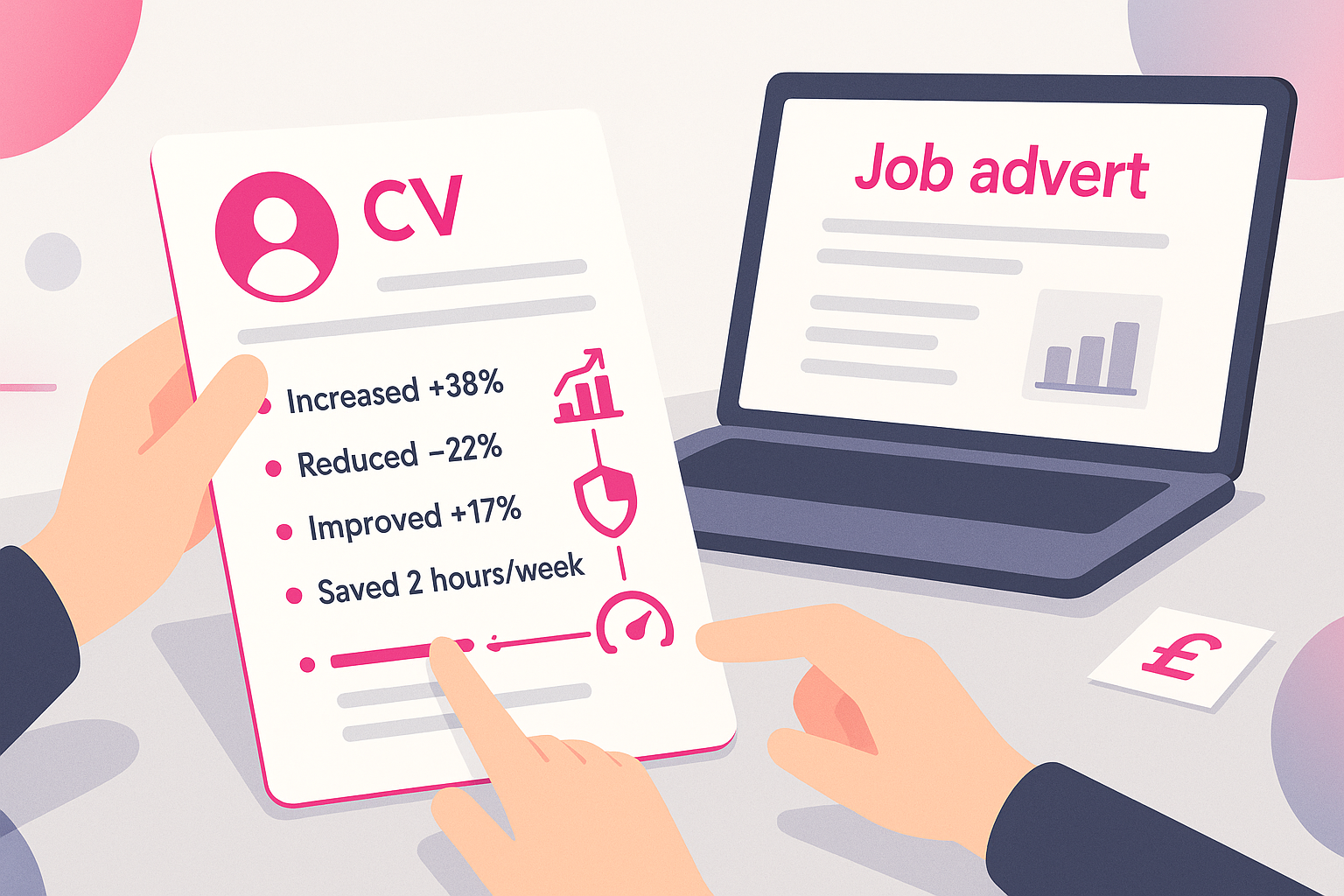
If your CV talks about you, it will be ignored
If your CV talks about you, it will be ignored. If it speaks the language of the employer’s goals, it gets interviews. Brutal, but true. Hiring managers are not shopping for potential. They are buying outcomes. Revenue protected. Costs reduced. Risks lowered. Customers kept. Speed improved. If your CV does not show you can move one of those needles, it is a polite no.
This article shows you how to write employer-centred CV language. Not fluff. Not buzzwords. Clear, hard-edged statements that map your experience to what employers actually pay for. Do this and you become easy to hire. Keep writing from your own perspective and you will be invisible.
What Employer-Centred CV Language Really Means
Employer-centred language is writing every line of your CV to answer one question: how did this create value for the employer? It converts tasks into outcomes and outcomes into business impact, in words hiring managers trust. It forces you to stop saying “I want” and start proving “I deliver.” You write through the lens of the role’s pain points, not your preferences.
The quick mental switch
Look at each bullet on your CV. Ask So what for the employer? Keep asking until the value is obvious. If the value is not obvious, rewrite or delete.
The Harsh Truth: Phrases That Get Skipped
You think these sound professional. They read as noise:
- Responsible for
- Assisted with
- Involved in
- Worked on
- Participated in
- Exposure to
- Familiar with
- Passionate about
- Hard-working team player
None of these show impact. Replace them with verbs that signal ownership and outcomes: delivered, improved, reduced, resolved, increased, launched, automated, streamlined, coached, negotiated, implemented, shipped.
The Employer Value Map: What Your CV Must Target
Employers hire to change one or more of these needles:
- Revenue: acquire customers, increase average order value, reduce churn, cross-sell.
- Cost: cut waste, reduce rework, automate manual steps, shorten cycle times.
- Risk: reduce errors, improve compliance, prevent outages, enhance safety.
- Speed: ship faster, respond quicker, meet deadlines, unblock dependencies.
- Quality: raise CSAT, NPS, first-contact resolution, on-time delivery, accuracy.
- Capacity: do more with the same team, handle peak demand, scale processes.
- Insight: better reporting, clearer decisions, improved forecasting.
Your CV must show you have moved at least one of these. Not wishful thinking. Evidence.
The Conversion Formula: Task → Outcome → Business Impact
Use this simple build to convert any experience into employer-centred proof:
- Context: where, scale, constraints.
- Action: what you did, tools, behaviours.
- Result: measurable change.
- Business impact: which needle moved and why it matters.
Example rewrites
Retail Assistant
Before - Responsible for stocking shelves and helping customers.
After - Replenished high-demand SKUs every two hours to maintain 98 percent on-shelf availability during peak periods, reducing lost sales and improving daily revenue stability.
Customer Service
Before - Answered calls and handled complaints.
After - Resolved 45 to 55 customer queries per day with an 87 percent first-contact resolution rate, cutting escalations by 22 percent and improving CSAT from 4.1 to 4.5.
Warehouse Operative
Before - Worked in a warehouse environment, loading and scanning.
After - Scanned and sorted 1,200 to 1,500 parcels per shift with 99.6 percent accuracy, reducing rework time by 18 percent and maintaining outbound SLAs.
Marketing Graduate
Before - Helped with social media posts.
After - Created a 4-week content calendar and published 12 posts that lifted engagement by 38 percent and click-through by 22 percent, contributing 140 qualified site visits.
Hospitality
Before - Worked as a barista in a busy café.
After - Prepared 200 to 250 drinks per shift at peak with under 90-second average wait, upselling bakery items to lift average order value by 14 percent.
The Language Toolkit: Words That Signal Value
Use verbs that imply ownership, change, and completion:
- Delivered, shipped, launched, implemented, executed, deployed, completed
- Increased, grew, expanded, accelerated, boosted, improved, upgraded
- Reduced, cut, eliminated, prevented, mitigated, de-risked, streamlined
- Solved, resolved, fixed, unblocked, simplified, automated, consolidated
- Led, owned, coordinated, facilitated, coached, trained, mentored
- Analysed, modelled, audited, benchmarked, forecast, reported, validated
- Negotiated, secured, closed, retained, recovered, renegotiated
- Designed, built, tested, iterated, optimised, refined
Anchor your claims with employer nouns and context:
- Customers, orders, tickets, defects, returns, escalations, outages, audits
- Pipeline, conversion, churn, CSAT, NPS, AOV, ARPU, retention
- SLA, backlog, cycle time, lead time, throughput, utilisation, uptime
- Budget, margin, cost per unit, write-offs, wastage, shrinkage
Fast Quantifiers When You Think You Have None
You do have numbers. Use:
- Frequency: per day, per shift, per week.
- Scale: number of customers, products, locations, channels.
- Ratios and rates: accuracy, on-time, completion, response, show-up.
- Time savings: minutes per task, hours per week, days per month.
- Proxies: peak footfall windows, busiest routes, seasonal spikes.
- Ranges: when exact numbers vary, give a credible bracket.
Example: Process improvement without exact savings
Before - Improved filing process.
After - Digitised 200+ paper records and indexed by date and client, reducing retrieval time from 6 minutes to under 45 seconds and freeing 3 hours weekly.
Ten Ruthless Language Swaps That Raise Credibility
- Responsible for → Delivered
- Helped with → Partnered with X to deliver Y
- Worked on → Built, executed, or shipped
- Assisted team → Owned part X, increased Y by Z percent
- Familiar with → Applied X in Y context to achieve Z
- Exposure to → Used X in production or real-world setting
- Participated in → Contributed A that resulted in B
- Good communication skills → Presented X to Y audience, led to Z decision
- Team player → Coordinated across A and B to unblock C and meet D deadline
- Fast learner → Picked up X in 10 days to complete Y one week early
Write For The Job, Not For Yourself: Decode The Spec
Start here. Print the job advert. Highlight:
- Top 5 responsibilities
- 6 to 10 core skills and tools
- The real outcomes implied by the language
Translate each responsibility into an employer value statement template:
- Responsibility: Maintain customer satisfaction metrics.
- Employer outcome: Protect retention and prevent support cost spikes.
- Your line: Lifted CSAT from 4.2 to 4.6 over 3 months by reducing average response time from 11 minutes to 5 minutes via templated replies and triage.
ATS Without Becoming A Robot
Yes, you need keywords. No, you should not stuff them. Practical approach:
- Mirror the employer’s exact phrasing for must-have tools and skills in your Skills and Experience sections.
- Use synonyms where natural. Example: Excel and Google Sheets, CRM and Salesforce.
- Put the most relevant keywords in the top third of page one.
- Write like a human. ATS passes your keywords. Humans hire your value.
Craft A Value Proposition Summary That Sounds Like An Offer
Top of page, 3 to 4 lines. Write it as a small promise.
Bad: Recent graduate seeking an opportunity to grow and learn.
Good: Graduate analyst who simplifies messy data into clear decisions. Cleaned and joined 150k-row datasets, automated weekly reporting, reduced stakeholder wait times from 2 days to 2 hours.
Hiring Manager Reading Lens: Make It Stupidly Easy
The first 6 to 10 seconds decide if you live or die. Design your language and layout accordingly:
- Top third must prove fit. Summary plus 3 bullets mapped to the job.
- Put your strongest outcomes first under each role.
- Use short lines, 12 to 16 words, one result per bullet.
- Avoid paragraphs in Experience. Bullets are easier to scan.
- Front-load results. Start lines with the outcome, then how.
Example front-loaded bullet
Increased first-contact resolution from 72 percent to 89 percent by designing a troubleshooting decision tree used by 12 agents.
Employer-Centred Examples Across Functions
Sales support
Before - Cold-called prospects and booked demos.
After - Conducted 40 to 60 targeted outreach calls weekly, booking 6 to 8 demos and contributing £28k pipeline per month.
Operations
Before - Monitored schedules and communicated with drivers.
After - Rebuilt driver rota to balance peak demand, cutting late deliveries by 19 percent across 3 postcodes.
Finance
Before - Helped with invoice processing.
After - Processed 180+ invoices monthly with 99.8 percent accuracy, reducing month-end close from 7 to 5 days by resolving discrepancies proactively.
IT support
Before - Assisted with helpdesk tickets.
After - Closed 25 to 35 tickets daily with 95 percent first-fix rate, reducing average downtime per incident from 42 minutes to 18 minutes.
Administration
Before - Managed diaries and bookings.
After - Coordinated 5 manager calendars and 40+ weekly meetings, cutting scheduling conflicts to near-zero and safeguarding 6 hours of leadership time weekly.
Hospitality
Before - Waiter in busy restaurant.
After - Managed a 6-table section at peak, maintaining under 3-minute greet times and up-selling specials to lift nightly revenue by 9 to 12 percent.
Retail
Before - Cashier and shop floor.
After - Handled 300 to 400 transactions per shift with under 0.2 percent till variance, implemented queue triage to cut average wait by 3 minutes.
Education or projects
Before - Final-year project on sustainability.
After - Led a 4-person project estimating energy savings for a small venue, recommending measures projected to cut annual usage by 12 percent with 8-month payback.
No Formal Experience? You Still Have Employer Value
Translate life into outcomes. Use the same formula.
- Volunteering: Coordinated 12 volunteers across Saturday shifts to sort 300+ donations weekly, cutting backlog by 30 percent.
- Community: Organised a local match with 18 teams, managing fixtures and officials, ran to time with zero disputes.
- Coursework: Built a Google Sheets model with 5 scenarios to forecast club cash flow, avoided a projected shortfall by adjusting fees.
- Personal projects: Launched a 3-page site for a community group, reduced common queries by posting clear FAQs, cut incoming questions by 40 percent.
- Care responsibilities: Managed medication schedules and appointments, never missed a dose in 18 months and reduced travel time by clustering bookings.
If It’s Not Credible, It’s Not Helping
Truth beats theatre. Use ranges and context if you lack exact data. Avoid wild claims. Show how you measured it.
- Bad: Increased sales massively.
- Good: Upsold add-ons to roughly 1 in 6 customers during weekday lunch, estimated 12 to 15 percent lift in average order value based on till receipts.
A Clean Structure That Amplifies Employer-Centred Language
Use this layout:
- Name and contact details.
- Value summary: 3 to 4 lines that sound like a promise.
- Key skills matched to the job spec. 6 to 10 bullets with tools and methods.
- Experience: reverse chronological. 3 to 6 bullets per role. Outcome first.
- Education and certifications: relevant first.
- Proof: portfolio links, GitHub, LinkedIn, testimonials.
Keep to one page early career. Two pages only if every line justifies its seat.
Swap Fluff For Proof With A Simple Evidence Stack
Employers trust what they can verify. Add these lightweight proof points:
- Links: portfolio, project screenshots, case notes.
- Public data: GitHub commits, Kaggle notebooks, Figma files, Notion docs.
- Testimonials: a one-line quote from a supervisor or customer.
- Endorsements: a referee ready to confirm specific outcomes.
- Artifacts: before and after screenshots, process maps, templates you built.
Precision Templates You Can Steal Today
Use these to force employer-centred writing. Plug your numbers in.
- Increased X metric from A to B by doing Y, which reduced employer pain Z.
- Reduced cost/time/errors by A through B, resulting in C business impact.
- Improved customer outcome A by building B, leading to C retention uplift.
- Delivered A ahead of B deadline by doing C, avoiding D risk.
- Automated A manual step, saving B hours per week and freeing capacity for C.
Micro Makeovers: Rewrite Lines The Right Way
CV line makeovers across roles
Admin
Before - Strong attention to detail.
After - Processed 300+ data entries weekly with under 0.1 percent error rate after validation checks.
Customer service
Before - Good communication skills.
After - De-escalated 15+ complaints monthly with a calm script, preventing churn and refunds.
Retail
Before - Team player.
After - Trained 4 new starters on POS and returns handling, cutting early errors by 60 percent.
Tech intern
Before - Knowledge of Python and SQL.
After - Cleaned and joined two 150k-row datasets in Python and SQL, automated a weekly report and cut manual work by 6 hours.
Warehouse
Before - Familiar with health and safety.
After - Zero safety incidents across 9 months by maintaining clear aisles and enforcing PPE compliance during peak shifts.
Hospitality
Before - Fast learner.
After - Learned full menu in 3 days, enabling independent cover on Friday peaks one week early.
How To Quantify Service Work With No Sales Numbers
Not all roles tie directly to revenue. Use service metrics the business tracks:
- Volume: number of calls, tickets, visitors served.
- Speed: response time, handle time, time to resolution.
- Quality: first-contact resolution, error rate, returns, complaints.
- Reliability: attendance, punctuality, rota flexibility, coverage.
- Capacity: tasks automated, hours saved, backlog cleared.
- Customer outcomes: CSAT, NPS, repeat visits, positive reviews.
Hiring Manager Cheatsheet: What They Want To Read First
- Evidence you have done similar tasks in a similar context.
- Proof you can deliver without high supervision.
- Signals you care about customers and quality.
- Signs you can learn quickly and fix problems.
- Low risk of drama, high readiness on day one.
Write your CV to answer those.
Implementation Plan: One Ruthless Week
Day 1: Pull 5 target job adverts. Highlight responsibilities, tools, outcomes.
Day 2: Draft your value summary and a 10-bullet skills list mapped to the adverts.
Day 3: Rewrite your top 10 CV bullets using the conversion formula.
Day 4: Quantify with ranges and proxies. Cut every vague line.
Day 5: Add proof links and a testimonial.
Day 6: Peer review with someone who has hired before. Tighten verbs, front-load results.
Day 7: Ship. Apply to 10 roles. Track response rate. If under 10 percent, iterate.
Quality Control Checklist Before You Send
- Every bullet shows an outcome and implies a business needle.
- The top third matches the job ad language.
- Verbs show ownership and completion.
- Numbers appear in at least half of your bullets.
- No fluff words remain.
- Links open and prove what you claim.
- Layout is clean, one page, scannable.
Advanced Tactics For Extra Edge
- Integrate customer voice: Mention a specific customer type or scenario. Example: Resolved payment failures for international students by clarifying IBAN steps, cutting repeat queries by 40 percent.
- Show constraint handling: Delivered under pressure, limited tools, or shifting goals.
- Reference scale credibly: Number of locations, systems, SKUs, users.
- Highlight compounding wins: The second improvement you enabled because of the first.
- Pre-empt objections: If you lack industry experience, show domain learning speed with a short project or certification that solved a real problem.
Common Mistakes That Kill Employer Trust
- Duties list with no results.
- Vague soft skills without evidence.
- Unverifiable numbers or implausible claims.
- Generic objective statements about learning and growth.
- Keyword stuffing that reads like a bot.
- Wall of text. No one will read it.
A Final Word: Opportunity Should Be Earned And Available
Employer-centred CV language is not about gaming the system. It is about respect. Respect for the employer’s constraints. Respect for the customer’s needs. And respect for your own effort by communicating it in a way the market values.
Talent is equally distributed. Opportunity is not. Writing with employer-centred clarity narrows that gap. Translate what you have done into the outcomes they care about and you become obvious to hire.
Practical Next Step
Rewrite 10 bullets today using the conversion formula. Measure your interview rate over the next 2 weeks. Improve the worst-performing lines. Repeat until your phone starts ringing. That is how you get to work that matters, faster.
Next Steps
Want to learn more? Check out these articles:
Turn Volunteering Into Proof With Metrics Employers Trust
Show Impact From Part-Time Roles [The Practical Playbook]
Craft a Returning-to-Work Story Employers Can Trust [Guide]
Check out our Advanced Employability Course for all the help you need to get your dream job, fast.