
Turn Volunteering Into Proof With Metrics Employers Trust
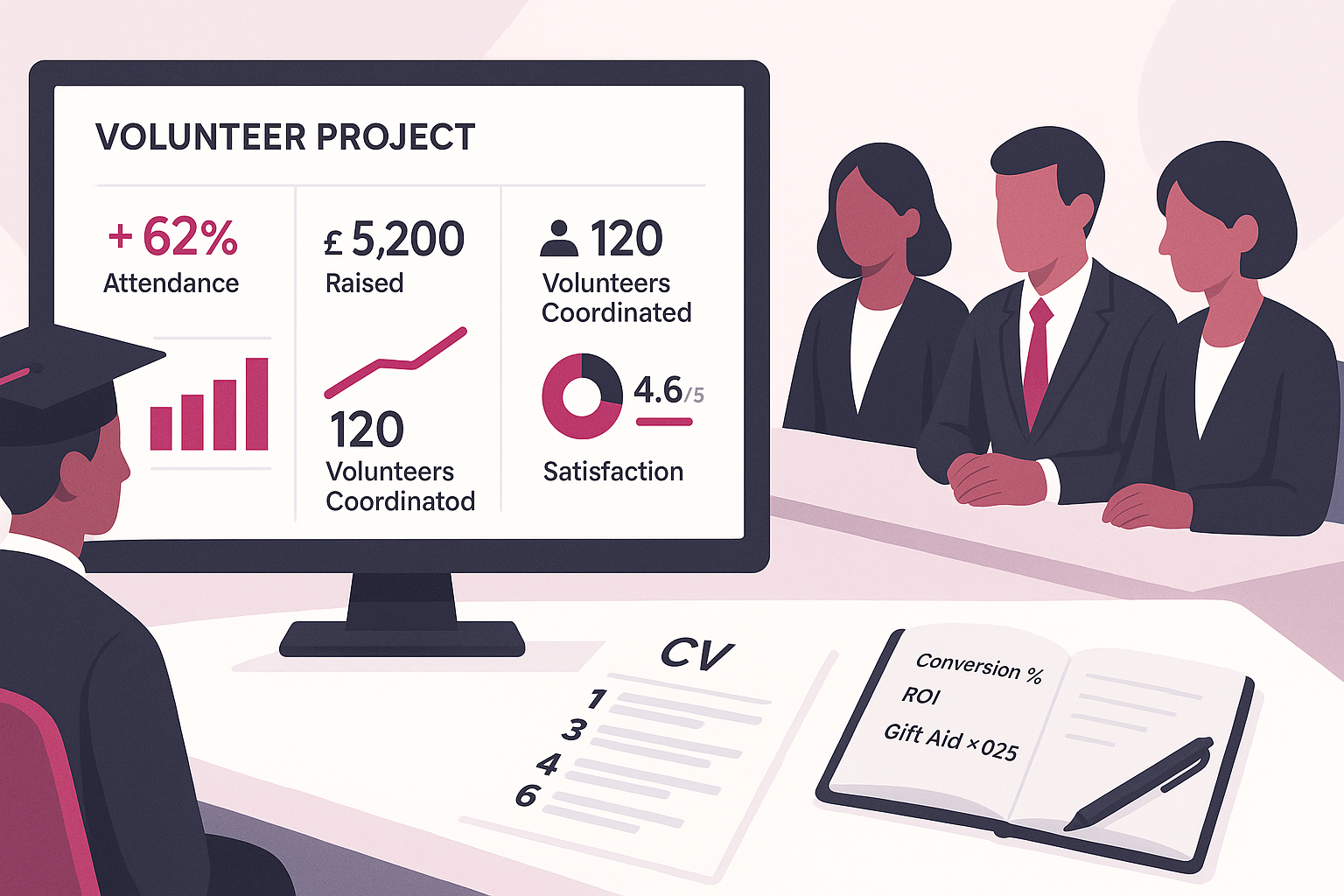
Stop writing “helped” on your CV. Start proving impact.
You volunteered. You worked hard. You learned a lot. Then you wrote “helped organise events” on your CV and wondered why nobody called. Brutal truth: “helped” is invisible. Employers do not hire “helped”. They hire evidence. Numbers. Trajectory. Risk reduction.
Metrics turn nice into valuable. They convert goodwill into business signals hiring managers understand. If you want interviews, start talking in metrics. This guide shows you exactly what to measure, how to find credible numbers fast, and how to present them so employers pay attention.
Why metrics matter for volunteer experience
Employers are drowning in CVs and time-poor. Eye-tracking research suggests recruiters spend seconds on an initial scan. Numbers anchor attention. They shout scale, performance and commercial thinking in one glance.
Volunteering is often undervalued because it is framed as charity rather than capability. Metrics wipe out that bias. They translate your contribution into outcomes: throughput, quality, growth, savings, reliability.
There is also data behind this. Many hiring managers say volunteer experience can build leadership and problem-solving they value. That only lands if you quantify it. Vague stories are easily discounted. Measured results are hard to ignore.
What to measure: eight categories that convert
You do not need a dashboard. You need the right few numbers. Focus on these categories and pick two to three per role.
1) Output metrics
- Volume delivered: meals packed, calls handled, parcels sorted.
- Hours contributed: per week and total. Better when paired with throughput.
- Deliverables shipped: workshops run, events executed, reports compiled.
Examples: “Processed 450 donation items in four Saturdays” or “Supported 6 workshops for 120 learners”.
2) Outcome metrics
- Beneficiary impact: people served, placements achieved, completion rate, improvement percentage.
- Behaviour change: attendance increase, drop-out reduction, follow-up engagement.
Examples: “Matched 18 learners to mentors with 89 percent completing a 12-week programme”.
3) Efficiency metrics
- Time saved: minutes or hours shaved off a task after your change.
- Cost avoided: £ saved through reuse, negotiation, or better process.
- Throughput uplift: tasks per hour before and after.
Examples: “Cut check-in time from 4 minutes to 90 seconds, enabling 2.6x faster entry”.
4) Growth and reach metrics
- Attendance: headcount, sell-out rate, waitlist length.
- Digital reach: followers, email list growth, impressions, click-through.
- Community expansion: partner sign-ups, school or group participation.
Examples: “Grew newsletter from 280 to 1,040 in 10 weeks with a referral CTA”.
5) Quality and satisfaction metrics
- Satisfaction rates: post-event survey score, NPS, five-star reviews.
- Error rates: mislabelled items reduced, rework down, complaints down.
- Service level: response time, resolution time.
Examples: “Raised satisfaction from 78 percent to 94 percent across three events”.
6) Revenue and fundraising metrics
- Funds raised: total £, average donation, Gift Aid captured.
- Cost-to-raise: spend versus funds raised.
- Donor conversion and retention.
Examples: “Raised £7,420 with £180 spend, 41x return; captured £1,120 Gift Aid”.
7) Process and reliability metrics
- On-time delivery rate: events launched as planned.
- Backlog reduction: outstanding cases cut.
- Compliance: safeguarding training completion, audit pass rate.
Examples: “Cleared 62 percent of case backlog in 3 weeks by triage redesign”.
8) Leadership and team metrics
- Volunteers recruited or trained.
- Retention or attendance: rota fill rate, show-up rate.
- Skills progression: certifications completed.
Examples: “Recruited 24 volunteers, lifted rota fill from 68 percent to 96 percent”.
Turn fluffy duties into hard proof: before and after
Your CV must trade duties for impact. Use this formula: Action verb + specific metric + business outcome + context.
- Fluffy: Helped organise a charity fun run.
- Proved: Coordinated 35 marshals, delivering a 600-runner event with 98 percent on-time start and zero safety incidents.
- Fluffy: Volunteered at a food bank.
- Proved: Streamlined packing line from 12 to 8 steps, raising throughput 54 percent to 180 parcels per hour.
- Fluffy: Managed social media for a youth club.
- Proved: Launched content calendar that grew Instagram from 430 to 1,250 in 9 weeks and lifted event sign-ups 62 percent.
- Fluffy: Assisted with fundraising.
- Proved: Wrote three donor emails that converted 22 percent of lapsed supporters, adding £5,200 and 27 new monthly givers.
- Fluffy: Tutored school pupils.
- Proved: Delivered 24 maths sessions with 94 percent attendance, raising mock exam pass rate from 52 percent to 78 percent.
How to get the numbers when nothing was tracked
No data? You can still build credible estimates. Be conservative, transparent, and time-bound.
- Ask the organiser. Most charities have attendance lists, donation totals, rota data, Eventbrite exports, or finance reports. Request ranges if exacts are sensitive.
- Use sign-up tools. Eventbrite, Mailchimp, Google Forms, WhatsApp groups, and Square all store counts and timestamps.
- Sample and extrapolate. Count for one hour across three typical shifts. Average. Multiply by total hours. Example: You sorted 28 items in 60 minutes. Typical shift is 3 hours. You worked 7 shifts. 28 x 3 x 7 = 588 items. State “approximately”.
- Reverse-calc from capacity. If 20 tables seat 8 and every seat was filled twice, that is 320 attendees. Sanity-check with photos and staff.
- Convert time saved into outcomes. If you cut check-in from 4 minutes to 90 seconds for 250 attendees, you saved 250 x 2.5 minutes = 625 minutes. That is 10.4 hours freed.
- Use ratios from similar programmes. If typical conversion from enquiry to placement is 30 percent and your cohort did 42 percent, cite the uplift with source context if asked.
- Track retroactively. Create a simple spreadsheet. Columns: date, event, your task, quantity, time, result, source of evidence. Add photos, screenshots, or testimonials. Build an evidence folder.
Build credible and compliant numbers
- Always time-frame. State the period: “over 6 weeks” or “Q2 2025”.
- Round responsibly. Use whole numbers or one decimal place. Avoid spurious precision.
- Anchor to a baseline. Say “from X to Y” or “by Z percent”. Baselines make change real.
- Link to employer value. Translate your metric into risk reduced, revenue raised, cost saved, or satisfaction improved.
- Avoid vanity. Followers are weaker than sign-ups. Impressions are weaker than conversions.
- Protect privacy. Anonymise names. Aggregate sensitive data. Get permission for photos.
- Be referenceable. Keep quick proof. A screenshot, roster, or email thread is enough. If a hiring manager checks, you answer fast.
Where to place metrics on your CV and LinkedIn
- CV section. Put high-impact volunteer roles under Experience if relevant to the job. Otherwise, create a Volunteering section. Do not bury results under Interests.
- Bullet structure. First bullet should carry your strongest metric and employer-relevant outcome. Example: “Raised £6,240 in 4 weeks by segmenting donor list and adding Gift Aid prompts, funding 3 new laptops for the centre”.
- Micro case study. Use two bullets per role: one to prove scale, one to prove improvement.
- Tools and scale. Add the tools you used and the environment scale. Example: “Used Airtable to build rota for 52 volunteers covering 7-day operations”.
- LinkedIn Projects. Add a Project entry for major initiatives with a title, your role, metrics, and media. Pin it in Featured.
- Recommendations. Ask a coordinator to mention your metric explicitly in a recommendation. It triangulates your claim.
Metric formulas you can use today
- Conversion rate = converted ÷ total x 100.
- Response rate = responses ÷ messages sent x 100.
- Satisfaction rate = positive responses ÷ total responses x 100.
- Attendance rate = attendees ÷ sign-ups x 100.
- On-time rate = tasks on time ÷ total tasks x 100.
- Throughput = units completed ÷ time period.
- Reduction = (old - new) ÷ old x 100.
- Gift Aid uplift = eligible donations x 0.25.
- ROI = net gain ÷ cost.
Worked examples
- Email appeal: Sent 840 emails, 168 donations. Conversion 20 percent. Average donation £18. Gift Aid on 60 percent of donations adds £756. Total raised: 168 x £18 + £756 = £3,780.
- Process improvement: Parcel packing improved from 70 to 115 per hour. Uplift: (115 - 70) ÷ 70 x 100 = 64 percent.
- Event attendance: 320 sign-ups, 268 attendees. Attendance rate 83.8 percent. Implemented SMS reminder. Next event: 290 sign-ups, 262 attendees. Attendance 90.3 percent. Improvement 6.5 percentage points.
How to talk about your metrics in interviews
Metrics win attention on paper. Your explanation wins offers.
- Prepare three impact stories. Pick one growth, one efficiency, one quality improvement. Each should have baseline, action, result, verification.
- Use a sharp structure. Situation, problem, decision, action, result, learning. Add the metric at problem, action and result. Show you manage by numbers, not by hope.
- Be ready for “how measured”. Keep a one-sentence answer: “I exported Eventbrite attendance and cross-checked with sign-in sheets. Numbers match within three.”
- State constraints. If you estimated, say so and state your conservative method. It signals integrity.
- Translate to business. After you share a metric, add the business value. “This cut queue time by 10 minutes for 150 people, which meant we started sessions on time and avoided room overrun fees.”
- Bring proof. Carry a one-page portfolio with screenshots and a short graph for each story. You will be the only candidate who does.
A fast, high-level implementation plan
- Day 1: List your top two volunteer experiences. For each, write three outcomes that matter to employers: growth, efficiency, quality.
- Day 2: Hunt the data. Ask organisers, harvest exports, scan group chats, count from photos, sample and estimate.
- Day 3: Build your evidence folder. Screenshots, sheets, links, testimonial lines. Name files clearly.
- Day 4: Write three quantified bullets per role using the formula. Cut fluff. Front-load numbers.
- Day 5: Add to CV and LinkedIn. Place where relevant. Add a Project entry with media.
- Day 6: Rehearse your three impact stories. 90 seconds each. Smooth delivery, exact numbers.
- Day 7: Ask for a recommendation that mentions your metric. Update your portfolio and keep iterating.
Common pitfalls that kill credibility
- Over-claiming. If it sounds heroic, it will be tested. Be specific not cinematic.
- Irrelevant metrics. Align to the job. Marketing roles care about conversion and cost per result. Operations roles care about on-time and throughput. Customer roles care about satisfaction and first response time.
- No baseline. “Increased attendance” is weak. “From 78 to 94 percent” is strong.
- Per-hour inflation. Do not multiply a personal best by the whole month. Use a typical rate across typical shifts.
- Hiding the time frame. A big number over two years is less impressive than a sharp improvement in four weeks. State both.
- Using only vanity numbers. Followers mean little if sign-ups are flat. Prioritise conversions and completions.
- Forgetting the team. If it was a team result, say “as part of a 5-person team” and state your slice. Ownership matters.
Three mini case studies
1) Charity shop throughput lead
- Before: “Volunteered in a charity shop on Saturdays.”
- After: “Analysed sorting bottlenecks and re-zoned backroom, lifting processing from 42 to 88 items per hour, clearing 70 percent of weekly backlog in 3 weeks.”
- Why it works: Clear baseline, change, result and timeline. Shows process thinking and measurable improvement.
2) Food bank scheduling and rota
- Before: “Helped schedule volunteers.”
- After: “Built a rota in Airtable for 52 volunteers across 7 days, raising shift coverage from 68 to 96 percent and cutting no-shows by 43 percent with SMS reminders.”
- Why it works: Leadership, reliability, tool use, and outcome that matters to any operations manager.
3) Youth club digital growth
- Before: “Managed social media.”
- After: “Launched a 10-week content plan that grew Instagram from 430 to 1,250 followers, lifted event sign-ups 62 percent, and achieved 23 percent email click-through via segmented calls-to-action.”
- Why it works: Ties digital growth to real participation, not vanity.
Templates you can steal
- Growth: “Grew X from A to B in T weeks by doing Y, which led to Z employer-relevant outcome.”
- Efficiency: “Cut process time from A to B by doing Y, increasing throughput C percent and reducing cost £D.”
- Quality: “Raised satisfaction from A to B by introducing Y, cutting complaints E percent.”
- Fundraising: “Raised £A at £B cost, added £C Gift Aid, converting D percent of target segment.”
- Reliability: “Lifted on-time delivery from A to B by implementing Y and weekly stand-ups.”
Keep an eye on ratios that hiring managers love
- Cost per result: spend ÷ results achieved. Lower is better.
- Time to result: weeks to hit X. Faster is better.
- Conversion: step-to-step performance. Shows funnel thinking.
- Adoption: how many people used your improvement. Indicates influence.
- Retention: who came back. Predicts durability of impact.
Smart estimation without lying: a worked template
- State what you know: “We ran four Saturday workshops with 30 seats each. Three sold out.”
- Add conservative fill for the partial case: “The fourth was roughly two-thirds full based on seating.”
- Calculate: 3 x 30 + 20 = 110 attendees.
- Cross-check: “Sign-in sheets show 108. Photos appear consistent.”
- Present: “Hosted 4 workshops for 108 to 110 attendees. Satisfaction 4.6 out of 5 from 83 respondents.”
Final push: your volunteering is a business lab. Prove it.
Volunteering is not filler. It is a live environment where you planned, shipped, fixed, persuaded, and delivered. The moment you quantify it, you stop asking for a chance and start showing you are ready. Numbers reduce risk. Clarity builds trust. Trust gets you interviews.
Take the next hour. Pick one role. Write three bullets. Add one baseline, one improvement, one time frame, one business outcome. That is it. Ship it. Then watch how differently employers react.
Because in a market that scans CVs in seconds, the candidate who measures wins.
Next Steps
Want to learn more? Check out these articles:
Show Impact From Part-Time Roles [The Practical Playbook]
Craft a Returning-to-Work Story Employers Can Trust [Guide]
Confidence Reset for Interviews: A Practical, Rapid Playbook
Check out our Advanced Employability Course for all the help you need to get your dream job, fast.