
Confidence Reset for Interviews: A Practical, Rapid Playbook
Confidence Reset for Interviews: Why You Need One Now
You do not need more bravado. You need a reset. Interviews are controlled environments where uncertainty punishes waffling and rewards clarity. If you have been spiralling, second-guessing or shrinking on camera, this is your hard stop. Here is the practical, rapid playbook to reset your confidence and deliver under pressure.
If your heart races, your mind blanks and every answer sounds weaker out loud than it did in your head, welcome to the club. High performers choke when they treat interviews as a verdict on their worth. Interviews are not court. They are an operating test. Can you deliver value in conditions you do not control? The good news is confidence is not a personality trait. It is a system you run. And any system can be rebuilt fast.
This is a field-tested confidence reset for first-time jobseekers and career starters who cannot afford to wing it. Four parts. State. Story. Substance. System. Fix these and you will sound like yourself at your best, not your worst.
The Brutal Truth Interviewers Will Not Say Out Loud
- You are judged fast. Humans form strong impressions in under a minute. You can moan about fairness or you can engineer those first 60 seconds.
- Nerves are not the problem. Unmanaged nerves are. The goal is not calm. The goal is controlled intensity.
- You think your experience is the pitch. It is not. Your value is the pitch. Experience is evidence.
- Vague confidence dies under follow-up questions. Precise, evidenced confidence gets stronger.
- You do not rise to the occasion. You fall to your preparation. That is why average candidates with rehearsed answers beat talented candidates with messy ones.
A Confidence Reset That Works in the Real World
This playbook is built on four resets. Each is practical, testable and repeatable under pressure.
1) Reset Your State: Control Your Body to Free Your Mind
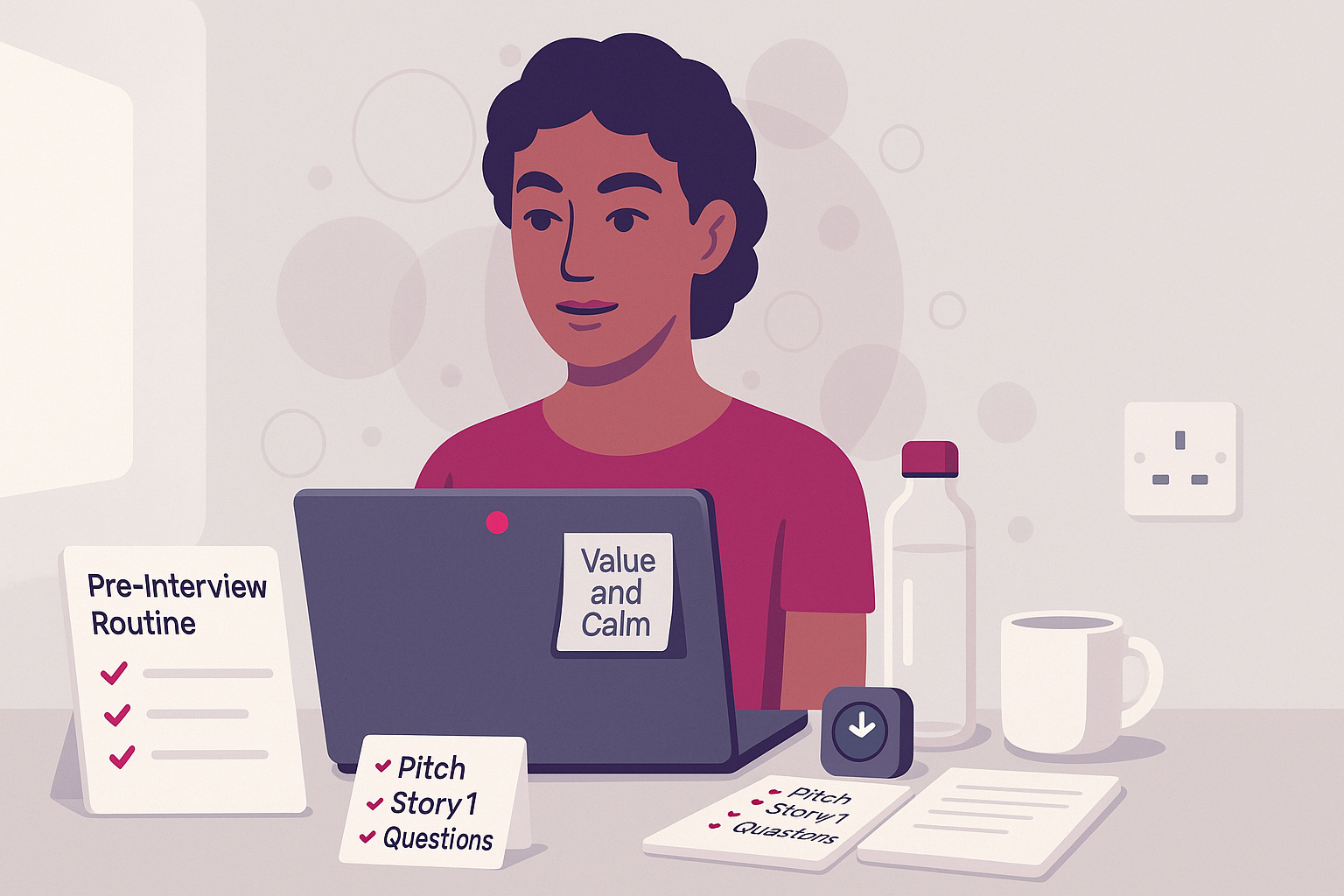
Interview anxiety is physiological before it is psychological. Reduce the body’s threat response and your brain unlocks clarity. Use this pre-interview routine. Ten minutes. Non-negotiable.
- Two-minute breathing reset. Try box breathing: inhale 4, hold 4, exhale 4, hold 4. Repeat for eight cycles. If you prefer, use the double exhale technique: inhale through nose, short second inhale, long slow exhale through mouth. Both lower heart rate and steady voice.
- Three-minute movement. Walk briskly, shake out arms, roll shoulders, stretch neck. Movement burns off excess adrenaline and loosens speech.
- One-minute vocal warm-up. Read a paragraph out loud slowly. Over-enunciate. Then increase pace. This prevents the first answer from sounding thin or shaky.
- Two-minute clarity script. Say your 60-second pitch and one impact story out loud. Do not read. Record and play back. Fix one thing only, not five.
- One-minute environment check. For video: camera at eye level, light in front, not behind, notifications off, water reachable, CV and notes to your side. For in-person: arrive 10 minutes early, restroom stop, check posture and shoes, phone on silent.
- One-minute anchor. Place two words on a sticky note at eye level: Value and Calm. When pressure spikes, glance, breathe, continue.
Morning-Of Checklist
- Fuel: light breakfast or snack with protein. Avoid heavy meals that fog thinking.
- Hydration: water in the hour before. Avoid excess caffeine that triggers jitters.
- Sleep: if the night was poor, a 10-minute quiet eyes-closed recharge helps. Do not cram. Review only your pitch and stories.
During the Interview
- Pace: slow your first sentence of each answer. Then normal conversational speed.
- Pause: end answers with a calm pause. Let them interrupt if they want more.
- Posture: feet flat, shoulders back, chin level. On video, sit forward slightly. This opens airway and projects energy.
- Pen and paper: note keywords from the question. This slows your response by two seconds and improves structure.
2) Reset Your Story: Upgrade the Narrative Running Your Brain
Your self-talk shows up in your voice. You cannot fake certainty if your internal script says you are an imposter. Replace unhelpful narratives with evidence-led beliefs you can defend.
Build a Confidence Stack
- Identity statement: I deliver X value by doing Y reliably. Example: I turn messy customer data into clear insights that help teams make faster decisions.
- Proof points list: capture 12 specific wins, however small. Use numbers, time saved, quality improved, problems resolved or praise earned. Example: Reduced onboarding emails from 3 to 1, cutting response time by 40 percent in a student society project.
- Adversity-to-value reframes: for every gap or rejection, write how it sharpened a skill. Example: Two unsuccessful assessment centres improved my case structure and timeboxing. I can now drive a case to a decision in 12 minutes.
- Useful self-talk: When stuck, ask, What problem are they trying to solve and how can I be useful? This shifts focus from performance to service and kills stage fright.
Create Three Power Stories That Actually Land
Use STARL: Situation, Task, Action, Result, Learning. Keep each story to 90 seconds maximum.
- Impact story 1: hardest thing you have done that maps to the job. Quantify the result.
- Initiative story 2: where you saw a need and acted without permission. Show ownership.
- Recovery story 3: where something went wrong and you fixed it. Show resilience and judgement.
Memorise the beats, not the script. You want sharp edges, not wooden delivery.
Design Micro-Beliefs for Predictable Spikes
- Before tough questions: I will slow down, buy time with a clarifying line, and deliver structure.
- After a stumble: Reset breath, label it in one sentence if needed, then move on. Example: Let me tighten that. The biggest point is...
- Before salary or gaps: Treat it as a business conversation. Clear, calm, factual.
3) Reset Your Substance: Say Less, Say It Better, Tie It to Value
Confidence is credibility plus clarity. Both come from substance. Build your message like a product.
Your Five Message Pillars
- 60-second pitch that answers who you are, what you do well and how it maps to this role. Finish with a role-specific value thesis. Example: For this customer success role, I will reduce time-to-value in the first 30 days by improving onboarding checklists and customer comms.
- Three impact stories using STARL that hit the top three competencies in the job description.
- Five credible signals they can verify: certifications, GitHub, portfolio, references, grades, awards or measurable outcomes.
- Clear employer value thesis: one sentence on the problem you will help solve and how. Make it specific to their product, customers or goals.
- Three sharp questions that show thinking: about metrics, onboarding, and collaboration. Example: What does success look like by day 90 in this role and how is it measured?
Answer Frameworks That Hold Under Pressure
- Tell me about yourself: Present 20 seconds, Past 20 seconds, Future 20 seconds anchored to the role. End with the value thesis.
- Strengths: choose one strength the role needs. Define it, prove it with a 45-second story, then show how it benefits their team.
- Weakness: pick a real but non-core weakness. State it crisply, show the mitigation you use and evidence of improvement. Keep it under 45 seconds.
- Competency questions: Use STARL. One line per letter. Do not bury the Result. Put a number on it, even if approximate.
- Technical or case: Restate the problem, list assumptions, outline approach, then take them through your steps. Narrate trade-offs. Summarise recommendation. Ask if they want depth on any step.
- Gaps or career changes: one-sentence cause, one-sentence action, one-sentence outcome and learning. Calm and factual.
The Evidence Rule
If you say it, prove it. For every claim, attach one of: metric, artefact, third-party praise, before/after comparison, or time saved. No buzzwords without proof.
4) Reset Your System: Run an Interview Operating System, Not Vibes
Confidence is a by-product of reps, not pep talks. Build a simple process you can run every week until you get the offer.
Your Interview OS
- Question bank: 30 core questions grouped by category. Keep best answers in a document. Update after each interview.
- Rehearsal loop: daily 20-minute drills. One pitch, one story, two random questions. Record audio. Fix one improvement per day only.
- Mock schedule: two live mocks per week with a friend or AI tool. Use a scoring sheet: clarity, structure, evidence, concision, relevance.
- Video setup SOP: camera, light, sound, background, notes. Test 15 minutes before.
- Tech fallback: phone hotspot ready, interview link bookmarked, alternate device nearby, phone number of interviewer saved.
- Follow-up SOP: same day thank-you email with one reinforced value point and one specific reference to the conversation. If you promised materials, send them within 24 hours.
- Debrief tracker: after each interview, write three bullets. What landed, what wobbled, what to change. Close the loop by updating your question bank.
A Seven-Day Confidence Reset Sprint
- Day 1: Build the five message pillars and the 60-second pitch. Write your 12 proof points.
- Day 2: Write three STARL stories. Rehearse each to 90 seconds.
- Day 3: Set up your environment. Create your question bank and follow-up templates.
- Day 4: Run two timed mocks. Focus on slowing first sentences and ending answers cleanly.
- Day 5: Record and review the pitch and one story. Fix one thing only.
- Day 6: Research two target companies. Tailor your value thesis and questions.
- Day 7: Full dress rehearsal. Outfit, setup, timer, water, anchor note. Then rest.
What to Do When Confidence Is Shattered by Rejection
Rejection is data. Use it. Do not take it personally, take it professionally.
- Build an evidence archive: a folder with proof of work, praise snippets, portfolios and metrics. Review before interviews to prime useful memories.
- Run a lessons log: after every rejection, write two specific learnings and one change. If you cannot find any, ask for feedback with a short, polite email.
- Break the spiral: schedule two easy wins this week that reaffirm competence. Volunteer task, short course completion, or a micro-project you can ship in 48 hours.
- Increase exposure, not pressure: double mock reps, not self-criticism. Confidence returns through doing, not rumination.
- Adjust volume and focus: apply to slightly more roles while improving tailoring. Variance in process reduces the weight you place on any single outcome.
Video, In-Person and Phone Specifics
Video
- Eye-line: look at the camera for key lines, at the screen for rapport. Stick a small arrow near the lens.
- Framing: head and upper torso visible. Avoid dark backgrounds.
- Latency: pause a beat after questions to avoid talking over.
In-Person
- Arrival: 10 minutes early. Time your route. Know the floor and entrance.
- First contact: greet the receptionist by name if possible. It sets tone.
- Walk and talk: match interviewer’s walking pace. It signals calm.
Phone
- Smile: it changes your tone.
- Notes: keep your message pillars in front of you. Do not read.
- Pace: slightly slower than normal. Use verbal signposts to structure answers.
Rapid Troubleshooting for Common Confidence Killers
- Mind blank: write PARL on your notepad. Problem, Action, Result, Learning. Use it to rebuild an answer.
- Waffling: stop, summarise in one sentence, then conclude. Example: In short, I did X, which resulted in Y, and the key learning was Z.
- Aggressive interviewer: lower your volume slightly, keep answers short, ask clarifying questions. Do not mirror hostility.
- Unexpected technical: narrate approach, list options, choose one, state trade-offs. They want to see thinking, not a perfect answer.
- Curveball questions: buy time with a sip of water or note-taking. Then link back to your value thesis.
A High-Level Implementation Plan
- Week 1: Build your message pillars, stories and question bank. Set up your environment and anchors.
- Week 2: Daily 20-minute drills, two mocks, one full dress rehearsal. Refine only one element per day.
- Week 3+: Run your interview OS for every conversation. Debrief, update, repeat. Consistency over intensity.
Harsh Truth, Hopeful Ending
You do not need to wait to feel confident. You need to act yourself into it. Control your state and your voice clears. Upgrade your story and your brain calms. Fortify your substance and your answers tighten. Run your system and offers follow. This is not magic. It is operational discipline applied to the moment that decides your next chapter. Start today. Your next interviewer will meet the most useful, composed and credible version of you.
Appendix: Quick Templates You Can Copy
60-Second Pitch
- Present: I am a [discipline or recent graduate] who specialises in [core strength].
- Past: I have done [short example with metric or artefact].
- Future: For this [role], I will [value thesis tied to their needs].
STARL Story
- Situation: one sentence.
- Task: one sentence.
- Action: three crisp steps.
- Result: quantified outcome.
- Learning: how you now operate better.
Follow-Up Email
- Subject: Thank you, [Role] interview
- Body: Thank them, reinforce one value point you discussed, attach any promised materials, confirm interest, close politely.
Run this confidence reset before every interview. Consistency beats hype. Precision beats bravado. Value beats noise. That is how you get hired faster.
Next Steps
Want to learn more? Check out these articles:
Show Impact From Part-Time Roles [The Practical Playbook]
Craft a Returning-to-Work Story Employers Can Trust [Guide]
Tailor Your Cover Letter To Fit Culture [A Practical Guide]
Check out our Advanced Employability Course for all the help you need to get your dream job, fast.