
How to Prepare for Psychometric Tests and Beat the Cut
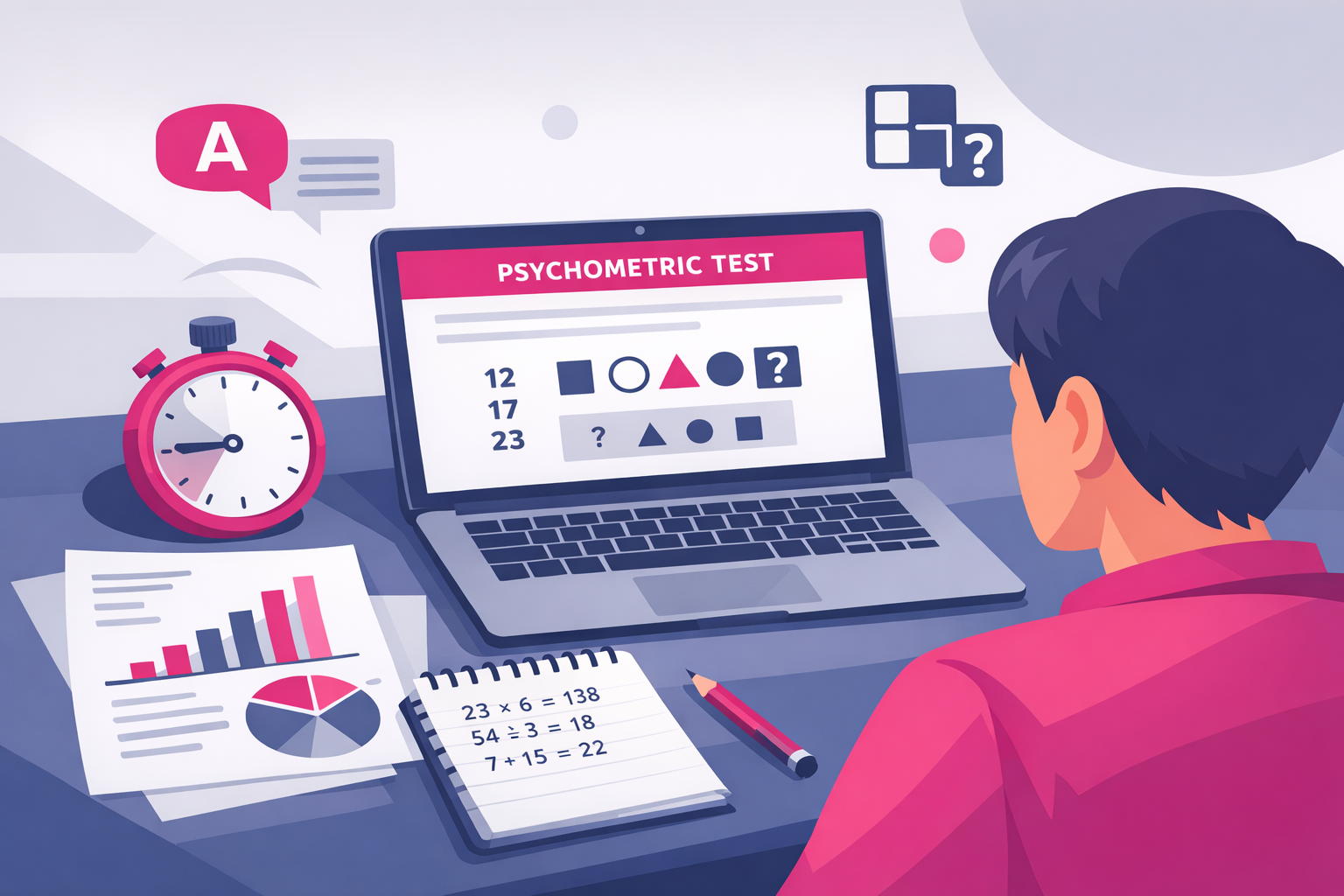
Psychometric tests are not “a bit of admin”. They are the bouncer on the door.
If you fail, you do not get to show your personality. You do not get to explain your potential. You do not even get to be rejected by a human.
And here’s the harsh truth most candidates refuse to face.
Psychometric tests are not mainly testing how smart you are.
They are testing whether you can perform under constraints: time pressure, unfamiliar formats, and zero second chances.
The good news is simple.
This is trainable.
This article shows you exactly how to prepare for psychometric tests, what to practise, how to avoid the common traps, and how to walk into test day calm, fast, and accurate.
What psychometric tests are really doing
Employers use psychometric tests because they are cheap, scalable, and consistent. They help recruiters sift hundreds of applicants without reading every CV in detail.
Most tests fall into two buckets:
- Aptitude tests (your ability to solve problems)
- Behavioural or personality questionnaires (your preferences and working style)
Aptitude tests are where most people lose.
Not because they cannot do the questions.
Because they do not prepare for the format.
If you take one thing from this article, take this.
You are not competing against the test. You are competing against other candidates who practised.
The main types of psychometric tests you will face
You prepare better when you know the enemy.
Numerical reasoning tests
These test how well you interpret numbers under time pressure.
Typical content includes:
- Percentages, ratios, averages
- Tables, charts, and graphs
- Currency conversions
- Basic algebra and rearranging formulas
The most common failure mode is not maths. It is reading.
People misread the chart, miss a unit, or ignore a footnote.
Verbal reasoning tests
These test whether you can:
- Read quickly
- Extract meaning
- Decide what is supported by the text
Questions are often “True”, “False”, or “Cannot say”, based only on what the passage states.
The trap is using outside knowledge.
The test does not care what you think is true in real life. Only what the text proves.
Logical or abstract reasoning tests
These test pattern recognition and rule finding.
You will see:
- Shape sequences
- Matrices
- Odd one out
- Next in series
The trap is staring too long at one possible pattern and getting emotionally attached to it.
Situational judgement tests (SJTs)
These present workplace scenarios and ask you to rank responses or choose the best and worst options.
They are not testing your moral philosophy.
They are testing whether you understand workplace priorities: safety, professionalism, customer impact, and escalation.
Personality questionnaires
These ask how you tend to behave.
The trap here is trying to “game” the test by answering inconsistently.
Many questionnaires include repeated or inverted questions to check reliability.
The brutal truth about passing psychometric tests
Most people “prepare” like this:
- Watch one YouTube video
- Do three practice questions
- Hope for the best
That is not preparation. That is stress management.
Real preparation is training:
- Building speed
- Reducing careless errors
- Learning question patterns
- Developing a decision strategy under time pressure
If you do this properly, you gain an advantage fast.
Even a few hours of targeted practice can materially improve your performance. That is one reason these tests predict more about preparation and composure than raw intelligence.
Step 1: Find out exactly which test you will take
Preparation without specificity is wasted effort.
Before you practise, get clarity on:
- The test type (numerical, verbal, abstract, SJT, personality)
- The provider (SHL, Capp, Talent Q, Korn Ferry, Saville, Aon, Thomas, etc.)
- The time limit and number of questions
- Whether calculators are allowed
- Whether it is supervised (proctored) or unsupervised
- Whether the test is adaptive (gets harder as you answer correctly)
How to find out:
- Read the invitation email carefully
- Look for links to practice materials from the provider
- Check the employer’s early stage recruitment page
- If unclear, email the recruiter and ask directly
Send a short message:
- “Please can you confirm the test provider, time limit, and whether a calculator is permitted?”
This is not needy. It is professional.
Step 2: Set a training plan you can actually execute
You do not need a 6-week revision timetable. You need a tight, repeatable routine.
Here is a simple plan that works.
The 7-day psychometric preparation plan
Day 1: Baseline
- Take one timed practice test in your target area
- Record your score, time per question, and error types
Day 2: Accuracy
- Redo the same test slowly
- For every wrong answer, write the reason in one line
Day 3: Speed technique
- Practise timed sets of 10 questions
- Aim to finish with 60 seconds spare
Day 4: Weak spots
- Drill the two weakest topics (for numerical this is often percentages and ratios)
Day 5: Full timed test
- Replicate test conditions exactly
Day 6: Review and repeat
- Rework every incorrect question
- Create a “trap list” of the mistakes you keep making
Day 7: Final rehearsal
- One full timed test
- Stop heavy practice after that
If you have only 48 hours, compress the same logic:
- One baseline test, one drill session, one full rehearsal
Step 3: Learn the question patterns, not just the content
Psychometric tests are predictable. The questions are not random life problems. They are templates.
Numerical: the highest value patterns to master
Master these and you will see your scores rise:
- Percentage change (increase and decrease)
- Converting fractions, decimals, and percentages quickly
- “Part-to-whole” interpretation in charts
- Weighted averages (common in “overall score” tables)
- Rate problems (speed, productivity, cost per unit)
Tactical rule:
- If a question involves a chart, spend 5 seconds scanning for units, time period, and definitions first
That one habit eliminates a lot of stupid mistakes.
Verbal: the only rule that matters
Treat the passage like a legal document.
- If it explicitly states it, it can be True
- If it explicitly contradicts it, it can be False
- If it is not stated, it is Cannot say
Do not infer. Do not assume. Do not “fill in”.
Abstract: how to stop guessing
Most abstract patterns use a short list of transformations:
- Rotation (clockwise or anti-clockwise)
- Reflection (mirror)
- Addition or removal of shapes
- Movement of an element around a grid
- Alternating sequences (A, B, A, B)
- Counting sides, corners, or shaded areas
Tactical rule:
- Choose three features to track: shape count, position, and shading
If you track everything, you waste time. If you track nothing, you guess.
Step 4: Build a time strategy before you start
Time pressure is not incidental. It is the point.
A lot of candidates fail because they try to solve every question perfectly.
That is not the job.
The job is to score higher than other people.
Use a two-pass approach
Pass 1:
- Answer the easiest questions first
- Skip anything that looks time-expensive
Pass 2:
- Return to the harder ones
- Use elimination and estimation when possible
Skipping is not weakness. It is competence.
Know your pacing
Do the maths.
- 20 questions in 20 minutes means 60 seconds per question
- That includes reading and checking
If you spend 2 minutes on one question, you are stealing time from the rest.
Step 5: Remove avoidable errors with a checklist
Most performance loss is careless error, not inability.
Use this checklist.
Numerical error checklist
Before you click submit, confirm:
- You used the correct row and column
- You used the correct unit (thousands, millions, £, %, etc.)
- You used the correct time period
- You did not mix up increase vs decrease
- You rounded as instructed
Verbal error checklist
- The question asks about the statement, not your opinion
- The passage directly supports your choice
- You did not use outside knowledge
Abstract error checklist
- You checked for alternation (every other frame)
- You checked rotation direction and degrees
- You checked if multiple rules are operating together
Step 6: Get your test day setup right (it matters)
If the test is online, your environment is part of the assessment.
Do not sabotage yourself with sloppy basics.
30-minute pre-test setup
- Laptop, not phone
- Plugged in, not on battery
- Stable internet
- Quiet room
- Water nearby
- Calculator ready if allowed
- Pen and paper ready if allowed
- Close every extra tab and app
- Put your phone in another room
If the test is proctored, you may be asked to show your desk area and ID. Read the instructions in advance.
The 5-minute warm-up
Do not start cold.
- 3 quick percentage questions
- 3 quick table interpretation questions
- 3 quick mental arithmetic drills
This reduces the early “rust” that ruins the first few questions.
How to prepare for personality tests without looking fake
You cannot “revise” a personality questionnaire in the same way.
But you can avoid the two mistakes that kill you.
Mistake 1: Trying to be the superhero candidate
If you answer as if you are:
- Always confident
- Always decisive
- Always the leader
- Never stressed
You look unrealistic.
Employers do not want a fictional character. They want someone reliable.
Mistake 2: Being inconsistent
If you swing between extremes or contradict yourself, your profile may look unstable.
Tactical rules:
- Answer as your best professional self, not your weekend self
- Be consistent across similar questions
- Avoid extreme responses unless they are genuinely true for you
Situational judgement tests: how to pick the best response
SJTs often feel subjective. They are not.
Most employers score responses against workplace norms.
The decision hierarchy that usually wins
When choosing the best action, prioritise:
- Safety and legal compliance
- Customers and service impact
- Professionalism and respect
- Following process and escalation
- Speed, but not at the cost of quality
What usually scores badly:
- Ignoring the issue
- Blaming others
- Escalating everything instantly without trying a sensible first step
- Going rogue and bypassing your manager or policy
Tactical approach:
- Choose options that solve the problem, communicate clearly, and involve the right people
The most common myths that cause people to fail
Myth: “Psychometric tests are unfair, so preparation won’t help”
They may be imperfect. Complaining does not increase your score.
Preparation helps because formats repeat.
Myth: “If I practise, I might memorise answers and that’s cheating”
You are not memorising. You are training a skill: speed plus accuracy.
That is exactly what the tests measure.
Myth: “I’m just not a maths person”
Most numerical reasoning tests use GCSE level content. The difficulty is time.
You can improve quickly by drilling.
High-level implementation plan (keep it simple)
If you want a clean plan you can execute without overthinking, do this:
- Identify the test type and provider today
- Take one timed practice test to get a baseline
- Spend 3 sessions drilling your weakest topic areas
- Take two more full timed tests under real conditions
- On test day, follow your setup checklist and use a two-pass strategy
That is enough to beat most unprepared candidates.
Final word: treat it like a performance, not a quiz
Psychometric tests reward calm execution.
You do not need to be a genius.
You need to be trained.
When you prepare properly, two things happen.
- Your speed increases
- Your errors drop
That combination is what gets you through the automated gate and into the human conversation where you can actually win the job.
Next Steps
Want to learn more? Check out these articles:
Strengths-Based Interview Prep: Win Without Sounding Fake
Best Questions to Ask at the End of an Interview (Win Offers)
Assessment Centre Prep: Win the Day Without Guessing
Check out our Advanced Employability Course for all the help you need to get your dream job, fast.