
Turn Your Employability Results Into a Plan to Get Hired
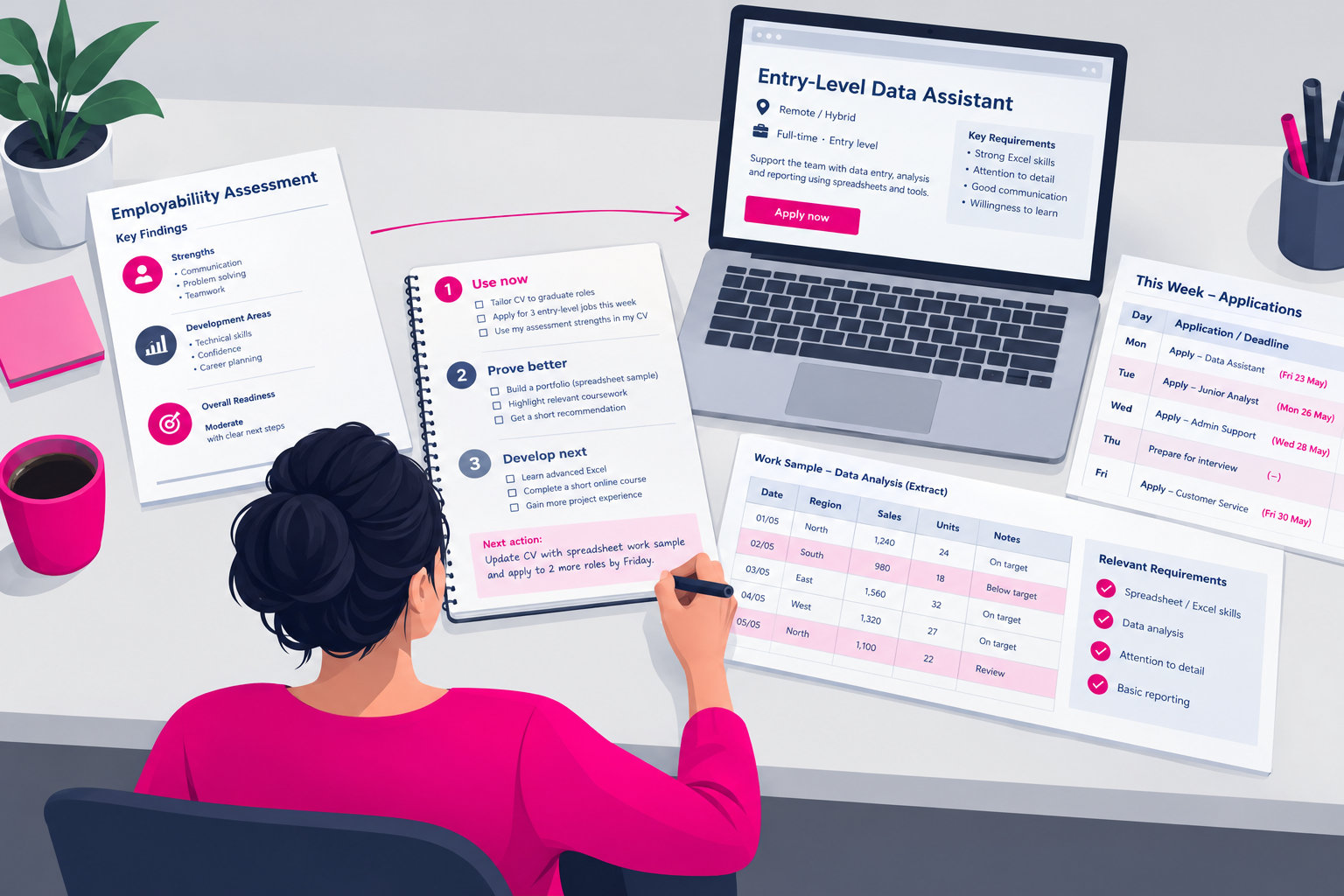
You have completed an employability assessment. You have scores, feedback and perhaps a colourful chart.
What you do not have is a job.
That gap matters. An assessment can highlight strengths and development needs. It cannot choose your target roles, produce convincing applications or explain your value to an employer. You have to turn the information into decisions.
The biggest mistake is treating every low score as homework. That creates an endless improvement project while suitable vacancies pass you by.
Your objective is not to become the perfect candidate. It is to become a credible candidate for a specific opportunity, then demonstrate why you deserve consideration.
Here is how to turn employability assessment results into a job search action plan: choose a realistic target, identify the gaps that matter, gather evidence and schedule actions that put you in front of employers.
No motivational fog. No waiting until you feel completely ready.
1. Understand what your results actually mean
An employability assessment is a starting point, not a hiring decision. Before acting on the results, check what was assessed and how the conclusions were reached.
Separate perception from performance
A self-assessment tells you how you judge yourself. A practical task provides evidence of how you performed under particular conditions. Feedback from a tutor or supervisor adds another perspective.
These are useful signals, but they are not interchangeable.
For example, a low communication score might reflect nervousness about public speaking. That does not automatically mean you struggle to write clear customer emails. Equally, feeling confident with spreadsheets does not prove you can check a dataset accurately.
Read the assessment guidance. If the scoring method is unclear, avoid treating small numerical differences as meaningful.
The National Careers Service offers a skills assessment as part of exploring career options. That is the useful role of an assessment: informing your next decision, not issuing a verdict on your potential.
Turn labels into observable behaviour
Replace broad labels with specific questions:
- Communication: Can I explain a problem clearly and confirm what happens next?
- Organisation: Can I track several deadlines and flag a likely delay?
- Digital capability: Can I complete the software tasks this vacancy requires?
- Problem solving: Can I identify a cause, compare options and justify a decision?
If you cannot explain what a score means in practical terms, investigate before building your plan around it.
2. Choose a target before choosing what to improve
A development priority only makes sense in relation to a job.
An entry-level administrator, retail assistant and junior technician may all need reliability and communication. Their day-to-day tasks and evidence requirements still differ.
Without a target, your assessment results become a shopping list. With a target, they become a filter.
Examine five relevant vacancies
Choose one role family to investigate first. Find five current vacancies you could realistically pursue, considering location, working hours, pay, travel costs and any essential qualifications or licences.
Record the following for each vacancy:
- The tasks you would actually perform.
- The requirements described as essential.
- The requirements described as desirable.
- The application method and deadline.
- Any practical barrier you need to resolve.
Highlight repeated requirements. These give you a stronger basis for prioritisation than an isolated phrase in one advert. Keep employer-specific essentials visible too. A mandatory licence does not become optional because other adverts omit it.
Do not confuse missing experience with automatic rejection
Read requirements carefully rather than assuming every preference is a strict condition. If something important is ambiguous, ask the recruiter a precise question.
For example: “Would experience maintaining records for a student society meet your requirement for administrative experience?”
Target roles where you can meet the genuine essentials and provide credible evidence for the core tasks. Do not self-reject because you lack every desirable attribute. Do not ignore explicit legal or mandatory requirements either.
3. Sort your findings into three action groups
Your assessment will probably reveal more than you can address at once. The answer is prioritisation, not a bigger to-do list.
Use three groups: use now, prove better and develop next.
Use now: relevant strengths you can demonstrate
These are capabilities that match your target vacancies and already have supporting examples.
Perhaps you scored well on organisation and have coordinated a college project with several deadlines. Put that evidence to work in your CV, applications and interview preparation.
A strength left inside an assessment report has little value to an employer who never sees it.
Prove better: capabilities with weak evidence
Sometimes you can do the work but cannot yet explain or demonstrate it convincingly.
You may be comfortable using spreadsheets but have no example beyond saying “good IT skills”. Your immediate task is not necessarily another course. It may be producing a small, accurate work sample and explaining how you checked it.
This distinction prevents wasted effort. A demonstration problem needs evidence. A capability problem needs practice.
Develop next: relevant gaps affecting your prospects
Prioritise gaps that matter to the target role and currently weaken your application or likely performance.
Ask three questions:
- Does this affect an essential requirement or a frequent job task?
- Is there credible evidence that I need to improve it?
- What useful progress can I make with the time and resources available?
Choose no more than two development priorities for your next review cycle. This is a focus limit, not a claim that every gap can be fixed quickly.
Keep less relevant gaps on a later list. You are choosing an order, not pretending they do not exist.
4. Build evidence an employer can evaluate
Employers cannot assess “I am motivated” very precisely. They can assess a relevant example, a clear explanation or a completed task.
Create a small evidence bank. For each priority requirement, record the situation, your responsibility, what you did and the outcome. Add an artefact where appropriate, such as a checklist, presentation or anonymised document.
Use experience beyond paid employment
First-time jobseekers often have more usable evidence than they realise. Look at:
- Coursework involving deadlines, research or collaboration.
- Volunteering involving customers, records or practical responsibilities.
- Community activities involving schedules, budgets or coordination.
- Personal projects involving planning, troubleshooting or delivery.
Be precise about the context. Running a student event is not the same as managing a commercial department. It can still demonstrate organisation and follow-through.
Protect other people's information. Remove names, contact details and confidential material. Ask permission before sharing work that belongs to someone else. You do not need to disclose sensitive personal circumstances to explain a capability.
Replace claims with facts
Weak: “I am organised and work well in a team.”
Stronger: “Coordinated deadlines for a four-person college project, tracked outstanding tasks and submitted our report on time.”
The stronger version names your actions and an observable outcome. It gives an interviewer something useful to explore.
Use numbers only when they are accurate. Never manufacture an improvement percentage because a CV template suggests that every bullet needs one.
Build a sample when experience is missing
For an administrative role, create a fictional appointment tracker. Include dates, status, follow-up actions and a simple check for missing information.
For customer support, draft responses to three fictional enquiries. Explain when you would resolve the issue yourself and when you would escalate it.
Label simulated work clearly. A sample demonstrates an approach, not previous employment. Follow the employer's application instructions rather than attaching extra files indiscriminately.
5. Turn each priority into a scheduled action
“Improve my confidence” is not an action plan. Neither is “work on applications”. Both leave you deciding what to do every time you sit down.
A useful action specifies the task, the output, the deadline and the check.
Use one repeatable structure
Write each action like this:
“By [date], I will complete [task], producing [output], and check it against [standard or feedback].”
For example:
“By Thursday, I will create a fictional appointment tracker with 20 entries, producing a spreadsheet that I check for missing dates, duplicate entries and unclear follow-up actions.”
Or:
“By Friday, I will draft two interview examples showing teamwork and organisation, then ask a careers adviser whether my individual contribution is clear.”
The check matters. Completion alone does not establish quality. Watching a tutorial is activity. Completing a relevant task accurately is stronger evidence of progress.
Include applications in the schedule
Do not turn development into a respectable way of avoiding rejection.
If you meet a vacancy's genuine essentials and have credible evidence for its core tasks, apply while improving the remaining relevant gaps. Where an essential qualification or licence is missing, pursue that requirement or choose a different target.
A workable week could contain two tailored applications, one evidence-building task and one feedback conversation. Adjust the volume to your circumstances and the availability of suitable vacancies.
Someone balancing caring responsibilities and limited internet access needs a different schedule from someone available full-time. Build a plan you can execute, not one that looks impressive on paper.
6. Track where your search is breaking down
A job search action plan needs feedback from the market, not just another assessment score.
Keep a simple tracker with the employer, role, deadline, submission date, evidence used, stage reached and next action. Record feedback separately from your own interpretation.
Measure more than application volume
Review three things:
- Execution: Did you complete the actions you scheduled?
- Quality: Did each application address the actual requirements with evidence?
- Progress: Are suitable applications leading to screening calls, interviews or other next steps?
These measures answer different questions. A missed schedule needs a practical adjustment. Weak applications need better targeting or evidence. Interviews without offers need a closer look at interview performance and role fit.
Avoid drawing sweeping conclusions from a handful of rejections. Hiring outcomes also reflect competition, timing and employer decisions you cannot see.
Change the part that evidence points to
If applications repeatedly stall before interview, review eligibility, targeting, CV clarity and evidence against the advert. Ask someone knowledgeable to inspect an actual application alongside the vacancy.
If you reach interviews but struggle to explain your contribution, practise specific answers and request feedback where available.
Do not respond to every rejection by rewriting everything. Make a focused change, then observe what happens. Your aim is to diagnose a problem, not punish yourself for an outcome.
A worked example: from assessment to application
Consider a first-time applicant targeting junior administrative roles.
Their assessment suggests strong organisation, lower confidence in interviews and uncertain spreadsheet capability. Five relevant adverts repeatedly mention accurate records, email communication and basic spreadsheet use.
Here is the translation:
- Use now: Turn a genuine college project coordination example into a CV bullet and interview story.
- Prove better: Draft a professional email explaining a changed appointment and the required next step.
- Develop next: Practise entering, sorting and checking fictional records in a spreadsheet.
- Apply: Submit tailored applications to suitable roles while completing that practice.
- Review: Check whether applications secure interviews and whether interview answers explain personal actions clearly.
Notice what is missing: a vague mission to improve everything.
Interview confidence gets a practical response through rehearsing relevant examples. Spreadsheet uncertainty gets a practical test. Existing organisation skills become visible evidence.
The result is not guaranteed employment. It is a more focused, defensible search with clear next actions.
Your first week: keep the plan small enough to use
You do not need an elaborate dashboard. One page is enough to start.
- Choose one target role family and examine five current vacancies.
- Map repeated requirements and vacancy-specific essentials against your assessment results.
- Select two priorities and identify the evidence each needs.
- Schedule one evidence task and a realistic number of suitable applications.
- Set a weekly review to check execution, quality and progress.
If the plan requires money, software or support you do not currently have, identify an accessible alternative or revise the task. A plan built on unavailable resources is not executable.
Your results are information, not your identity
A low score does not make you unemployable. A high score does not make an application convincing.
The value lies in what you do next: choose a target, test your assumptions, build relevant evidence and put it in front of employers.
Open one suitable vacancy today. Identify its three most important requirements. Beside each, write the evidence you already have or the next action needed to obtain it.
That is where an assessment stops being a report and starts becoming a job search.
Next Steps
Want to learn more? Check out these articles:
How to Prepare for a Written Exercise and Get It Right
How to Prepare for Your Assessment Centre Presentation
How to Prepare for a Group Task at an Assessment Centre
Check out our Advanced Employability Course for all the help you need to get your dream job, fast.