
How to Prepare for a Written Exercise and Get It Right
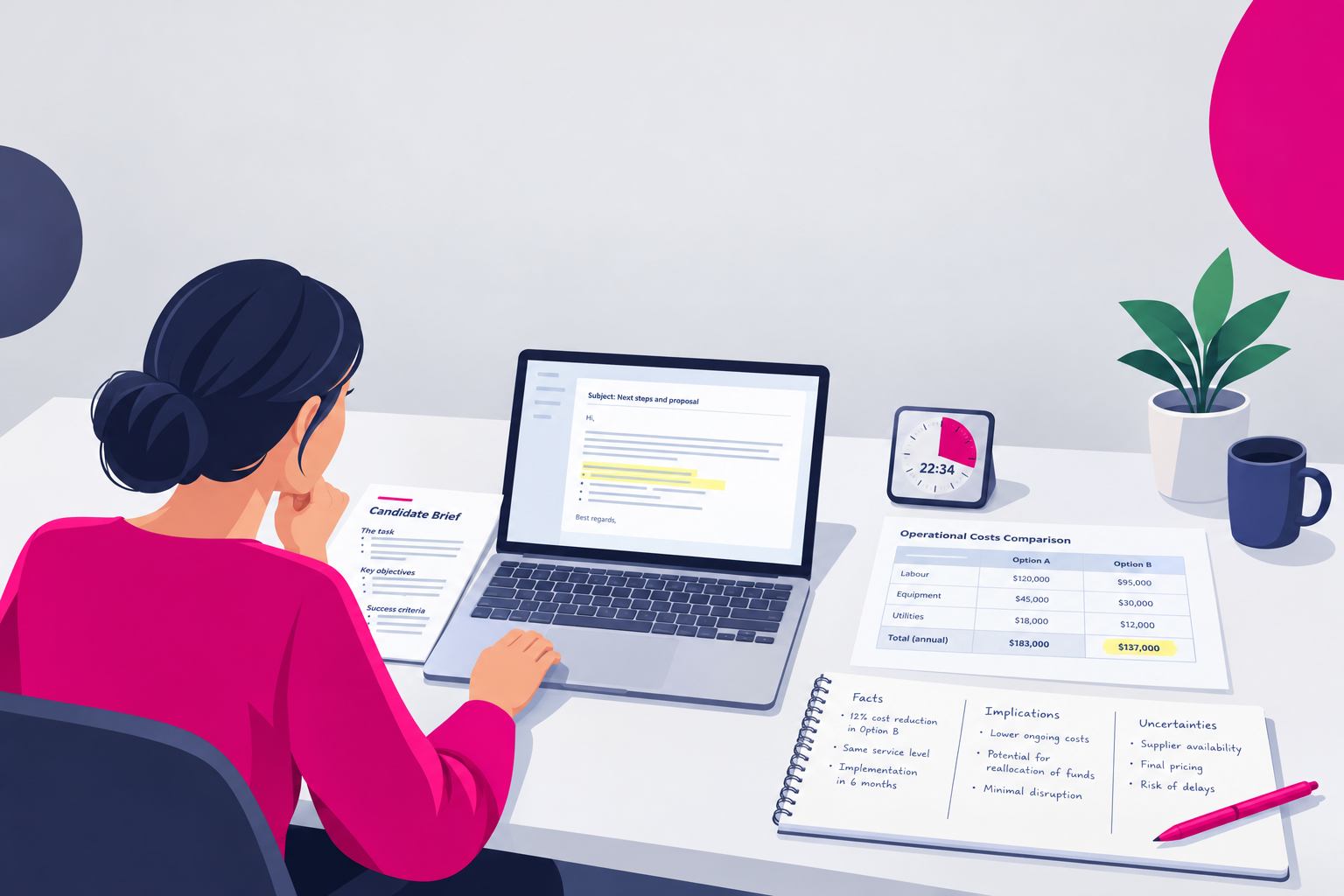
You have 45 minutes. A pack of information. A blank document. And a decision to make.
The temptation is to start typing immediately. Show them you can write. Fill the page. Look productive.
That can be your first mistake.
A written exercise at an assessment centre is not usually a competition to produce the most words. It is a test of whether you can turn information into something useful, under pressure, for a particular reader.
A polished answer to the wrong question is still the wrong answer.
If you want to know how to prepare for a written exercise at an assessment centre, focus on the whole task: understanding the brief, selecting evidence, making a defensible judgement and communicating it clearly.
This guide shows you how to practise those decisions, structure your response and manage the clock. You do not need years of office experience. You need a repeatable method.
What a written exercise actually tests
Depending on the employer and role, you might be asked to write an email, produce a short report, recommend an option, summarise a briefing pack or respond to a customer complaint.
Some exercises contain everything you need. Others expect relevant technical or commercial knowledge. The invitation and candidate guidance should help you distinguish between them.
Prospects’ assessment centre guidance provides useful background on the range of activities employers use. Your employer’s instructions remain the authority for your particular exercise.
The writing is visible. The judgement underneath matters.
Assessment criteria vary, but common areas include:
- Understanding: Have you identified the actual problem and followed the instructions?
- Analysis: Have you selected relevant information and interpreted it accurately?
- Judgement: Does your recommendation account for constraints, risks and competing priorities?
- Communication: Can the intended reader understand and use your response?
- Accuracy: Are names, figures, calculations and claims correct?
- Organisation: Have you delivered a coherent, complete answer within the time available?
Do not assume sophisticated vocabulary earns extra credit. If a manager needs a decision, a clear recommendation with sound reasoning is more useful than an elaborate introduction.
Equally, attractive formatting cannot rescue weak reasoning. Presentation helps the reader find your thinking. It cannot replace it.
1. Confirm the rules before you practise
Practising the wrong format wastes preparation time.
Read your invitation, attachments and candidate portal. Look for the time limit, response format, word limit, delivery method and any competencies or criteria provided.
Check what you can use
Establish whether the exercise is handwritten, completed in a document editor or entered into an online text box. Also check whether calculators, spellcheck, reference materials or external websites are permitted.
Never assume AI tools are allowed. Follow the assessment rules, including any restrictions on assistance or preparation materials.
If essential details are missing, ask the recruitment team a focused question:
“Could you confirm the duration and response format of the written exercise, and whether candidates may use a calculator?”
They may deliberately withhold the subject matter. That is different from leaving you unclear about practical arrangements.
Request adjustments early
If you need reasonable adjustments because of a disability or health condition, contact the employer before the assessment. Explain the barrier and discuss the support you need, such as accessible documents, assistive technology or additional time.
The aim is to demonstrate your capability, not to fight an avoidable access barrier while the clock runs down.
2. Turn the brief into a working checklist
Before reading every attachment in detail, read the task instructions. They tell you what to look for.
Write five short notes:
- Role: Who am I supposed to be?
- Reader: Who will receive this response?
- Output: What exactly must I produce?
- Decision: What question must I answer or action must I enable?
- Constraints: What limits apply to time, money, scope and length?
For example: “I am an operations assistant. I am writing to the branch manager. I need to recommend one way to reduce queues, within £1,500, in a 400-word briefing.”
That sentence becomes your filter. Information matters when it changes the recommendation, its feasibility or the reader’s next action.
Watch the instruction verbs
“Summarise”, “compare”, “recommend” and “respond” demand different outputs.
- Summarise means select the main points without reproducing everything.
- Compare means assess options against relevant criteria, not describe each in isolation.
- Recommend means choose a course of action and justify it.
- Respond means address the recipient’s issue in an appropriate tone, with a clear next step.
Underline any requirement to include risks, costs or implementation. Missing one explicit instruction can weaken an otherwise strong response.
Do not prepare a favourite answer and force the brief to fit it.
3. Extract evidence without drowning in it
An information pack may include emails, tables, complaints, policies and competing stakeholder views. Treat it as evidence to assess, not material you must mention.
Use a three-part note structure:
- Fact: What does the material actually establish?
- Implication: Why does that matter for this task?
- Uncertainty: What remains unknown or needs checking?
Suppose a table shows that most complaints concern slow replies. The implication might be that response handling deserves priority. It does not prove that staff are lazy, understaffed or poorly trained.
Those are possible explanations, not established facts.
Check numbers and contradictions
When figures matter, check units, dates, totals and whether you are comparing like with like. A rise from 10 complaints to 15 is a 50% increase, but it is also only five additional complaints. Both perspectives may matter.
If two documents conflict, do not quietly select whichever supports your preferred answer. Check their dates, scope and authority. If the conflict remains unresolved, flag it and explain how it affects your recommendation.
Use outside knowledge carefully. In a self-contained exercise, the supplied information should normally anchor your answer. Do not replace it with unsupported claims about what “always happens” in that industry.
4. Give your reader a usable structure
Choose a structure that matches the requested output. Do not turn every exercise into a formal report.
For a recommendation or short report
A dependable structure is:
- Recommendation: What should happen?
- Evidence: Which facts support that choice?
- Trade-off: What is the main downside or alternative?
- Action: What should happen next, and what needs checking?
Put the recommendation near the start unless the instructions require a different order. Your reader should not have to excavate it from the final paragraph.
Use headings when they help navigation. For a short response, four clear paragraphs may be enough.
For an email or customer response
Start with the purpose or acknowledge the issue. Explain the relevant facts in plain English, then state the next action and any realistic timescale.
Match your authority to your assigned role. If you cannot approve a refund, do not promise one. Explain that you will refer the request to the appropriate person, if that is consistent with the brief.
Avoid vague endings such as “This should be looked into.” Name the action. Identify the responsible person or team when the information allows it.
Clear ownership makes a response usable.
5. Practise with a clock, not just a checklist
Untimed practice helps you learn the method. Timed practice shows whether you can deliver it.
For a 45-minute exercise, try this starting allocation:
- Minutes 0 to 5: Read the instructions and identify the required output.
- Minutes 5 to 15: Review the evidence, make notes and plan your answer.
- Minutes 15 to 35: Draft the complete response.
- Minutes 35 to 45: Check reasoning, accuracy, length and submission requirements.
This is a practice model, not a universal rule. A long data pack may require more reading. A short email task may require less. Adjust after seeing where your practice attempts break down.
Build the whole answer before polishing it
During drafting, get every required component onto the page before perfecting individual sentences.
If you spend 15 minutes refining the opening, you may leave no time for the recommendation’s risks or next steps.
At the halfway point, check your progress against the output, not the word count. Have you chosen your answer? Have you covered the required questions? Is there enough time to finish?
For online assessments, read the saving and submission instructions before starting. Leave a buffer for the required submission steps. Do not assume the system saves automatically or accepts work after the deadline.
6. See what evidence-led writing looks like
Consider this fictional practice brief:
“You are an operations assistant. Write an email of no more than 200 words recommending a four-week trial to reduce lunchtime queues. The budget is £1,500.”
The supporting information says:
- Average lunchtime waiting time is 12 minutes.
- A staff rota adjustment would cost £1,200 over four weeks.
- A self-service kiosk would cost £4,000.
- Existing employees could cover the rota adjustment, subject to availability checks.
- Complaints frequently mention lunchtime queues.
A weak response might say, “We should invest in technology to modernise the customer experience.”
It sounds ambitious. It also ignores the budget and fails to use the available evidence.
A stronger response
Subject: Recommendation for a four-week lunchtime queue trial
I recommend trialling the proposed staff rota adjustment for four weeks. At £1,200, it falls within the £1,500 budget and targets the lunchtime period identified in the complaints.
The self-service kiosk costs £4,000, so it is outside the current budget. It should not be selected for this trial without separate funding approval.
Before proceeding, please confirm staff availability and check that the adjustment will not leave other periods inadequately covered.
During the trial, record waiting times at comparable lunchtime intervals and monitor queue-related complaints. Compare the results with the current 12-minute average and the equivalent pre-trial complaints period.
I suggest using an average lunchtime wait below eight minutes as a proposed success measure, subject to your agreement. This is a target, not a forecast.
If you approve, the next step is to confirm cover and agree the trial dates and measurement process.
Why this works
The response makes a choice, uses the cost evidence, rejects an unaffordable alternative and acknowledges an operational risk.
It also separates fact from proposal. The eight-minute target is clearly suggested, not presented as information from the pack or a guaranteed result.
The prose is straightforward because the thinking is doing the work.
7. Remove the mistakes that cost you clarity
Most avoidable problems are not dramatic. They are small failures of discipline that accumulate.
Describing instead of deciding
If asked to recommend, do not finish with “Both options have advantages.” Choose, explain why and acknowledge the strongest drawback.
Inventing certainty
Replace “This will solve the problem” with a bounded claim such as “This addresses the identified bottleneck, but the effect should be measured during the trial.”
Do not weaken every sentence with “perhaps”. Be decisive about your recommendation and honest about what the evidence cannot establish.
Writing beyond the reader’s needs
Delete generic background, repeated points and unsupported claims. If a sentence does not help answer the brief, justify the decision or enable action, question whether it belongs.
Proofreading only for spelling
Check the substance first:
- Have I answered every requested question?
- Does my recommendation fit the budget and other constraints?
- Do the figures support what I have written?
- Have I distinguished facts, assumptions and proposals?
- Is the next step clear?
Then check grammar, names, tone and formatting. A correct apostrophe will not compensate for a recommendation that exceeds the budget.
8. Use a short preparation loop
You do not need dozens of exercises completed badly. You need targeted practice followed by correction.
Complete one realistic cycle
- Find a public sample exercise or create a fictional brief relevant to the role. Use an employer’s practice materials where available.
- Complete it under the stated conditions, including the time and word limits.
- Review it against the published assessment criteria, if provided. Otherwise, use the common areas described earlier.
- Identify the single biggest weakness and practise that component again.
If your reasoning is sound but you run out of time, work on planning and drafting speed. If your answer is clear but ignores key evidence, practise extracting facts before writing.
Ask a tutor, careers adviser or trusted colleague to review a practice attempt. Give them the brief. Ask, “Can you identify my recommendation, supporting evidence and main risk without rereading?”
Respect assessment confidentiality. Use public or invented materials rather than sharing restricted employer exercises.
Prepare to be useful, not impressive
The strongest preparation builds a habit: read the task, find the evidence, make the judgement and write for the reader.
You cannot control every exercise format or anticipate every topic. You can control whether you follow instructions, make unsupported claims, waste time polishing or leave your recommendation unclear.
Start with one timed practice exercise. Review the result honestly. Fix the weakest part.
Your goal is not to sound like someone who has worked in an office for ten years. It is to demonstrate that you can be trusted with the next piece of work.
Next Steps
Want to learn more? Check out these articles:
How to Prepare for Your Assessment Centre Presentation
How to Prepare for a Group Task at an Assessment Centre
How to Prepare for a Job Role-Play and Show Your Value
Check out our Advanced Employability Course for all the help you need to get your dream job, fast.