
How to Prepare for a Group Task at an Assessment Centre
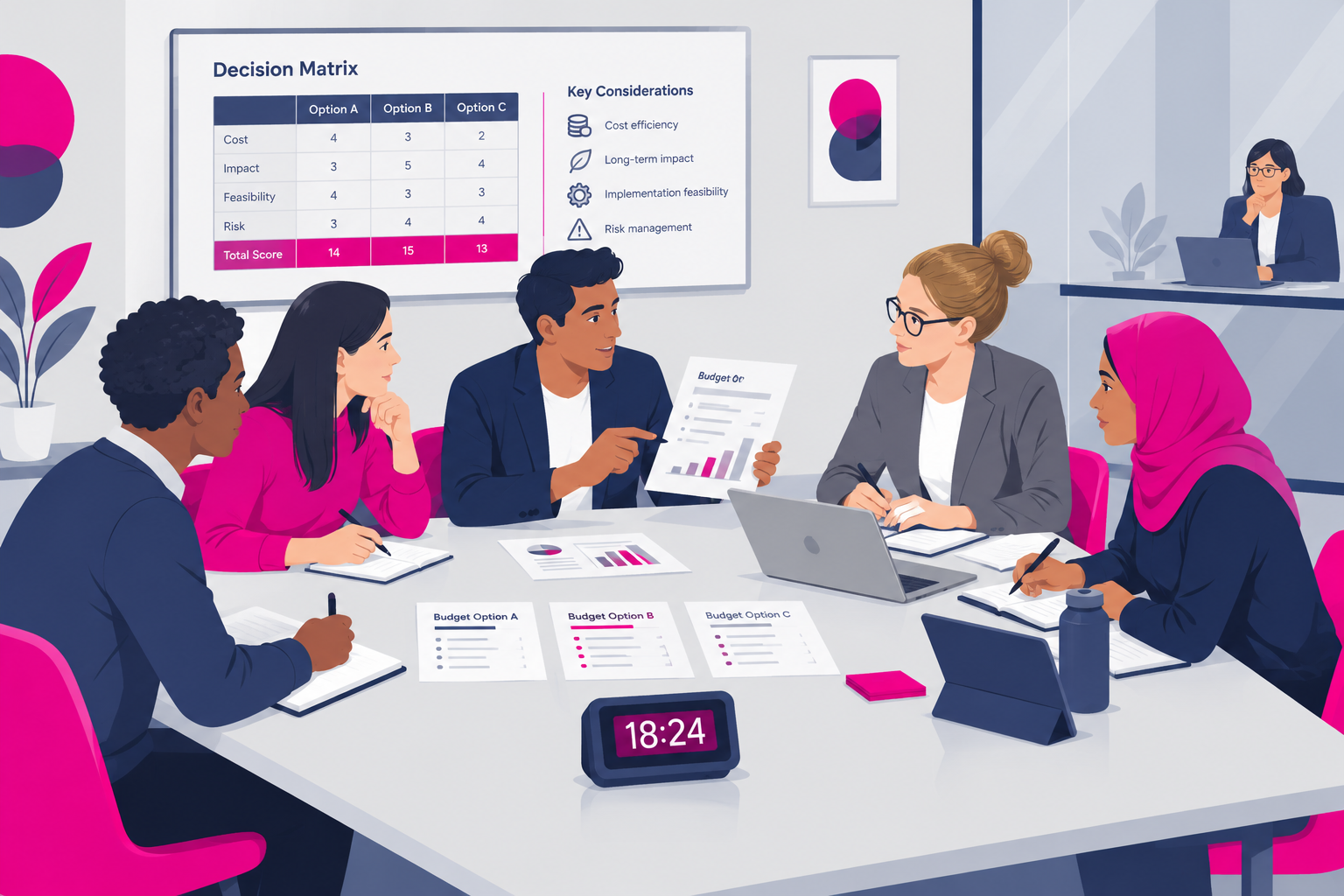
You can have the best idea in the room and still perform badly in a group exercise.
You can also speak more than everyone else and give assessors plenty of reasons not to hire you.
The mistake is treating the exercise as a competition for attention. It is a work simulation. Your job is to help a group reach a defensible decision, under pressure, while making your contribution visible.
That takes more than confidence. It takes preparation.
This guide explains how to prepare for a group exercise at an assessment centre, including what to practise, how to contribute without dominating, and what to do when the discussion becomes difficult. You do not need previous office experience. You need useful behaviours you can demonstrate when the clock starts.
What is an assessment centre group exercise?
A group exercise asks several candidates to complete a shared task while assessors observe their behaviour. Depending on the employer, you might need to:
- Rank competing priorities or choose between proposals.
- Allocate a limited budget using a briefing pack.
- Solve a business problem and recommend an action.
- Complete a practical challenge with restricted resources.
- Represent different interests and negotiate an agreement.
Some exercises give everyone the same information. Others give candidates separate facts or assigned roles. The assessment may happen in person or online.
Read the actual instructions. Do not assume the format will match a video you watched.
As the UK careers service Prospects explains in its assessment centre guidance, group activities help employers assess how candidates work with others. However, the precise criteria depend on the role and employer.
Your preparation should therefore build adaptable behaviours, not a performance you can only deliver under perfect conditions.
What assessors need to see
An impressive contribution is not necessarily a long contribution. It is one that improves the work.
Common assessment areas include collaboration, communication, reasoning, judgement and time management. Translate those abstract labels into observable actions:
- Collaboration: you build on someone’s suggestion and help others contribute.
- Communication: you explain a point clearly enough for the group to use it.
- Reasoning: you connect a recommendation to evidence in the brief.
- Judgement: you recognise constraints, risks and trade-offs.
- Delivery: you help the group produce the required output on time.
The important word is observable.
If you spot a serious flaw but never mention it, the group cannot benefit from your thinking. Equally, repeatedly announcing that you are “a team player” proves nothing.
Make your thinking useful and visible. That is different from making yourself the centre of attention.
How to prepare before assessment day
1. Read the invitation like a task brief
Check the format, timings, location or platform, equipment requirements and any instructions about preparation. Confirm whether you need to bring identification or submit anything beforehand.
If something material is unclear, ask the recruiter. A question about whether a calculator is permitted is sensible. Asking for confidential exercise content is not.
If you need a reasonable adjustment, raise it early. Explain the barrier and the support that would help, such as accessible documents or captions. Agree arrangements rather than assuming they will be available.
Remove avoidable uncertainty before the day. You want your attention on the exercise, not on a missing login.
2. Research the role, not just the company slogan
Review the job description and identify three or four behaviours the role requires. Look for specific demands such as analysing information, serving customers, managing competing deadlines or working across teams.
Then explore the employer’s products, customers and current priorities using its website and reliable public sources.
Turn that research into practical questions:
- Who would be affected by this decision?
- What would success look like for the customer?
- Which constraint could make an attractive option unworkable?
This gives your thinking context. It does not give you permission to invent facts about the exercise. The supplied brief remains your primary evidence.
3. Practise extracting what matters
Take a short business article, public report or sample case study. Give yourself five minutes to identify:
- Objective: what decision or outcome is required?
- Constraints: what limits the available choices?
- Evidence: which facts should influence the decision?
- Gaps: what is missing or uncertain?
- Output: what must be delivered, and to whom?
Write a three-sentence summary. State the problem, the key trade-off and your initial recommendation.
The point is not to become a speed-reader. It is to stop treating every sentence as equally important.
In a group exercise, the budget ceiling may matter more than three paragraphs of background. Train yourself to find it.
4. Rehearse concise contributions
Practise explaining an idea in roughly 30 seconds using this structure:
Point. Evidence. Implication. Invitation.
For example: “I favour option B. It meets the deadline and stays within budget. The trade-off is lower initial capacity. Does anyone see a requirement it fails?”
That contribution offers a position, supports it, acknowledges a weakness and opens the discussion.
Record yourself on your phone. Listen for lengthy introductions, repeated points and unsupported certainty. Cut anything that delays the useful part.
You are not trying to sound polished at all costs. You are trying to make your reasoning easy to follow.
5. Prepare ways to disagree productively
Disagreement is not the problem. Poorly handled disagreement is.
Practise challenging the proposal without judging the person:
- “That addresses speed. How does it meet the budget limit?”
- “I read that figure differently. Can we check the table?”
- “Could we compare both options against the same criteria?”
Avoid fake agreement followed by an unrelated speech. Respond to the actual point being made.
You should also practise changing your mind: “That additional cost changes my view. Option A now looks stronger.”
Revising a position because the evidence changed demonstrates judgement. Defending it because it was yours demonstrates something less useful.
Run one realistic practice exercise
Reading advice is preparation for preparation. At some point, you need to practise with other people.
Ask two or three friends, classmates or colleagues to join a short exercise. They do not need recruitment expertise.
Use this practice brief
A community organisation has £12,000 to help young people access employment. Choose two projects:
- Interview coaching: £4,000, reaching 40 people.
- Travel support: £6,000, reaching 30 people.
- Employer networking event: £5,000, reaching 80 people.
- Digital access support: £7,000, reaching 25 people.
Assume all projects can start within three months. The brief provides no evidence about their effectiveness. Agree a recommendation, identify one risk and explain what further information you would request.
Give yourselves 20 minutes, followed by a two-minute presentation. These timings are for practice, not a prediction of your assessment.
The missing information is deliberate. Reaching more people does not automatically mean achieving better employment outcomes. Notice the gap without using it as an excuse to avoid deciding.
Review behaviour, not personality
Afterwards, discuss three questions:
- Which contributions moved the decision forward?
- Where did someone make an unsupported assumption or miss useful information?
- Did the group deliver a clear recommendation within the time?
Ask for examples. “Be more confident” is weak feedback. “You spotted the budget problem but waited until the final minute to raise it” gives you something to fix.
If practising alone, record a two-minute recommendation and challenge its assumptions. This helps your reasoning, although it cannot replace practising interaction.
What to do when the exercise starts
Read before you lead
Use any individual reading time to identify the objective, constraints and required output. Mark important figures and separate facts from assumptions.
If candidates have different information, suggest sharing the key facts before debating solutions. Otherwise, the group may spend precious minutes arguing from incomplete pictures.
Do not rush to become chairperson before you understand the task. Taking control of the wrong problem is not leadership.
Offer a simple process
Once discussion begins, suggest a workable structure:
“Could we confirm the decision criteria, compare the options, then leave time to prepare our recommendation?”
For a 30-minute task, you might propose five minutes to clarify the brief, 15 to evaluate options, seven to agree the decision and three to check the output. Adapt this to the instructions and the group’s needs.
Offer the structure. Do not impose it.
If someone else proposes a sensible approach, support it and contribute. There is no prize for duplicating their suggestion in a louder voice.
Make an early, useful contribution
If nerves make you withdraw, aim to contribute during the first few minutes of discussion. This is a practical target, not a universal assessment rule.
Your first contribution could clarify a constraint, suggest a comparison criterion or share a relevant fact.
For example: “The brief says delivery must begin in September. Should we rule out options that cannot meet that date?”
You do not need the winning answer. You need to enter the work.
Then keep contributing when you have something useful to add. One opening comment followed by silence rarely shows the full range of your ability.
Listen in ways the group can use
Active listening is more than nodding while planning your next sentence.
Connect contributions: “Amira’s cost concern and Daniel’s staffing point both suggest we should check delivery capacity.”
Invite another perspective without putting someone on trial: “Leah, is there anything from your information sheet we have not considered?”
Check understanding: “Are we agreeing that cost matters most, provided the deadline is met?”
These behaviours reduce confusion and help the group use its collective information. That is substantive work, not merely being pleasant.
Handle difficult group dynamics without joining them
When someone dominates
Do not compete through longer speeches. Redirect attention to the task and widen participation.
“We have explored that option. Could we hear another view before comparing them against the criteria?”
If interrupted, calmly finish your point: “I will finish the budget point, then come to your suggestion.”
Stay professional. Assessors can observe how you respond to difficulty as well as how you behave when everyone cooperates.
When the group gets stuck
Identify the reason. Are you missing information, using different criteria or repeating preferences?
Then propose a decision method: “We have eight minutes left. Shall we compare both options on cost, delivery time and customer impact?”
If the brief leaves a genuine uncertainty, name an assumption and record the risk. Do not present the assumption as a fact.
Aim for a defensible decision, not artificial certainty.
When your idea is rejected
Ask whether there is a material risk worth clarifying. If there is, explain it briefly and connect it to the task.
If not, support the agreed direction and help improve it.
Sulking, disengaging or reopening a settled point without new evidence wastes the group’s time. So does agreeing to an obviously flawed decision merely to avoid tension.
The skill is knowing when to challenge and when to commit.
When time is running out
Stop expanding the discussion. Help turn it into an answer.
Summarise the decision, the strongest supporting reasons and the main risk. Check that the recommendation meets the stated constraints and that any totals add up.
If a presentation is required, agree who will cover which points. Do not assume that being the presenter is the only visible contribution.
A polished presentation cannot rescue a recommendation that ignores the brief.
For virtual exercises, prepare the mechanics
Test the platform, microphone, camera and internet connection beforehand. Check how to access the briefing materials and whether you can keep them visible alongside the meeting.
Use a quiet location where possible, connect your charger and keep the recruiter’s contact details accessible.
Online pauses can make turn-taking awkward. Use brief verbal signposts such as “I have one point on the deadline”, and follow any instructions about raising hands or using chat.
If you experience a technical problem, flag it promptly. Do not silently disappear and hope everyone understands what happened.
Your final preparation checklist
Before the assessment, confirm that you have:
- Read the invitation and resolved practical uncertainties.
- Identified the role’s most relevant behaviours.
- Practised extracting objectives, constraints and evidence.
- Rehearsed concise contributions and constructive disagreement.
- Completed a timed practice task and reviewed specific feedback.
- Checked travel arrangements or online equipment.
Then stop trying to predict every possible exercise. You cannot script other candidates, and you do not need to.
Your goal is to become someone a team can rely on: prepared, clear, evidence-led and willing to help deliver the result.
Do not enter the room asking, “How can I look like the best candidate?”
Ask, “What does this group need next, and how can I contribute?”
Then make that contribution.
Next Steps
Want to learn more? Check out these articles:
How to Prepare for a Job Role-Play and Show Your Value
What Is Employability Assessment and How Can It Help You?
How to Prepare for an In-Tray Exercise and Get It Right
Check out our Advanced Employability Course for all the help you need to get your dream job, fast.