
What Is Employability Assessment and How Can It Help You?
You can be capable, motivated and ready to work. You can still struggle to convince an employer.
That gap is brutal when you are applying for your first job. Employers want evidence. You need an opportunity to build it. Sending another CV does not automatically solve the problem.
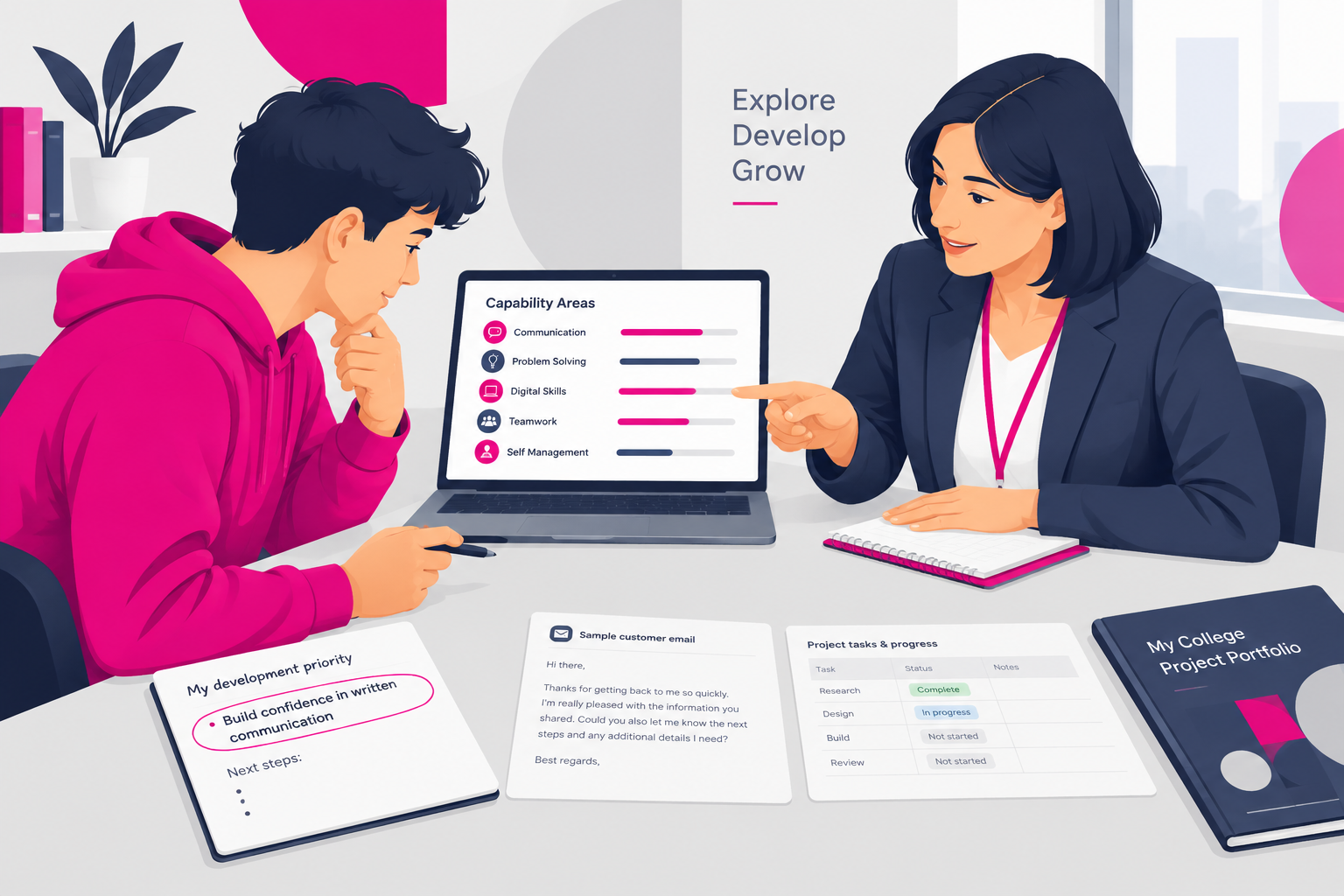
An employability assessment can help you identify what you can already offer, where you need development and how to demonstrate your readiness for work.
But only if it does more than hand you a score.
This guide explains what employability assessment means, what it measures and how to turn the findings into stronger applications and better preparation for work. The goal is not to collect a certificate. It is to make your next step clearer.
What is employability assessment?
An employability assessment is a structured process for evaluating the capabilities, behaviours and understanding that help someone obtain work and perform effectively in it. It identifies existing strengths, development needs and, where relevant, evidence of suitability for particular roles.
There is no single universal employability assessment. The term covers different approaches used by careers services, education providers, employment programmes and employers.
Some assessments support development. Others inform recruitment decisions. Some do both. Understanding the purpose matters because a careers questionnaire and an employer’s scored work sample answer different questions.
A useful assessment should help answer three practical questions:
- What can I already do that is relevant to work?
- What needs improving for the roles I want?
- What evidence could demonstrate my readiness?
It is not a verdict on your intelligence, ambition or personal worth. Nor does it guarantee employment. Hiring also depends on vacancies, competition, employer decisions and access to opportunity.
Employability assessment versus a recruitment test
A broad employability assessment may explore your readiness across several areas and help you plan development. A recruitment test usually contributes to a decision about a specific vacancy.
The methods can overlap. Both might include interviews, questionnaires or practical exercises. What changes is the purpose, the criteria and how the results are used.
Before starting, ask: “Is this designed to help me develop, assess me for a vacancy, or both?” That answer tells you how to interpret the outcome.
What does an employability assessment measure?
The content should reflect the assessment’s purpose and the work being considered. A customer service role and a laboratory assistant role should not be judged against identical requirements.
Common areas include the following. These are useful assessment domains, not a claim that every provider uses the same framework.
Attitudes and self-awareness
An assessment may explore how you respond to setbacks, feedback, uncertainty and responsibility. The important issue is how those attitudes affect your behaviour.
Saying “I am resilient” proves little. Explaining how you corrected an unsuccessful approach and tried again gives an assessor something concrete to examine.
Professional habits
Reliability, planning, prioritisation and following through matter because other people depend on your work.
An exercise might ask you to organise competing tasks or explain what you would do if a deadline became unrealistic. Strong responses show sensible priorities, early communication and ownership, not heroic promises to do everything.
Communication and practical capabilities
These may include listening, writing, numeracy, digital skills, research and problem solving. The assessment might use a written response, a spreadsheet task or a realistic workplace scenario.
A good task tests what the role actually requires. Writing a clear customer reply provides more relevant evidence for many support roles than using impressive vocabulary in an unrelated essay.
Understanding work and showing evidence
You may be asked about customers, organisational expectations, confidentiality, safety or when to ask for help.
Some assessments also examine how clearly you explain your capabilities through applications, interviews or examples. That matters because being able to do something and proving you can do it are separate challenges.
You may have a genuine strength that your current CV makes almost invisible.
How does employability assessment work?
The format varies, but common methods include:
- Self-assessment questionnaires: You rate your confidence, experience or typical behaviour.
- Structured interviews: An assessor asks consistent questions about examples and decisions.
- Situational judgement exercises: You evaluate possible responses to workplace problems.
- Work samples: You complete a task similar to something the role involves.
- Observed activities: An assessor watches how you approach an individual or group exercise.
- Evidence reviews: You discuss projects, volunteering, coursework or other relevant experience.
Each method reveals different information. A questionnaire captures your account of yourself. A work sample shows performance on a particular task under particular conditions.
Neither tells the whole story.
Confidence is not the same as competence
Two equally capable people can rate themselves very differently. One may underestimate their strengths. Another may overestimate what they can deliver independently.
That is why self-ratings are best treated as a starting point rather than conclusive proof.
For an accessible example, the National Careers Service offers skills assessments that help people explore their strengths and possible careers. Career exploration is valuable, but it is not certification that someone is ready for every job.
Where decisions carry significant consequences, look for clear criteria and evidence that the assessment is appropriate for its intended use. A polished report is not evidence of a sound method.
How should you prepare?
Prepare to show your actual capability clearly. Do not try to invent the personality you think an employer wants.
Start with these steps:
- Confirm the format. Ask about timing, tasks, permitted tools and whether the assessment is developmental or selective.
- Review the target role. Highlight the tasks and essential requirements in the job description.
- Gather relevant examples. Choose situations that show what you personally did and what happened.
- Check practical arrangements. Test your equipment and request any necessary adjustments early.
If practice materials are available, use them to understand the instructions and format. Familiarity can reduce avoidable confusion. Memorising supposedly ideal answers can produce a misleading picture of your development needs.
For timed or supervised tasks, follow the stated rules on outside help, AI tools and reference materials. If those rules are unclear, ask before starting.
You do not need paid experience to have evidence
First-time applicants often make a costly assumption: “I have never had a job, so I have nothing to show.”
Paid work is one source of evidence. It is not the only source.
You may have organised a college project, managed commitments while caring for someone, helped run a community event or resolved a problem in a voluntary role.
The task is to translate that experience into relevant evidence without exaggerating it.
- Planning: You divided a project into tasks, agreed responsibilities and monitored deadlines.
- Communication: You explained instructions to people unfamiliar with an activity.
- Problem solving: You identified why a process kept failing and tested a workable change.
- Digital capability: You created a usable spreadsheet, document or presentation for a real purpose.
Keep the claims proportionate. Helping organise one event does not make you an operations manager. It can demonstrate specific planning and coordination behaviours.
A simple structure for stronger examples
Use four parts: situation, task, action and result. Keep the background short and spend most of your answer on what you did.
For example: “Our college group had five days to finish a presentation. I created a shared task list, agreed deadlines with each person and checked progress daily. When one section fell behind, I helped redistribute the work. We submitted on time.”
That is stronger than “I have excellent teamwork skills”. It gives the assessor actions to examine.
Only include outcomes you can support. If the work was collaborative, distinguish your contribution from the team’s achievement. Clear boundaries make your evidence more credible, not less impressive.
How to interpret your results without getting trapped by a score
A number can look precise while telling you very little.
If your report says “68% employable”, ask what that means. Which capabilities were measured? Against which standard? Does the score reflect self-ratings, observed performance or both?
There is no universal employability pass mark. A provider may set a threshold for its own programme or an employer may set one for a particular role. That does not make the threshold meaningful everywhere.
Look for findings you can act on
“Improve communication” is too broad to guide useful practice.
“Your customer email explained the problem but omitted the next action and expected response time” is actionable. You know what to change and how to check whether you have changed it.
A useful result connects the assessed requirement, the evidence observed and the next development step.
Ask these questions when reviewing feedback:
- What specific behaviour or output led to this finding?
- Is this an essential requirement for my target role?
- What would stronger performance look like?
- What practice or support would help me improve?
- How could I demonstrate improvement afterwards?
Separate a skill gap from an evidence gap
These problems require different solutions.
A skill gap means you cannot yet perform the task to the required standard. You need instruction, practice and feedback.
An evidence gap means you may have the capability but have not demonstrated it clearly. You need a better example, a relevant work sample or a clearer explanation.
Taking another course will not necessarily fix an evidence gap. Rewriting your CV will not fix a genuine skills gap. Diagnose the problem before spending time or money.
What a useful assessment looks like in practice
Imagine you want an entry-level customer support role. You complete a customer email exercise and discuss an example of handling a difficult conversation.
The assessment finds that you understand the customer’s concern and write clearly. However, your reply promises a refund without checking whether you have authority to offer one.
That is not simply a writing problem. It is a judgement and workplace-context problem.
A useful development task would involve reviewing a sample refund policy, identifying the limits of your authority and drafting a reply that explains the next step without making an unsupported promise.
You then complete a different scenario and receive feedback against the same criteria.
The progression is straightforward: identify the gap, practise the relevant behaviour and produce fresh evidence. You now have something more useful than a broad label saying you need better customer service skills.
How to recognise a weak or unfair assessment
Not every assessment deserves your trust.
Be cautious if a provider:
- Promises that a score or certificate guarantees employment.
- Cannot explain what it measures or how results are produced.
- Uses one generic score to recommend or rule out very different careers.
- Provides labels without examples or practical feedback.
- Treats personality preferences as proof of capability or incapability.
- Makes unexplained requests for sensitive personal information.
- Uses a negative result to pressure you into buying training immediately.
A short questionnaire cannot responsibly reveal your entire professional potential. The more sweeping the claim, the stronger the supporting evidence needs to be.
Check accessibility and data use
Before participating, ask what information will be collected, who can access it and whether it will be shared with employers. Check how long it will be retained.
If disability, neurodivergence or another access need could affect participation, ask about adjustments in advance. Depending on the task, these might include accessible instructions, assistive technology or an alternative format.
The aim is to assess relevant capability, not introduce unnecessary barriers. You should understand both the assessment requirements and the support available before being judged against them.
Turn the findings into your next hiring advantage
Do not try to improve everything at once. Choose one target role and one meaningful priority.
Use a short development cycle:
- Select one essential requirement. Start with a gap that could prevent you performing a core task.
- Practise a realistic task. Produce something observable, such as a spreadsheet, customer reply or prioritised work plan.
- Get specific feedback. Ask someone familiar with the work to assess it against clear criteria.
- Capture the improvement. Save a non-confidential example and prepare a concise explanation for applications or interviews.
If you create a simulated work sample, label it honestly. Do not present practice work as a client project or paid employment.
Also check whether your actual obstacle is outside the assessment’s scope. Transport, caring responsibilities, inaccessible recruitment processes and a shortage of suitable vacancies are not personal capability defects. More training alone will not resolve them.
The point is better evidence, not a better label
An employability assessment is useful when it helps you make a better decision about what to develop, which roles to pursue and how to demonstrate your readiness.
It fails when it turns a complex person into an unexplained number.
Your next move is simple: choose a role, identify one essential requirement and find evidence that you meet it. If the evidence is weak, establish whether you need more practice or a clearer way to show what you already know.
That is how assessment becomes progress. Not through a flattering score, but through a clearer, more credible answer to the employer’s question: “Can you do the work?”
Next Steps
Want to learn more? Check out these articles:
How to Prepare for an In-Tray Exercise and Get It Right
How to Talk About a Missed Deadline and Still Get Hired
How to Answer When You Disagreed With Your Manager
Check out our Advanced Employability Course for all the help you need to get your dream job, fast.