
How to Match Your Employability Skills to the Right Job
You can be capable of doing a job and still write an application that gives an employer no reason to interview you.
That is the problem with listing skills.
Reliable. Organised. Good communicator.
These words describe thousands of applicants. Without relevant evidence, they tell an employer almost nothing about you.
The solution is not to collect more impressive adjectives. It is to connect what you can do with what this particular employer needs done.
This guide explains how to match your employability skills profile to a job description. You will learn to identify the real requirements, select credible evidence, handle gaps honestly and turn your strongest matches into an application that makes sense.
You do not need a long employment history to do this. You need a disciplined way to show your relevance.
Stop describing your potential. Start demonstrating your fit.
What are you actually matching?
Your employability skills profile is a structured record of the capabilities, behaviours and knowledge you can bring to work, supported by examples.
It is not a personality description.
“I am a people person” is not a useful profile entry. “I explained unfamiliar booking procedures to visitors during a community event” gives you something to work with.
A job description sets out the work and expectations of a role. An accompanying person specification may separate essential and desirable requirements.
Your task is to connect those requirements with evidence from your profile.
Build a profile with evidence attached
For each skill, record four things:
- Capability: what you can actually do.
- Example: where and when you demonstrated it.
- Outcome: what happened because of your contribution.
- Boundary: what you have not yet done independently.
For example: “Spreadsheets: built a shared tracker for a college fundraising project, used formulas to calculate totals and checked entries against receipts. Have not used spreadsheets to manage payroll.”
That final sentence is not weakness. It is precision. It prevents a basic capability from becoming an inflated claim.
If your profile is mostly adjectives, rebuild it before tailoring your application. The National Careers Service skills assessment can help you identify starting points, but you still need examples that substantiate them.
1. Read the job description as a set of work problems
Most applicants read a vacancy and ask, “Do I sound like this person?”
Ask a better question: “What will this person need to get right?”
Employers are not recruiting “organisation” in the abstract. They need someone to keep appointments accurate, meet deadlines or prevent orders from being missed.
Translate the description into work that must be delivered.
Separate four kinds of requirement
Read the advert and person specification together. Mark each requirement as one of the following:
- Essential conditions: explicit qualifications, licences, availability or other stated requirements.
- Work tasks: activities such as scheduling appointments, answering enquiries or maintaining records.
- Transferable capabilities: communication, numeracy, problem solving or digital skills.
- Working behaviours: accuracy, reliability, initiative or discretion.
Do not treat every phrase as equally important. A legally required licence is different from a preference for familiarity with a particular software package.
Equally, do not assume that a qualification labelled essential can be replaced by enthusiasm. If “or equivalent experience” appears, investigate what evidence would demonstrate that equivalence.
Find the tasks behind vague language
“Fast-paced environment” tells you little on its own. Read the surrounding duties.
Does the role involve handling simultaneous enquiries? Changing delivery schedules? Meeting daily processing deadlines?
Those tasks reveal what effective performance requires.
Also distinguish internal priorities from application instructions. You may choose three requirements to emphasise in your CV, but a supporting statement might require you to address every essential criterion.
Follow the employer’s instructions first.
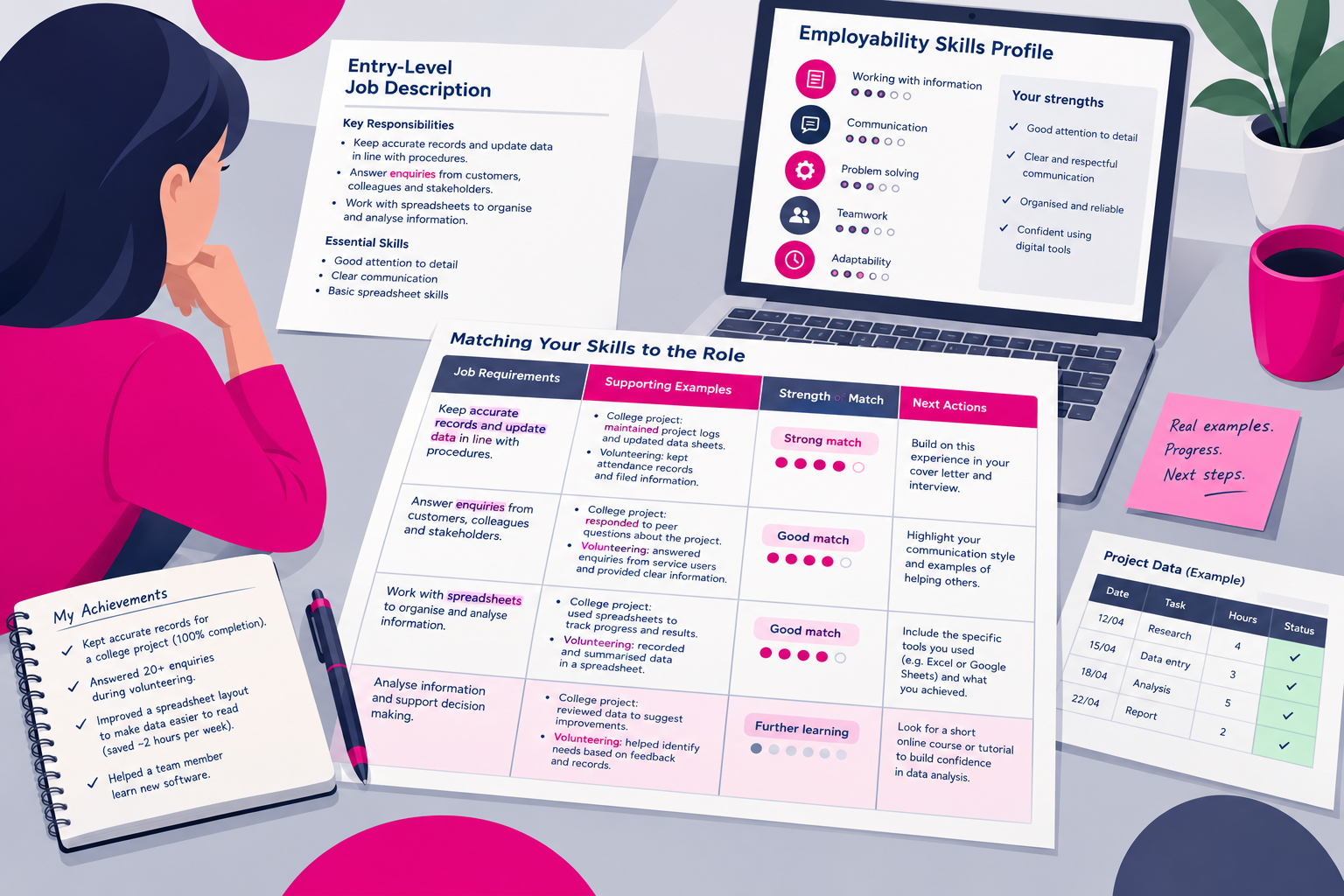
2. Create a requirement-to-evidence map
Do not start rewriting your CV yet.
First, build a simple comparison using four columns: requirement, your evidence, strength of match and next action.
This prevents wishful thinking and makes weak claims visible before you submit them.
Consider a fictional entry-level operations assistant vacancy. It asks for accurate records, professional responses to enquiries, task prioritisation, spreadsheet skills and experience with a customer database.
A first-time applicant might map their evidence like this:
- Accurate records: checked event bookings against payment confirmations. Direct match. Prepare a specific example.
- Professional enquiries: answered questions from visitors while volunteering. Transferable match. Explain the questions and how they were handled.
- Prioritising tasks: coordinated coursework deadlines alongside weekly volunteering. Transferable match. Show the planning method, not just the busy schedule.
- Spreadsheets: created a tracker using formulas, filters and consistent headings. Direct match for basic spreadsheet work. State the functions actually used.
- Customer database: no experience with the named system. Gap. Identify relevant data-entry experience without claiming database proficiency.
Direct evidence means you have performed the same or a closely comparable task. Transferable evidence means you have demonstrated the underlying capability in another context. A gap means you do not currently have adequate evidence.
These distinctions matter. They help you explain relevance without pretending that organising a college event is identical to running a commercial operations team.
Choose evidence for relevance, not prestige
A modest example that closely matches the task can be more useful than an impressive achievement with no clear connection.
If the job involves checking customer records, your careful maintenance of a club membership list may deserve more space than winning an unrelated competition.
Match the work. Do not simply showcase your favourite achievement.
3. Turn examples into credible proof
“I have excellent attention to detail” asks the employer to trust your opinion.
“I checked booking entries against payment confirmations and corrected discrepancies before the event” gives them evidence to assess.
Strong application evidence contains three elements: the task, your action and the outcome. Add scale when you can verify it.
Be specific about your contribution
Use this structure:
“When [situation], I [specific action], which [observable outcome].”
For example: “During a group research project, I combined four contributors’ findings into one document, checked references against the source material and resolved inconsistent figures before submission.”
Notice what makes that credible. It describes actual work. It identifies the applicant’s contribution. It does not hide behind “we worked well together”.
If the outcome belonged to a team, say so. Distinguish your actions from the collective result.
Never invent numbers to make an example look stronger.
Results do not have to be percentages. You can describe a deadline met, a discrepancy corrected, a handover completed or a process followed accurately.
Specificity is useful. Fabricated precision is not.
Use experience outside paid employment carefully
Relevant evidence can come from education, volunteering, caring responsibilities, clubs, personal projects and informal work.
The source does not automatically determine its value. The connection to the requirement does.
However, context still matters. Handling a household budget demonstrates something about organisation and numeracy. It does not establish competence in corporate financial reporting.
Present the capability you demonstrated, explain its relevance and keep the claim within its real limits.
You also do not need to disclose sensitive personal circumstances to make an example credible. Describe the task and your contribution without sharing private details.
4. Put your strongest matches where employers can see them
A useful evidence map is not the finished application. You must decide where each match belongs.
Your profile summary establishes relevance. Your experience bullets substantiate it. Your supporting statement addresses the requested criteria.
Each section has a different job.
Rewrite the summary around the vacancy
Weak: “Hard-working, enthusiastic individual with excellent communication skills, seeking an opportunity to grow.”
Stronger, if supported by your experience: “Entry-level administrator with experience maintaining event booking records, answering visitor enquiries and using spreadsheets to organise information. Seeking an operations support role requiring accurate records and dependable follow-through.”
The stronger version identifies relevant work. It does not ask the employer to translate personality claims into business value.
Keep the summary short. The evidence underneath must support every claim it makes.
Tailor bullets, not your employment history
Keep your job titles, dates, qualifications and responsibilities accurate. Tailoring means selecting and explaining relevant facts, not changing them.
For the operations vacancy, prioritise bullets about records, enquiries and coordination. For a customer service vacancy, the same experience might lead with answering questions and resolving confusion.
You are changing the emphasis, not the truth.
The National Careers Service guidance on CV sections offers a useful structural reference. Within that structure, give the most relevant evidence enough space to be understood.
Use the employer’s language when it is accurate
If the vacancy says “maintaining records”, use that phrase where it describes your work. Clear terminology helps people understand the match.
Some recruitment systems also search or filter application information. But there is no universal keyword formula that guarantees progression.
Repeating “teamwork” twelve times will not create evidence of teamwork.
Never add a skill merely because it appears in the advert. Write the relevant term beside a concrete example, then move on.
5. Handle gaps without either bluffing or retreating
You do not need to treat every missing desirable skill as a reason to withdraw. You also should not assume that enthusiasm cancels an essential requirement.
Separate gaps into three groups.
Non-negotiable gaps need a clear decision
If the role requires a current licence, registration or availability you do not have, acknowledge that constraint.
Where wording is genuinely unclear, ask the named contact a specific question:
“The person specification lists this certificate as essential. Would you consider applicants currently completing it, or must it be held at application?”
That is more useful than asking whether you should apply without explaining the issue.
Learnable gaps need a bounded action
If you lack a basic software capability, identify the actual task and practise it.
For spreadsheet work, that might mean building a fictional enquiry log, applying filters, adding simple formulas and checking for missing entries.
Label this honestly as a practice project. It is evidence of practice and learning, not professional experience.
Do not upload real customer, employer or personal data into a portfolio. Use fictional or appropriately anonymised material.
Experience gaps need transferable evidence
If you have not handled workplace customers, look for occasions when you answered questions, explained a process or dealt calmly with a misunderstanding.
Then state the context clearly.
A useful formulation is: “I have not used your booking system, but I have maintained structured booking records and checked entries against confirmations.”
That is stronger than pretending familiarity. It gives the employer an honest basis for judging the training required.
6. Prepare to defend the match at interview
Every claim in your application is a potential interview question.
Before submitting, choose your strongest examples and test them aloud. Ask yourself:
- What exactly was I responsible for?
- What did I do personally?
- Why did I choose that approach?
- What difficulty did I encounter?
- What changed as a result?
- What would I do differently next time?
If you cannot answer these questions, the example may be too vague or the claim too broad.
Also prepare the connection to the advertised role:
“This is relevant because your role involves checking information from several sources before updating records.”
Do not leave that connection entirely to the interviewer. Make it explicit, briefly and accurately.
A short workflow for your next application
Keep the process repeatable rather than elaborate.
- Extract the requirements: separate essential conditions, tasks, capabilities and behaviours.
- Map your evidence: identify direct matches, transferable matches and genuine gaps.
- Tailor the application: put relevant proof in the summary, experience bullets and required statements.
- Check every claim: confirm accuracy, follow the instructions and prepare to explain your examples.
Maintain a master evidence bank so that each application does not begin with a blank page. Record useful examples as they happen, including your actions and outcomes.
Then select from that bank for each vacancy. Do not send the whole bank.
Your goal is relevance, not volume.
Make the match easy to understand
A generic application says, “Here is everything I want you to know about me.”
A targeted application says, “Here is evidence that I can contribute to the work you need done.”
That difference matters, especially when you are applying for your first job.
You cannot control the competition or guarantee an interview. You can control whether your application makes an accurate, relevant and credible case.
Open one job description. Identify its key requirements. Put your evidence beside them.
Where the match is strong, show it. Where it is incomplete, explain it. Where it is missing, make a realistic decision.
You do not need to sound like the perfect candidate. You need to show clearly what you can do.
Next Steps
Want to learn more? Check out these articles:
Turn Your Employability Results Into a Plan to Get Hired
How to Prepare for a Written Exercise and Get It Right
How to Prepare for Your Assessment Centre Presentation
Check out our Advanced Employability Course for all the help you need to get your dream job, fast.