
How to Write a Cover Letter That Gets Interviews Fast
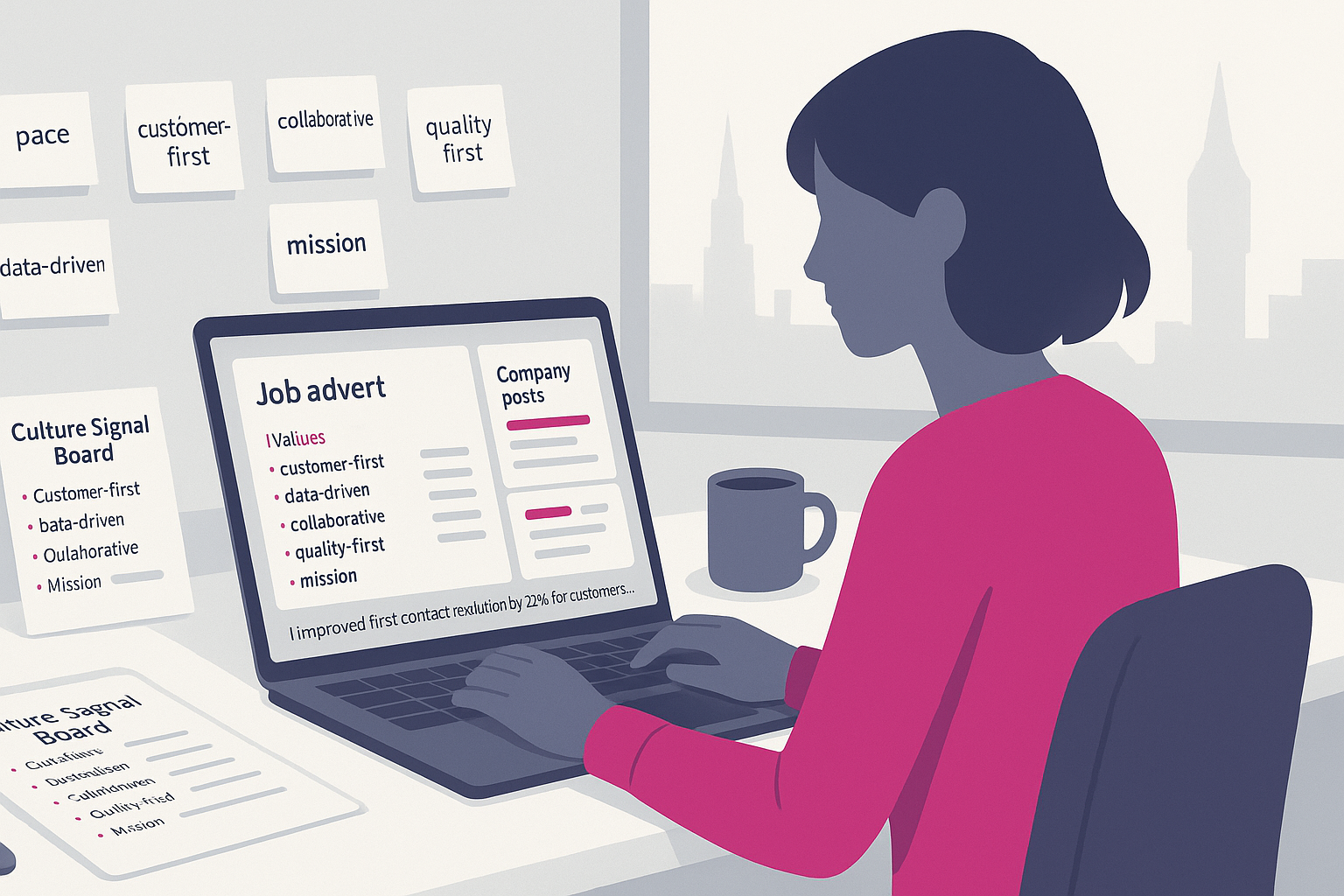
If your cover letter feels like a polite apology for existing, it will get treated like one.
Most cover letters are not rejected because the candidate is bad. They are rejected because the letter is useless.
Recruiters do not need a second version of your CV written in paragraphs. They do not need your life story. They do not need “I am writing to apply for the position of…” because they already know.
They need evidence, fast.
This article shows you exactly how to write a cover letter that gets interviews, especially if you are applying for your first job, an internship, or you do not have “years of experience” to lean on. You will get a clear structure, tactical templates, and the brutal truth about what actually works.
The hard truth: your cover letter is a sales page
A cover letter has one job: get the reader to open your CV and take you seriously.
Not “express passion”. Not “show personality”. Not “sound professional”.
Professional is table stakes. Proof is what wins.
Think like the hiring manager:
They have a problem.
They are paying money to make that problem go away.
Your letter must make a specific claim: “I can help solve this.”
Then it must back the claim with evidence.
If you cannot back it, you have to build it using projects, coursework, volunteering, part-time work, caring responsibilities, sports leadership, or anything that demonstrates the relevant skills in action.
Why most cover letters fail (and how yours won’t)
Let’s name the killers:
- Generic opening lines
“I’m excited to apply…” means nothing. Everyone is “excited”. - No proof
“Hard-working team player” is not a skill. It is a label. Labels are cheap. - Too long
If it needs scrolling, you are losing. - Wrong focus
Candidates talk about what they want. Employers care about what they need. - Bad tailoring
Changing the company name is not tailoring. It is lazy copying.
A strong cover letter is short, targeted, and built on evidence.
The interview-winning cover letter structure (use this)
Aim for 250 to 400 words. One page maximum. Three or four short paragraphs plus bullets.
Use this structure:
1) Header and subject line that makes sense
If sending by email, your subject line should be:
- Application: [Job Title], [Your Name]
If uploading to a portal, name your file:
- Cover Letter, [Job Title], [Your Name].pdf
Yes, this matters. Sloppy file names signal sloppy work.
2) Opening: one sentence that proves fit
Your first sentence must do real work.
Pick one of these patterns:
- Role + proof + outcome: “I’m applying for the Junior Marketing Assistant role and have already run two student society campaigns that increased event attendance by 35%.”
- Role + relevant training + evidence: “I’m applying for the IT Support Trainee role. I completed the Google IT Support Certificate and regularly troubleshoot Windows and network issues for a community centre.”
- Role + motivation that is specific: “I’m applying for the Care Assistant role because I have hands-on experience supporting a family member with mobility and medication routines, and I want to build a career in care.”
Notice what is missing: fluff.
3) Paragraph two: match their needs to your evidence
Open the job advert. Identify the top three requirements. Usually they are:
- Core task responsibility
- A tool or system
- A behaviour (customer service, accuracy, teamwork)
Now write one short paragraph that mirrors those requirements and proves you can deliver.
Example formula:
- “You need X. I have done X in Y context, which led to Z result.”
4) Bullets: your proof, quickly
This is where interviews are won.
Add 3 to 5 bullets. Each bullet must contain:
- Action you took
- Context
- Result (number if possible)
Examples:
- “Handled 40 to 60 customer queries per shift in a part-time retail role, maintaining calm service during peak periods.”
- “Built a simple Excel tracker for coursework deadlines that reduced missed submissions in a group project to zero.”
- “Led a five-person team in a sports club committee, improving membership sign-ups by 20% over one term.”
If you have no numbers, use credible indicators:
- frequency (weekly, daily)
- volume (number of customers, tickets, participants)
- time (delivered two days early)
- quality (zero errors, positive feedback)
5) Closing: clear next step, no begging
Close like an adult.
- Confirm interest
- Reassure availability
- Point to CV
Example:
“I’d welcome the chance to discuss how I can contribute in the first 90 days. My CV is attached. I’m available for interview with reasonable notice.”
That is it.
How to tailor a cover letter in 15 minutes
Tailoring does not mean rewriting everything. It means changing the parts that matter.
Here is a fast method.
Step 1: Pull keywords from the job advert
Copy the advert into a document. Highlight:
- tools (Excel, Salesforce, Zendesk)
- tasks (customer queries, scheduling, stock checks)
- traits (accuracy, resilience, collaboration)
Step 2: Write a “match list” before you write the letter
Create two columns:
- They need
- My evidence
Do not move on until you have at least three strong matches.
If you cannot find three matches, stop applying and fix the gap.
That is not negativity. That is strategy.
Step 3: Mirror their language, but keep your voice
If the advert says “stakeholders”, do not say “people”.
If it says “prioritise”, do not say “do many things”.
You are reducing the reader’s effort. That is what good candidates do.
Step 4: Tailor one bullet to their biggest pain
Every job has a pain point.
Examples:
- Busy inbox and complaints
- Missed deadlines
- Data errors
- High footfall
Add one bullet that directly attacks that pain.
Cover letter template (copy and use)
Use this as a base. Replace everything in brackets.
[Your Name]
[Your Phone] | [Your Email] | [LinkedIn if strong]
[City, Country]
[Date]
[Hiring Manager Name if known]
[Company Name]
Dear [Name or Hiring Manager],
I’m applying for the [Job Title] role. I bring [one relevant credential or experience] and have already demonstrated [relevant skill] by [specific proof with outcome].
From your job advert, you need someone who can [Requirement 1], [Requirement 2], and [Requirement 3]. In [context], I have [done relevant work], using [tool/process] to deliver [result]. I’m confident I can bring the same standard to [Company Name] and contribute quickly.
Key evidence:
- [Action] in [context], resulting in [metric or credible indicator].
- [Action] in [context], resulting in [metric or credible indicator].
- [Action] in [context], resulting in [metric or credible indicator].
- [Optional] [Action] in [context], resulting in [metric or credible indicator].
I’d welcome the chance to discuss how I can contribute in the first 90 days. My CV is attached. I’m available for interview with reasonable notice.
Kind regards,
[Your Name]
Cover letter examples by situation
You do not need “perfect”. You need “credible”. Here are patterns that work.
Cover letter example: first job with limited experience
Your advantage is freshness and speed to learn. Your risk is vagueness.
Use this angle:
- reliability
- learnability
- proof from school, volunteering, responsibilities
Bullets you can use:
- “Maintained 95% attendance over the last school year and met every deadline across five subjects.”
- “Volunteered weekly, handling cash and customer questions with accuracy and patience.”
- “Taught myself [tool] through [course], completing [project] to a defined deadline.”
Cover letter example: internship or placement
Internships are about trajectory.
Show:
- you understand the work
- you have done a small version of it
- you can be trusted with basics
Bullets you can use:
- “Completed a self-directed project analysing [topic] and presented findings to a group of 12, with a clear recommendation.”
- “Used Excel to clean and summarise data for coursework, building charts and a simple dashboard.”
Cover letter example: career change or gap
Do not explain your life. Translate your skills.
Use this structure:
- “I’m moving from [previous area] to [new role] because [specific reason].”
- “The overlap is [two skills].”
- “Here is proof.”
Avoid defensive language like “Although I don’t have…”.
Say what you do have.
The ruthless checklist before you hit send
Run this like a pre-flight check. If you skip it, you are gambling.
Content checks
- Does the first sentence include role + proof?
- Did you mirror the top three requirements from the advert?
- Do you have 3 to 5 proof bullets?
- Did you remove every empty phrase (passionate, hardworking, team player) unless you prove it?
Accuracy checks
- Correct company name and job title, everywhere
- Correct hiring manager name, if used
- Spelling and grammar clean (use a checker, then read it aloud)
- Dates and facts match your CV
Format checks
- One page
- Short paragraphs
- Easy to skim
- PDF unless the portal says otherwise
Common cover letter mistakes that cost interviews
You can be good and still get rejected if you do these.
Writing to impress instead of to be understood
Complex words do not signal intelligence. Clarity does.
Using AI and forgetting to personalise
AI can help you draft. It cannot replace your proof.
Recruiters can smell generic output because it avoids specifics.
Repeating your CV
If it is already in your CV, do not paste it again.
Your cover letter should answer:
- Why this role?
- Why you?
- Why should we believe you?
Focusing on your needs
Statements like “This role will help me grow” may be true, but it is not persuasive.
Translate:
- “I’m looking to grow” becomes “I’m ready to contribute and grow quickly in [specific area].”
A brief implementation plan you can follow this week
If you want interviews, treat this like a process, not a one-off.
- Build a master cover letter using the structure above.
- Create a proof bank: 20 bullets from school, work, volunteering, projects, sport, caring responsibilities. Add metrics.
- For each application, tailor in 15 minutes by swapping the opening, one paragraph, and one bullet.
- Track outcomes: role, company, version used, response. Stop repeating what does not work.
Small changes, consistently applied, beat “perfect writing” every time.
The standard you should hold yourself to
A cover letter that gets interviews is not clever. It is not cute. It is not long.
It is a clear argument.
It says:
- Here is what you need.
- Here is proof I can do it.
- Here is why you should talk to me.
Do that, and your CV stops being ignored.
It starts getting read.
Next Steps
Want to learn more? Check out these articles:
Tailor Your Cover Letter To Fit Culture [A Practical Guide]
Cover Letter Opening Lines That Get Attention
New Year Cover Letter Refresh: A 7 Day Practical Rebuild Now
Check out our Advanced Employability Course for all the help you need to get your dream job, fast.