
How to Show Leadership Potential in a Job Interview Fast
Most candidates think “leadership potential” means sounding confident, talking loudly, and name-dropping group projects.
That is not leadership. That is theatre.
In an interview, leadership potential is one thing: evidence that you make good things happen when nobody is watching, when the brief is unclear, and when the stakes are real.
Especially if you are early in your career, you will not be judged on how many people you have managed. You will be judged on whether you can be trusted to take ownership, make decisions with limited information, and raise the standard around you.
This guide shows you exactly how to demonstrate that, without pretending to be a CEO.
What interviewers really mean by “leadership potential”
Hiring managers rarely need a motivational speech. They need someone who:
- Owns outcomes, not tasks
- Thinks in systems, not excuses
- Influences without authority
- Makes trade-offs when everything matters
- Raises clarity in messy situations
- Acts with maturity under pressure
This is why “leadership potential” shows up in graduate roles, apprenticeships, internships, and first professional jobs. Organisations are hiring future capability, not just today’s output.
And here is the brutal truth: most candidates do not give evidence. They give adjectives.
“I’m proactive.” “I’m a natural leader.” “I take initiative.”
Those phrases are weightless. Evidence is heavy.
The number one mistake: confusing leadership with seniority
If you think leadership is a job title, you will fail this part of the interview.
Leadership is behaviour. It is what you do when:
- No one tells you what to do next
- Two priorities clash
- A teammate drops the ball
- The customer is unhappy
- The plan stops working
You can demonstrate leadership potential from:
- A part-time retail job
- A university assignment
- Volunteering
- Sport
- Care responsibilities
- An online community role
The setting does not matter. The pattern of behaviour does.
The Leadership Evidence Stack (what you must show)
If you want to be taken seriously, build your interview answers around six proof points. Think of this as your Leadership Evidence Stack.
1) You spot the real problem, not the loud problem
Potential leaders do not get hypnotised by surface-level drama. They ask, “What is actually causing this?”
What to say in an interview
- “At first it looked like a time management issue. After checking the workflow, the real bottleneck was approvals sitting with one person.”
- “The complaint was about speed, but the root cause was unclear expectations.”
What to prepare
- One story where you diagnosed the cause, not just treated the symptom
- The specific signals you noticed
- The questions you asked to verify your theory
2) You take ownership without becoming unbearable
Ownership is not control. It is accountability.
Interviewers look for people who step in without stepping on people.
What to say
- “I wasn’t the most senior, but I was closest to the issue, so I took responsibility for getting it resolved and kept everyone updated.”
- “I offered a plan, checked it with the team, then executed.”
What to avoid
- “Nobody else did anything, so I did it all myself.” (This signals poor collaboration.)
- “I told them what to do.” (This signals ego.)
3) You communicate decisions and trade-offs clearly
Leaders are paid to make trade-offs. Most candidates avoid them because they are afraid of being wrong.
Show you can choose, explain, and live with the consequences.
What to say
- “We could either ship on time with a reduced scope, or delay for a more complete version. We chose reduced scope because the deadline affected customers, and we documented what we would add next.”
- “I prioritised accuracy over speed because the data was used for a report sent externally.”
What to prepare
- A story where you had to pick between two good options
- The criteria you used
- How you communicated the decision
4) You influence without authority
This is the core of leadership potential. If you can only lead when you have power, you are not a leader. You are a manager-in-waiting.
What to say
- “I couldn’t force the change, so I spoke to the people it affected, showed them the impact, and proposed a small trial. Once the trial worked, others adopted it.”
- “I aligned the team around a shared target, then agreed simple roles and check-ins.”
Evidence that counts
- You convinced people using logic and benefits, not status
- You created momentum with a small win
- You handled pushback professionally
5) You raise standards and make things better
Leadership is not just “getting it done”. It is leaving things better than you found them.
What to say
- “I noticed the handover notes were inconsistent, so I created a simple template. It reduced errors and made onboarding faster.”
- “I built a checklist for closing tasks because we kept missing steps under pressure.”
What to prepare
- One improvement you introduced
- How you tested it
- The measurable result, even if small
6) You show maturity under pressure
Pressure is where leadership potential becomes visible.
Interviewers listen for emotional control, not bravado.
What to say
- “I stayed calm, clarified what was urgent versus important, and communicated updates at agreed times so people did not panic.”
- “I owned my mistake early, fixed it, and put a prevention step in place.”
What to avoid
- Blaming “a toxic teammate” as your main narrative
- Over-explaining your feelings without showing decisions and actions
Your interview answers need a structure that screams leadership
Most people use STAR (Situation, Task, Action, Result). It is fine, but it often produces “I did my tasks” stories.
Use this instead for leadership potential:
The LDR framework: Lead, Decide, Resolve
- Lead: What did you notice, and what did you take ownership of?
- Decide: What options did you consider, and what trade-off did you choose?
- Resolve: What changed because of you, and how do you know?
This forces you to show judgement, not just activity.
Example answer (early-career friendly)
Question: “Tell me about a time you showed leadership.”
Lead: “In my part-time job, we had frequent customer complaints about long waits at peak times. I noticed the problem was not just volume, it was the way we were batching tasks at the counter.”
Decide: “I mapped the flow for one shift and saw two options. Either we add a second person permanently, which we could not staff, or we change the process so one person focuses on payments while the other prepares orders. I proposed a trial for the Saturday rush.”
Resolve: “We trialled it for two weekends, tracked queue length informally every 15 minutes, and complaints dropped. The manager kept the process and used it to train new starters.”
That is leadership. No title required.
The questions where leadership potential is hiding in plain sight
Some interviews never ask “Do you have leadership potential?” directly. They test it through other questions.
Here are the common ones and how to answer them like a leader.
“Tell me about a time you dealt with conflict”
What they want: Can you handle tension without ego?
What to include
- What the real issue was (usually expectations)
- How you reset the goal
- What you agreed as next steps
Strong line: “I focused on what we needed to achieve, then agreed a clear way of working so it did not repeat.”
“Tell me about a time you made a mistake”
What they want: Accountability and learning speed.
What to include
- What you did wrong, plainly
- How you contained the impact
- What system you changed to prevent it
Strong line: “I didn’t just fix it once, I fixed the cause.”
“Tell me about a time you handled ambiguity”
What they want: Can you create clarity when the brief is weak?
What to include
- The assumptions you tested
- The questions you asked
- How you aligned stakeholders on a definition of “done”
Strong line: “I wrote down what we were solving, what success looked like, and what constraints we had, then got agreement before moving.”
“Why should we hire you?”
What they want: Can you connect your strengths to their outcomes?
Use this three-part answer
- Outcome: “You need someone who can [key outcome from job description].”
- Evidence: “I’ve done that in [context] and got [result].”
- Operating style: “How I work is I clarify priorities early, keep people informed, and improve the process as I go.”
This is leadership in a single paragraph.
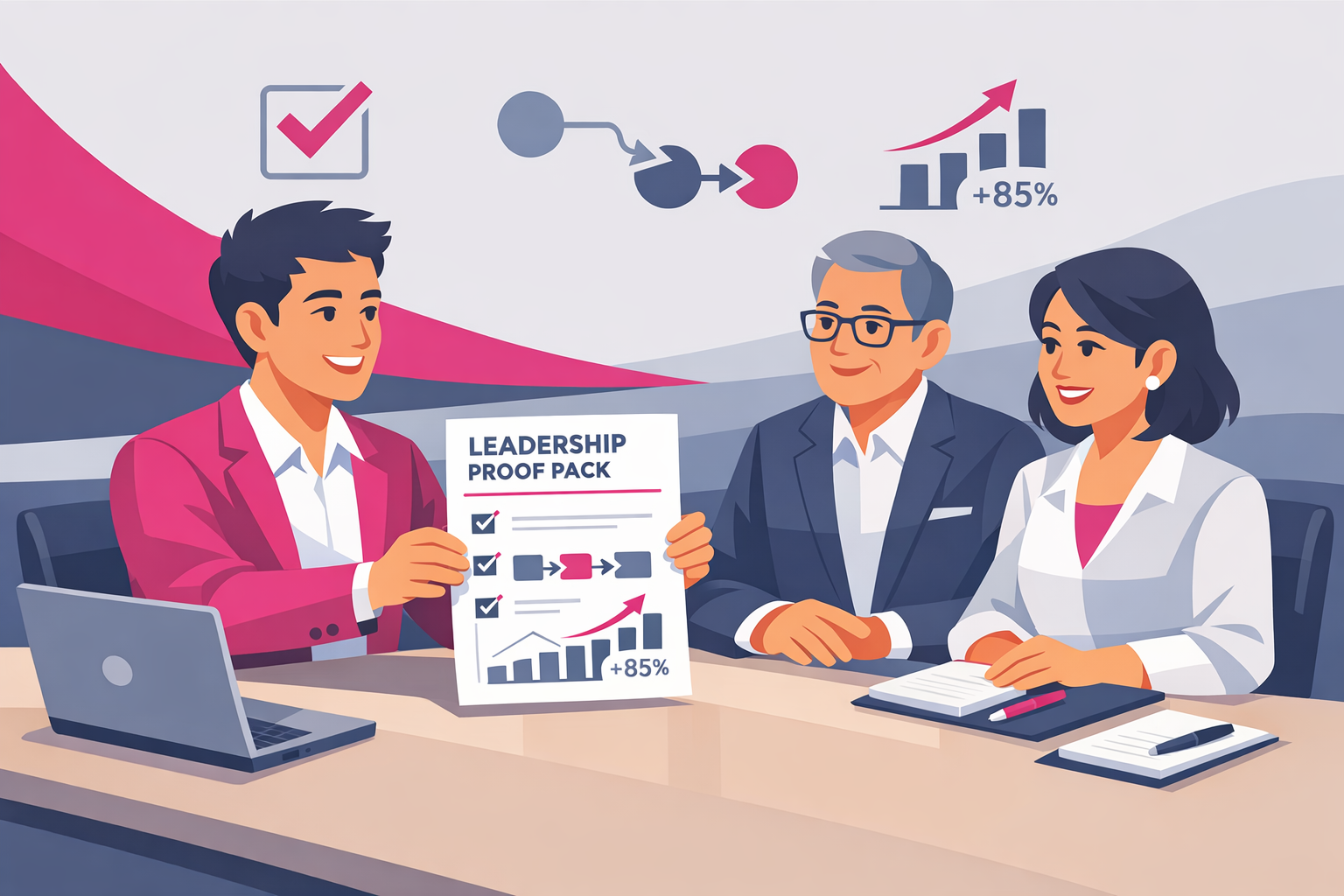
What to bring: a Leadership Proof Pack
If you want to separate yourself from 90% of candidates, bring a simple proof pack. Not a flashy portfolio. A tight set of evidence.
Your Leadership Proof Pack can include
- A one-page “projects snapshot” with 2 to 3 examples and metrics
- A process improvement you made (before/after screenshot, checklist, template, short summary)
- A short reflection on what you learned and how you would do it again
Rules
- Keep it to one or two pages max
- Use numbers where possible (time saved, error reduced, volume handled)
- Do not overwhelm them with documents
You are not trying to impress them with design. You are making it easy to believe you.
How to talk about leadership when you have no formal experience
Many people panic here and start exaggerating. Do not.
Instead, choose stories that show the behaviours organisations associate with leaders.
Use these “no-title leadership” sources
- Customer-facing work: De-escalation, prioritising, fixing recurring issues
- Group assignments: Setting roles, timelines, quality control, handling non-contributors
- Volunteering: Coordinating people, improving a system, delivering an event
- Family responsibilities: Planning, budgeting, conflict management, reliability
- Self-directed projects: Learning fast, shipping outcomes, iterating based on feedback
Translate your experience into leadership language
Do not say: “I helped out.”
Say: “I noticed X, proposed Y, and delivered Z.”
Do not say: “We did a project.”
Say: “I defined the plan, clarified roles, and handled the risk when the timeline slipped.”
Do not say: “I’m good with people.”
Say: “I aligned people around the goal and removed friction so we could execute.”
Metrics: the fastest credibility boost you can add
Leadership without outcomes is just personality.
You need numbers. If you do not have formal KPIs, estimate responsibly and explain your method.
Metrics you can use
- Time saved (minutes per shift, hours per week)
- Volume handled (customers served, tickets closed, items processed)
- Error reduction (fewer returns, fewer reworks, fewer complaints)
- Speed improvements (faster turnaround, shorter queues)
- Engagement (attendance, sign-ups, participation)
Good phrasing when numbers are approximate
- “Roughly”
- “On average”
- “Over a two-week period”
- “Based on counting for three peak shifts”
Honesty builds trust. Fake precision destroys it.
What leadership potential sounds like (phrases you can steal)
Use language that signals ownership, judgement, and clarity.
- “I took responsibility for the outcome, not just my part.”
- “I clarified what success looked like before starting.”
- “I escalated early, with options, not complaints.”
- “I made the trade-off explicit and got buy-in.”
- “I ran a small trial to prove it.”
- “I documented the process so it was repeatable.”
- “I asked for feedback and adjusted quickly.”
Notice what is missing: buzzwords.
What will quietly kill your leadership credibility
Many candidates sabotage themselves with avoidable signals.
1) You talk in vague generalities
“I’m a leader.” Prove it.
2) You dominate the story and erase the team
Leaders give credit and still show accountability.
Use “I” for what you owned. Use “we” for what the team executed. Be precise.
3) You sound like you need constant instruction
If every story begins with “My manager told me…”, you are not demonstrating leadership potential. You are demonstrating compliance.
4) You avoid decisions
If your stories contain lots of effort but no choices, you will not be seen as high potential.
5) You blame other people
Leaders describe constraints calmly and focus on actions.
A brief implementation plan: prepare in 90 minutes
You do not need weeks. You need focused preparation.
Step 1: Pick three leadership stories (20 minutes)
- One improvement you made
- One situation under pressure
- One example of influencing without authority
Step 2: Write each story using LDR (30 minutes)
- Lead: what you noticed and owned
- Decide: options and trade-off
- Resolve: result and evidence
Step 3: Add one metric to each story (15 minutes)
- Even if it is an estimate, make it honest
Step 4: Build a one-page proof pack (15 minutes)
- 2 to 3 examples, each with outcome and evidence
Step 5: Practise the first 20 seconds (10 minutes)
- Leadership answers fall apart at the start. Nail your opening line.
The final standard: make them feel safe hiring you
Leadership potential is not about charisma. It is about trust.
When the interviewer leaves the room, they ask a simple question:
“Will this person raise the bar, or create more work for everyone?”
If your answers show ownership, judgement, clarity, and measurable outcomes, you will be the rare candidate who feels like a safe bet and a smart bet at the same time.
Next Steps
Want to learn more? Check out these articles:
Explain No Management Experience in Interviews Without Apologising
Answer ‘Working Under Pressure’ Interview Questions Like a Pro
How to Explain a Disciplinary Warning in Interviews
Check out our Advanced Employability Course for all the help you need to get your dream job, fast.