
How to Explain a Disciplinary Warning in Interviews
The question you are dreading is not the real problem
You are not scared of the warning.
You are scared the interviewer will decide you are “risky” and mentally file you under: not worth it.
That fear is rational. Employers hire to reduce risk, not to do you a favour.
But here is the brutal truth.
Most candidates handle this the worst possible way. They ramble. They overconfess. They get defensive. Or they try to hide it and look slippery.
None of those approaches works.
A disciplinary warning is not automatically a career-ender.
But a sloppy explanation is.
This article gives you a practical way to explain a disciplinary warning in a job interview without self-destructing, while still being honest. You will learn what to say, what not to say, and how to build trust fast.
First: decide whether you must disclose it
Before you script anything, get clear on one point.
In most interviews, you are not required to volunteer a disciplinary warning unless:
- You are asked a direct question that covers it
- It is relevant to a regulated role or specific background checks
- You signed an agreement requiring disclosure in defined circumstances
- The warning led to dismissal and you are asked why you left
If the interviewer does not ask, do not randomly confess.
Volunteering unnecessary negatives is not “integrity”. It is poor judgement.
That said, never lie. If you are asked directly, answer directly.
The goal is simple.
Tell the truth with control.
Understand what the employer is really asking
When an employer asks about a warning, conduct, or “what happened”, they are not looking for gossip.
They are running a risk audit.
They want to know:
- Is this a one-off or a pattern?
- Do you take responsibility or blame everyone else?
- What did you learn and what changed?
- Will it happen here?
- Can I trust you under pressure?
Your job is to answer those questions clearly.
Not to give a courtroom speech.
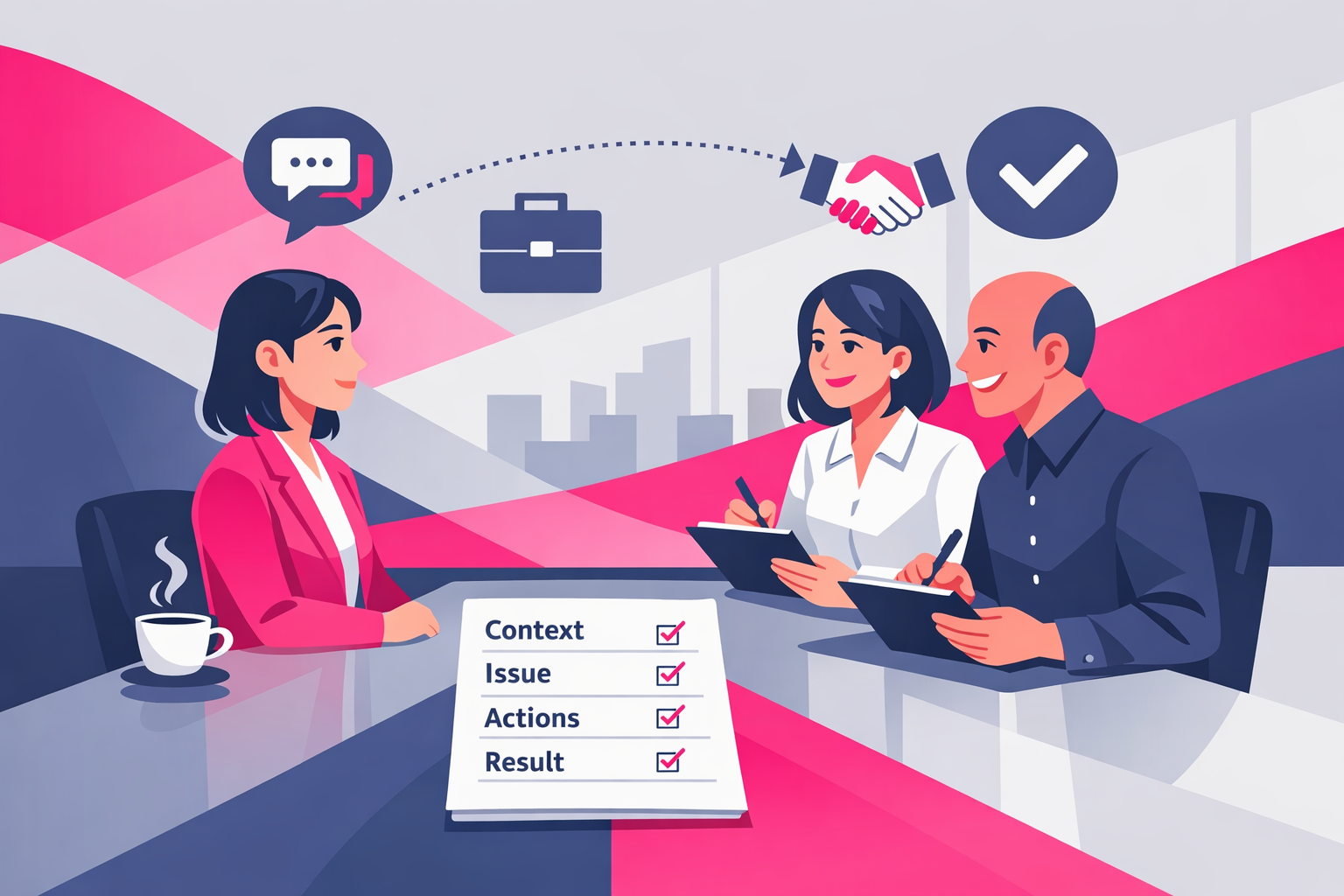
The only structure that consistently works: C.L.E.A.R.
If you remember nothing else, remember this.
You need a tight story with boundaries.
Use C.L.E.A.R.
C: Context in one sentence
Give the minimum background needed to understand the situation.
No drama. No backstory. No character assassination.
L: Label the issue plainly
Name what the warning was for in a neutral, factual way.
Avoid euphemisms that make you look evasive.
E: Explain your part and take responsibility
Not “I’m sorry if anyone felt…”.
Say what you did or did not do.
Own it.
A: Actions you took to fix it
This is the credibility section.
Policies, habits, training, feedback loops, management check-ins.
Show change you can prove.
R: Result and reassurance
What has been the outcome since?
Why is it unlikely to repeat?
Bring it back to the role you want.
This structure keeps you honest without handing the interviewer a weapon.
What to say: high-trust phrases that work
Use straightforward language.
Examples you can adapt:
- “I received a formal warning for missing a critical deadline. That was my responsibility.”
- “I mishandled a situation with a customer. I should have escalated earlier.”
- “I breached a process. It was not malicious, but it was still a breach.”
- “The warning was a turning point. I made specific changes and the issue has not repeated.”
- “I can talk you through what I changed and how I manage that risk now.”
Notice the pattern.
Factual. Accountable. Forward-looking.
What not to say (because it screams ‘risk’)
These are the phrases that kill offers.
Avoid them.
Do not blame or attack
- “My manager had it in for me.”
- “Everyone else did it.”
- “HR overreacted.”
Even if true, you look hard to manage.
Do not overexplain
“So what happened was… [ten minutes later] …and that’s why.”
Long stories feel like excuses.
Do not minimise
- “It was nothing.”
- “Just a minor thing.”
If it was “nothing”, it would not be formal.
Minimising makes you look like you learned nothing.
Do not confess extra offences
You are not there to volunteer every mistake you have ever made.
Answer the question asked.
Do not claim perfection
“I’ve never had an issue since and never will again.”
Absolute promises make adults roll their eyes.
Give systems, not slogans.
Build your answer in 45 to 75 seconds
Your goal is a clean, confident explanation.
Not a TED Talk.
Aim for under 90 seconds.
Here is a template you can memorise.
The plug-and-play script
“In my last role, I received a formal warning for [label the issue]. The context was [one sentence]. The key point is I take responsibility for [your part]. After that, I did three things: [action 1], [action 2], and [action 3]. Since then, [result]. What I learned is [lesson], and it’s now built into how I work, especially in areas like [relevant part of new role].”
If you deliver that calmly, most interviewers will move on.
Because you just did what most candidates cannot.
You made them feel safe.
Examples for common disciplinary warning scenarios
Below are realistic examples. Adjust the details to match your truth.
Example 1: Timekeeping or attendance
“I received a written warning for lateness. The context was unreliable transport and poor planning on my part. I take responsibility because I did not build in buffers or communicate early enough. I changed my routine, moved to an earlier service, and set a hard rule to leave with a 20-minute margin. I also agreed weekly check-ins with my supervisor for a month. Since then, my attendance has been consistent. The lesson was that reliability is not a personality trait, it’s a system, and I now run it like one.”
Example 2: Performance or missing deadlines
“I received a warning after missing a deadline that affected another team. The context was a workload spike, but I did not manage it properly. I should have flagged the risk earlier and renegotiated priorities. I changed how I plan by breaking work into weekly milestones, confirming expectations in writing, and escalating sooner when timelines are at risk. Since then, I’ve delivered on time and had positive feedback on communication. It made me stricter about planning and proactive updates.”
Example 3: Conduct or conflict
“I received a formal warning for how I spoke to a colleague during a pressured situation. It was unprofessional and I own that. I apologised directly, and I worked with my manager on a clear plan for handling conflict, including stepping away when I’m triggered and using structured language to raise issues. Since then, I’ve had no repeat incidents and I’ve contributed well in team settings. The lesson was that pressure is not an excuse, and professionalism is a skill.”
Example 4: Policy breach (non-malicious)
“I received a warning for not following a process correctly. It was not intentional, but it was still my responsibility to follow procedure. After that, I asked for retraining, built a checklist for that task, and had my work reviewed for a short period until it was consistent. There have been no further issues. I’m now very process-driven, particularly in areas that impact compliance and customers.”
Example 5: Misuse of equipment or IT
“I received a warning related to IT usage. It was a poor decision and I should have followed the policy. I clarified the rules with my manager, completed refresher training, and I now keep personal and work activity completely separate. Since then there have been no concerns, and I’m careful about compliance.”
If the warning relates to safeguarding, fraud, violence, serious harassment, or regulated prohibitions, you need specialist advice before interviewing. Do not wing it.
If they push for details: hold the line
Some interviewers will probe.
That is normal.
Your job is to stay factual and not spiral.
Use bridging statements that answer without bleeding out.
Try these:
- “I can share the key points. The details are not appropriate, but the lesson and changes are.”
- “What matters is what I did next, and I’m happy to walk you through that.”
- “The warning was handled through the company process and resolved. Since then my record has been clear.”
- “I understand why you’re asking. Here’s how I make sure it doesn’t happen again.”
If they demand gossip or try to bait you into blaming others, that is information too.
It tells you what kind of culture you may be walking into.
Use evidence, not emotion
An interviewer trusts proof.
Bring receipts where appropriate:
- A reference that confirms improvement (if you can get one)
- A performance review after the warning
- Metrics: attendance, on-time delivery, customer scores
- Training certificates
- A simple personal system: checklist, calendar, escalation rule
Do not bring the warning letter itself unless requested.
You are not building a legal case.
You are building confidence.
The tightrope: accountability without self-sabotage
Many people get this wrong because they confuse accountability with self-attack.
Accountability is:
- “I did X. It was wrong. I changed Y. Here’s the result.”
Self-attack is:
- “I’m terrible at this. I always mess up. I feel so bad.”
Employers do not hire guilt.
They hire capability and maturity.
You can be humble without being weak.
Prepare for the two killer questions
Expect these follow-ups.
If you are ready, you will look unshakeable.
“Why should we hire you if this happened?”
A strong answer:
“Because I’m not asking you to ignore it. I’m showing you I took it seriously, changed how I work, and have evidence of consistent performance since. You’re hiring the person I am now, with a system that prevents a repeat.”
“What would you do differently now?”
A strong answer:
“I would act earlier. I would flag the risk, confirm expectations, and escalate before it becomes damage. That’s now my default.”
A brief implementation plan: your 7-day prep
Keep it simple. Execute it properly.
Day 1: Write your C.L.E.A.R. story
- 6 to 8 sentences
- Under 90 seconds out loud
Day 2: Identify your proof
- One document, one metric, or one reference angle you can use
Day 3: Draft your boundaries
- Decide what details are private
- Write two bridging statements you will use
Day 4: Practise under pressure
- Record yourself on your phone
- Fix rambling, fillers, defensive tone
Day 5: Do a mock interview
- Ask a friend to interrupt and probe
- Practise staying calm and brief
Day 6: Prepare your “risk reversal” close
- One sentence linking your lesson to the role
Day 7: Final polish
- Reduce it by 20 percent
- Clarity beats completeness
When honesty becomes your advantage
Most candidates try to look flawless.
It makes them look fake.
Handled correctly, a disciplinary warning can do something surprising.
It can prove you are:
- Coachable
- Accountable
- Able to learn fast
- Stronger under scrutiny
That is what employers actually want.
Not perfection.
Control.
Maturity.
Evidence.
Final checklist: do this, not that
Do this:
- Answer directly
- Keep it short
- Own your part
- Show the fix
- Show the result
- Link it back to the job
Not that:
- Hide it when asked
- Blame others
- Overconfess
- Ramble
- Make emotional appeals
- Promise “never again” without systems
A disciplinary warning is a moment.
Your explanation is the message.
Make it one that says: “I can be trusted.”
Next Steps
Want to learn more? Check out these articles:
Explain a Non-Linear Career Path in Interviews (Win Trust)
Answer Conflict Interview Questions With Proof Not Excuses
Explaining a Failed Probation in Interviews Without Panic
Check out our Advanced Employability Course for all the help you need to get your dream job, fast.