
Answer Conflict Interview Questions With Proof Not Excuses
Introduction: this question is not about conflict
“Tell me about a time you had conflict at work.”
Most candidates hear that and think: They are testing if I am nice.
No. They are testing if you are safe to hire.
Because conflict is not rare. It is not an edge case. It is the daily friction of deadlines, unclear ownership, clashing priorities, mismatched standards, and people having a bad week. Employers ask conflict questions to find out three things:
- Do you create problems or solve them?
- Can you protect relationships while still protecting results?
- Will you handle pressure like an adult or like a grenade?
If your answer sounds like a rant, a sob story, or a vague “we talked it out”, you fail.
This article shows you exactly how to answer conflict interview questions with specific, believable examples, even if you are applying for your first job.
What interviewers are really measuring
Conflict questions are a proxy test. The hiring manager is trying to predict how you will behave when:
- Someone disagrees with you in a meeting
- A colleague drops the ball and blames you
- You think the process is stupid but you still have to follow it
- A customer is angry and your team is split on what to do
- You are stressed, tired, and tempted to be sharp
Underneath, they are scoring you on six traits:
- Ownership: do you take responsibility for your part?
- Self-control: can you stay calm and respectful?
- Communication: can you clarify, listen, and summarise?
- Judgement: do you escalate at the right time, not too early and not too late?
- Fairness: do you seek a win-win or just a win?
- Results focus: do you actually resolve anything or just “feel better”?
If you build your answer to demonstrate those six things, you will stand out. If you do not, you will blend into the pile of candidates who “handled it professionally”.
The biggest mistakes candidates make (and why they kill your chances)
1) Choosing a story where you look like the victim
“My coworker was rude and I just kept my head down.”
This tells the interviewer you will avoid problems until they become toxic. It also tells them you will not challenge poor behaviour, which is how small issues become team-wide damage.
2) Naming a conflict that sounds like you are the problem
“I get frustrated when people do not work as hard as me.”
Translation: difficult to work with. High standards are good. Contempt is not.
3) Being vague
“We had different opinions so we communicated and resolved it.”
No facts means no trust. Vague answers sound invented.
4) Blaming the other person
Even if they were wrong, blaming makes you look unsafe. The interviewer imagines you doing the same to them.
5) “I have never had conflict”
That answer is either dishonest or shows a lack of real teamwork. Healthy teams disagree. You need to show you can handle it.
The only structure you need: S-T-A-R, upgraded
You have heard of STAR: Situation, Task, Action, Result. It is useful, but most people use it like a checklist and still sound weak.
Use this upgraded version for conflict questions:
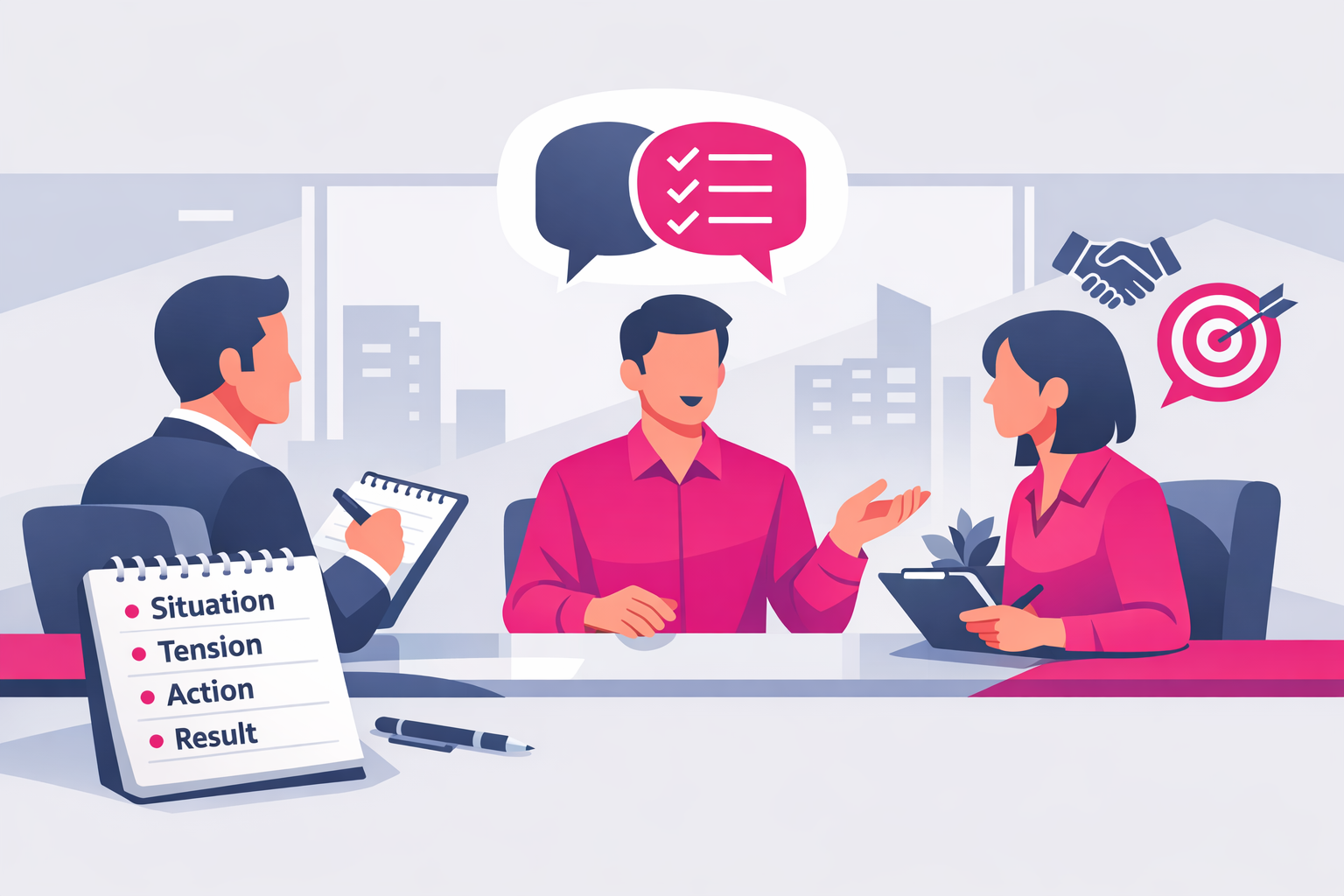
- Situation: where, who, what was at stake. One sentence.
- Tension: what specifically was the disagreement. One sentence.
- Action: what you did, step by step, with exact words where possible.
- Result: outcome plus evidence. Metrics if you have them.
- Reflection: what you learned and what you would repeat next time.
That last part, reflection, is where you look like a professional. It signals coachability and maturity.
What counts as “conflict” if you have not had a full-time job yet
If you are applying for your first job, stop panicking. Interviewers are not asking for corporate war stories. They are asking for proof of behaviour.
You can use examples from:
- School or college group projects
- Sport teams
- Part-time work, volunteering, placements
- Family responsibilities (caregiving, organising)
- Societies, clubs, student leadership
- Customer service situations
The conflict must include real stakes. Not “we disagreed about the font”. Choose something with pressure: deadlines, grades, customers, money, safety, or reputation.
Pick the right conflict story: a simple decision filter
Use this filter before you commit to an example.
Your story is strong if it shows:
- A clear disagreement about approach, priorities, standards, or responsibility
- Your calm response under friction
- Specific actions you took to reach a resolution
- A positive outcome for the work and the relationship
- A learning point that makes you sound better, not guilty
Avoid stories that include:
- Disciplinary issues, shouting, insults, or threats
- Anything HR-heavy unless you handled it impeccably and briefly
- “They were awful, I was perfect” energy
- Highly personal topics (religion, politics) unless essential to the role
Remember: your goal is not to prove you were right. Your goal is to prove you can be trusted.
The conflict answer formula that actually works in interviews
Here is the template you can memorise and adapt. It keeps you factual and stops you rambling.
1) Set the context in 10 seconds
“In my last [project/role], we were working on [goal] with a deadline of [time].”
2) Name the exact tension without drama
“We disagreed on [specific thing]. I felt [brief reason]. They were concerned about [their reason].”
This is crucial. You show you understand their perspective. That is emotional intelligence without saying “emotional intelligence”.
3) Walk through your actions like a professional
Use a short sequence. Three to five steps is enough.
- Clarified: asked questions, defined the real issue
- Aligned: agreed the shared goal
- Proposed options: two paths, with trade-offs
- Agreed decision: who decides, by when
- Documented: summary message, responsibilities, next steps
4) Prove the result
“We ended up [outcome]. The work was delivered [on time/with X impact]. Our working relationship improved because [evidence].”
5) Add the reflection that seals the deal
“What I took from that is [lesson]. Now I [repeatable behaviour].”
High-impact phrases to use (and what they signal)
Words matter. Some phrases sound like leadership. Others sound like avoidance.
Use phrases like:
- “I asked to clarify what ‘done’ looked like” (standards and clarity)
- “I summarised what I heard to check we were aligned” (listening)
- “I separated the person from the problem” (maturity)
- “I proposed two options with risks and trade-offs” (judgement)
- “I documented the decision so we did not relitigate it later” (execution)
- “I escalated with a recommendation, not a complaint” (professional escalation)
Avoid phrases like:
- “They were toxic” (diagnosis, not evidence)
- “I just ignored it” (avoidance)
- “I told them off” (poor self-control)
- “Management did nothing” (blame)
- “That is just my personality” (fixed mindset)
Example answers you can model (and customise)
Do not copy these word-for-word. Use them as patterns.
Example 1: conflict over quality vs speed (entry-level friendly)
Situation: “In a university group project, we had to deliver a client-style report and presentation in two weeks.”
Tension: “One teammate wanted to move fast and submit a basic version. I was concerned the analysis was thin and would cost us marks. They were worried we would miss the deadline.”
Action: “I suggested we define a minimum standard for each section, then timebox the work. I set up a 20-minute meeting, summarised what each of us wanted, and proposed a split: we would produce a ‘good enough’ draft within 48 hours, then spend the remaining time improving only the highest-impact sections. I also created a shared checklist so we agreed what ‘finished’ meant.”
Result: “We submitted on time and got a strong grade. More importantly, the tension dropped because we had a plan and clear standards.”
Reflection: “I learned that conflict often comes from different risk fears, not bad intentions. Now I try to surface the risks early and put structure around the work.”
Example 2: conflict caused by unclear ownership (workplace example)
Situation: “In a part-time retail role, two of us were responsible for closing tasks, and we kept finding stock left in the wrong place.”
Tension: “The other person felt I was being picky. I felt we were creating extra work for the morning team.”
Action: “I picked a calm moment, not during closing rush, and asked if we could run through the closing checklist together. I kept it factual, showed two examples of misplaced items, and asked what was making it hard to complete. It turned out the checklist order did not match the actual store layout. I suggested we reorder it and label the bays. I sent a short summary to the supervisor with the updated checklist for approval.”
Result: “Closing time became faster and we got fewer complaints from the morning shift. My relationship with the colleague improved because it was no longer personal, it was a shared process.”
Reflection: “I now look for process fixes before assuming it is attitude.”
Example 3: conflict where you had to escalate
Situation: “During a volunteer event, we had to manage registrations with a small team and a strict start time.”
Tension: “A teammate insisted on doing registrations manually, but the queue was growing and we were at risk of starting late.”
Action: “I asked them to explain their concerns about the digital system. They were worried it would fail. I proposed a simple fallback: use the digital check-in as the default and keep a paper list as backup. When we could not agree quickly, I escalated to the event lead with a recommendation, explaining the time risk and the fallback plan. Once the decision was made, I supported it and helped set up the backup.”
Result: “We started on time and handled the queue smoothly. The teammate felt heard because we included their risk and built a backup.”
Reflection: “Escalation is not ‘telling on someone’. It is protecting the objective when time is critical.”
How to answer the follow-up questions (these trip people up)
After your main answer, expect follow-ups designed to test whether your story is real and whether your learning is genuine.
“What was your role in the conflict?”
Say it plainly. Own something small and real.
- Good: “I was pushing for quality and I could have communicated the time risk earlier.”
- Bad: “Honestly, none of it was my fault.”
“What would you do differently?”
Do not rewrite history. Improve the process.
- “I would align on the definition of done on day one.”
- “I would ask more questions before offering a solution.”
- “I would document decisions earlier to prevent repeat arguments.”
“How do you deal with difficult people?”
This is a trap for arrogance. Keep it professional and behaviour-based.
Use a three-part answer:
- Focus on behaviours, not personalities
- Ask clarifying questions and confirm expectations
- Escalate if it affects delivery, safety, or conduct
Example: “I focus on specific behaviours and outcomes, align expectations in writing, and if it still impacts the work I escalate with evidence and a proposed next step.”
Brutal truth: your story must make you look employable
Conflict answers fail for one reason: people treat them like therapy.
An interview is not therapy. It is a risk assessment.
Your conflict story must show you can:
- Disagree without disrespect
- Push for standards without ego
- Handle tension without going quiet or going nuclear
- Turn messy human moments into clear next steps
That is employability. Not perfection. Not being “nice”. Being effective when it counts.
A brief implementation plan (30 minutes, done properly)
Step 1: Write two conflict stories
One about a disagreement on approach. One about responsibility or standards.
Step 2: Convert both into the upgraded STAR format
Situation, Tension, Action (steps), Result (evidence), Reflection.
Step 3: Add proof
Numbers if possible. If not, use concrete evidence:
- “Submitted two days early”
- “Queue reduced”
- “Fewer errors the next week”
- “Client accepted the deliverable without changes”
Step 4: Practise out loud twice
Time yourself. Aim for 60 to 90 seconds. If you cannot say it clearly in that time, you do not understand your own story yet.
Step 5: Prepare three follow-up answers
Your role, what you would do differently, and how you prevent similar conflicts.
Conclusion: conflict is where you prove maturity
Anyone can smile in an interview.
Conflict questions exist to expose what you do when smiling is the hardest option.
Give them a story with tension, structure, and evidence. Show you can protect the relationship and the result at the same time. That is what hiring managers are quietly begging for.
Next Steps
Want to learn more? Check out these articles:
Explaining a Failed Probation in Interviews Without Panic
How to Explain Being Fired in a Job Interview Clearly
How to Explain a Low University Grade in Interviews
Check out our Advanced Employability Course for all the help you need to get your dream job, fast.