How to Follow Up After a Job Application (Without Begging)
You hit “submit”. You breathe. You refresh your inbox like it owes you money.
Days pass. Nothing.
And then the doubts arrive.
“Did my application even go through?”
“Have they already hired someone?”
“If I follow up, will I look desperate?”
Here is the brutal truth. Most candidates lose this game in silence. Not because they are unqualified, but because they treat the application like the finish line. It is not. It is the starting gun.
Following up is not needy. It is professional.
Done well, a follow-up does three things at once:
- It confirms you are serious.
- It makes it easier for the employer to act.
- It separates you from the pile of “same-ish” applicants who disappear.
This guide gives you the exact follow-up timelines, message templates, and decision rules to use after a job application, especially if it is your first serious role.
First, understand what you are really doing when you follow up
Most people think following up is asking for an update.
It is not.
A strong follow-up is a micro-demonstration of employability. It proves you can operate like someone who gets hired:
- You communicate clearly.
- You respect process and time.
- You take initiative without being pushy.
- You make the next step easy.
Employers do not just hire skills. They hire signals. Following up is one of the highest leverage signals you control.
Before you follow up, check these three things (most people skip this)
1) Did they give you a timeline?
Read the advert and any auto-confirmation email. If they say “we will respond within two weeks”, believe them. Following up on day 3 makes you look like you cannot follow instructions.
2) What channel did you apply through?
- Company portal: follow-up via the recruiter or hiring manager if named, otherwise via HR email or the contact listed.
- Email application: reply to the same thread.
- LinkedIn Easy Apply: follow up via LinkedIn message to recruiter or hiring manager, then email if you can find it.
- Agency recruiter: follow up with the recruiter, not the company.
3) Did you actually submit something strong?
If your CV is generic and your cover note is weak, following up just reminds them you are generic and weak.
Fix the input first. Then follow up.
The follow-up timeline that actually works
There is no magic number. There is only professional timing.
Use this default timeline unless the employer stated otherwise.
Step 1: Confirm delivery (optional, but smart for email applications)
When: 24 to 48 hours after emailing an application, only if you have no acknowledgement.
Why: Sometimes messages land in spam or attachments fail. You are not chasing. You are confirming receipt.
Step 2: First real follow-up
When: 5 to 7 business days after applying.
Why: Enough time for initial screening, not so long that you become forgettable.
Step 3: Second follow-up
When: 7 to 10 business days after your first follow-up.
Why: It is reasonable persistence. Most candidates vanish after one attempt.
Step 4: Close the loop
When: 7 to 10 business days after your second follow-up.
Why: You take control, stay polite, and keep the door open without hovering.
After that, stop. Do not turn a professional process into a personal campaign.
What to say: the follow-up message formula
Most follow-ups fail because they are vague.
“Just checking in” is weak. It adds no value and forces the employer to do work.
Use this formula instead:
- Subject line: clear and searchable.
- Context: role name, date applied, where you applied.
- Value: one relevant proof point aligned to the job.
- Simple ask: next steps and timeline.
- Low-friction close: availability, contact details.
This is what competence looks like in writing.
Email subject lines that get opened
- Follow-up: [Job Title] application submitted [date]
- [Job Title] application: quick question on timeline
- Application for [Job Title] | [Your Name]
- Re: [Job Title] application
Do not use gimmicks. Do not use “Urgent”. Do not use “Just checking in”.
Templates you can use today (copy, paste, edit)
Template 1: Delivery confirmation (email applications)
Subject: Re: Application for [Job Title] | [Your Name]
Hi [Name],
I applied for the [Job Title] role by email on [day, date] and wanted to confirm my application came through successfully.
If it helps, I am happy to resend the CV and cover note in a different format.
Kind regards,
[Your Name]
[Mobile]
[LinkedIn URL]
Template 2: First follow-up (5 to 7 business days)
Subject: Follow-up: [Job Title] application submitted [date]
Hi [Name],
I applied for the [Job Title] role on [date] via [portal/email/LinkedIn] and wanted to check on next steps.
Based on the job description, the key need seems to be [one core need]. In my [project/part-time job/placement], I [specific outcome with a number], which is directly relevant.
Is there a timeline for shortlisting and interviews?
Kind regards,
[Your Name]
[Mobile]
[LinkedIn URL]
Template 3: Second follow-up (7 to 10 business days later)
Subject: Checking next steps: [Job Title] | [Your Name]
Hi [Name],
I am following up on my application for [Job Title]. I appreciate you may be working through a high volume of candidates.
If helpful, I can share a one-page summary of relevant work I have done on [relevant topic], including [one measurable result].
Are you able to confirm whether the role is still in progress and what the next stage looks like?
Kind regards,
[Your Name]
[Mobile]
[LinkedIn URL]
Template 4: Closing the loop (polite, firm, final)
Subject: Closing the loop: [Job Title] application | [Your Name]
Hi [Name],
I wanted to close the loop on my [Job Title] application submitted on [date].
If the position has been filled or you are not progressing my application, no problem. A quick confirmation would be appreciated so I can plan accordingly.
Thanks for your time,
[Your Name]
[Mobile]
[LinkedIn URL]
LinkedIn follow-up: how to do it without being ignored
LinkedIn is not magic. It is a channel. If your message is generic, it will die in their message requests.
Keep it short. Make it easy to respond.
LinkedIn message template (recruiter)
Hi [Name], I applied for [Job Title] on [date]. Quick check: is the team already shortlisting? Happy to send a 3-bullet summary of my most relevant experience if useful. Thanks, [Your Name].
LinkedIn message template (hiring manager)
Hi [Name], I applied for [Job Title] because the role focuses on [core problem]. In [context] I delivered [result]. If you are open to it, I would value a quick steer on whether my background matches what you need. Thanks, [Your Name].
Do not ask for a “quick chat” in the first message. Earn the right first.
If you can find the hiring manager, do this (it is unfair, in a good way)
Many first-time applicants only ever talk to HR. That is a mistake.
If you can identify the hiring manager, you can follow up in a way that shows you understand the work, not just the process.
Here is the rule: do not bypass HR to be sneaky. You are not “going around” anyone. You are engaging the person who owns the outcome.
Send a short, respectful note that points to value.
Hiring manager email template (value-first)
Subject: [Job Title] application | one relevant example
Hi [Name],
I applied for [Job Title] on [date]. I realise HR are managing the process, but I wanted to share one directly relevant example in case it helps your shortlisting.
In [context], I [action] and achieved [measurable result]. If that is the kind of output you need in this role, I would welcome the chance to interview.
Kind regards,
[Your Name]
[Mobile]
[LinkedIn URL]
This works because it is not “please pick me”. It is “here is evidence”.
What not to do (if you want to stay employable)
- Do not follow up the next day unless you are correcting an error or confirming delivery.
- Do not send daily messages. That is not persistence. That is noise.
- Do not guilt-trip with lines like “I really need this job”. Employers are not your safety net.
- Do not write essays. Nobody is reading a 400-word follow-up.
- Do not ask questions you could answer yourself by reading the advert.
- Do not use passive language like “just checking in”. Say what you mean.
How to follow up if you have no response at all
This is common. It is also infuriating.
Do not take it personally. Hiring processes are messy, under-resourced, and often poorly run. That does not excuse it. It explains it.
Here is what you do:
- Follow the timeline above with two follow-ups and one close-the-loop message.
- Move on while you follow up. Keep applying elsewhere. Do not pause your life for silence.
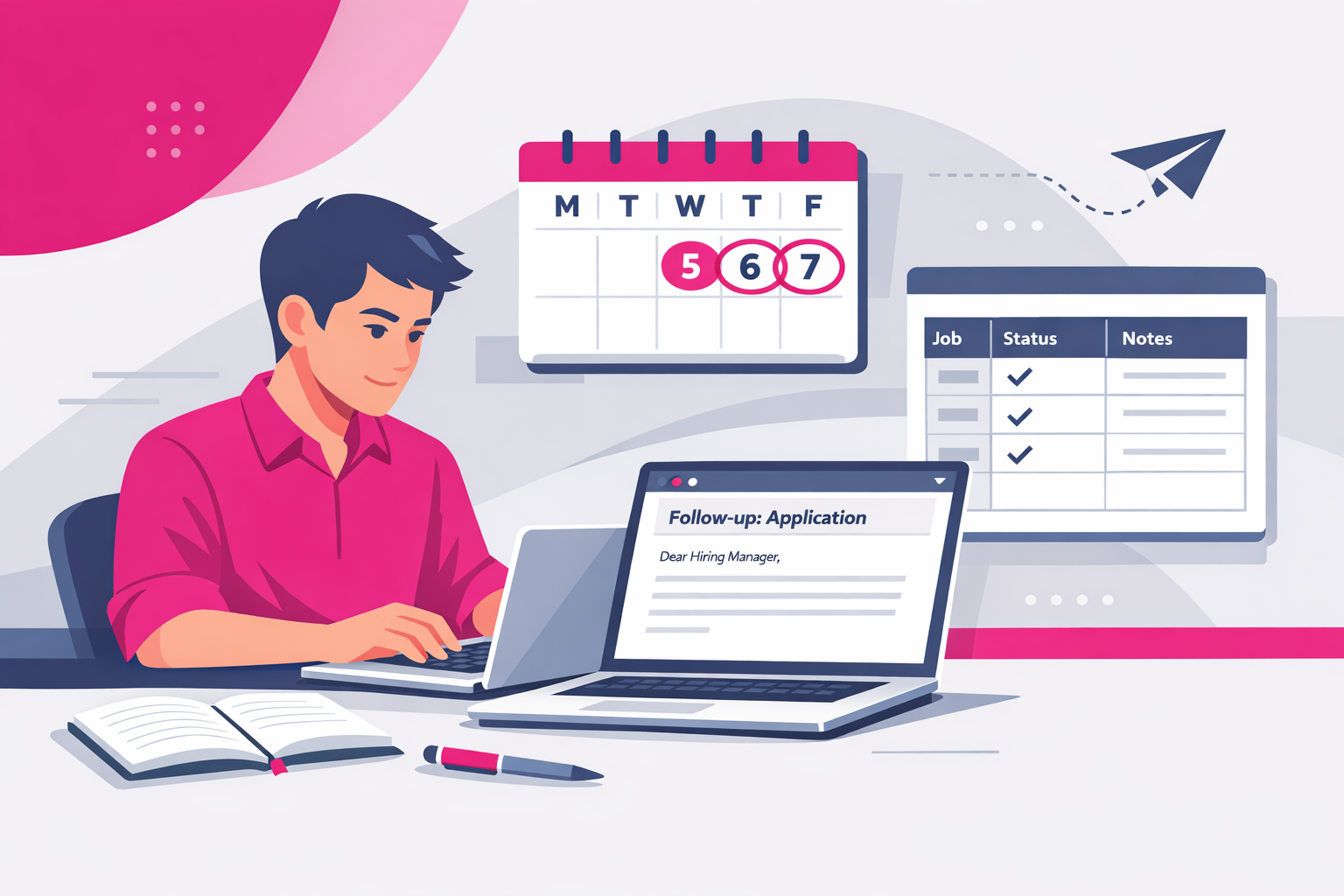
- Track it in a simple spreadsheet: company, role, date applied, follow-up dates, outcome.
The goal is momentum. Not emotional attachment to one application.
How to follow up after a rejection (this is where grown-ups win)
If you got a rejection email, you still have an opportunity.
Most people either argue or vanish. Both are wrong.
Instead, ask for one thing: actionable feedback. You might not get it, but when you do, it is gold.
Rejection follow-up template (tight and professional)
Subject: Thank you | [Job Title] application
Hi [Name],
Thanks for letting me know. If you are able to share it, what was the main reason I was not progressed, and what is the one improvement you would suggest for future applications?
Thanks again for your time,
[Your Name]
If they respond, do not debate. Thank them. Apply the insight. That is how you compound progress.
How to follow up if you forgot to attach your CV (or made a mistake)
This happens. Fix it fast. Do not spiral.
Send a correction email immediately with a clear subject line.
Mistake correction template
Subject: Correction: [Job Title] application | CV attached
Hi [Name],
Quick correction. My application for [Job Title] sent on [date/time] was missing [CV/cover letter/portfolio link]. Apologies for the oversight.
Please find it attached here: [attachment].
Kind regards,
[Your Name]
Adults correct errors quickly. Employers respect that.
The hidden reason your follow-up is not working
If you follow up and still hear nothing, one of these is usually true:
- Your application is not aligned to the role, so it is being screened out quickly.
- Your CV is not proving impact, it is listing duties.
- You are applying too broadly, so your story is inconsistent.
- The role is on hold internally.
- They already have an internal candidate.
You cannot control the last two. You can control the first three.
So here is the hard, useful question:
Does your CV make it obvious, in 10 seconds, that you can do this job?
If not, your follow-up is a reminder of uncertainty.
A brief implementation plan (so you actually do this)
Day 0: Apply
- Record the role, date, and contact details in a tracker.
- Save the job description as a PDF or screenshot.
Day 5 to 7 (business days): Follow-up #1
- Use Template 2.
- Add one measurable proof point that matches the job’s core need.
Day 12 to 17: Follow-up #2
- Use Template 3.
- Offer a one-page summary or portfolio piece if relevant.
Day 20 to 27: Close the loop
- Use Template 4.
- Then stop contacting them unless they re-engage.
The standard you should hold yourself to
Following up is not about chasing validation.
It is about operating like a professional, even before you are paid to be one.
Be clear. Be brief. Be useful. Be persistent without being annoying.
And keep moving. The best candidates do not wait. They build options.
Next Steps
Want to learn more? Check out these articles:
How to Prepare for Situational Judgement Tests and Win
How to Answer Salary Expectations on Job Applications
Build a Data Entry Portfolio With No Experience [Step-by-Step]
Check out our Advanced Employability Course for all the help you need to get your dream job, fast.