
How to Prepare for Situational Judgement Tests and Win
You can be the smartest person in the room and still get rejected by a multiple-choice test.
That is what makes situational judgement tests (SJTs) so brutal. They do not reward knowledge. They reward judgement. And judgement is hard to fake when you are under time pressure, facing messy trade-offs, with answer options designed to tempt you into sounding confident while being completely wrong.
If you have ever finished an SJT thinking, “None of these answers are what I would actually do”, you are not alone. That feeling is the point.
This article shows you how to prepare properly, not with vague “be ethical” advice, but with a clear decision framework, repeatable practice drills, and the patterns employers are scoring for.
What an SJT is really testing (and what it is not)
An SJT is a structured way for employers to test how you behave at work. They give you a scenario and ask you to choose the best (and sometimes worst) response, or to rank responses.
Here is the uncomfortable truth: most employers are not looking for your personality. They are looking for predictability.
They want someone who will:
- Protect customers, colleagues, and the organisation
- Follow policy and escalate risk appropriately
- Communicate clearly and professionally
- Take ownership without going rogue
- Stay calm and constructive under pressure
SJTs are often used early in applications because they filter fast. They are cheaper than interviews. They reduce human bias in early screening (though they can introduce other biases if poorly designed). They also correlate moderately with job performance in many settings, which is why employers keep using them.
What SJTs are not testing:
- Your technical skill
- Your life story
- Your creativity
- Your ability to “argue your case”
You do not get marks for being original. You get marks for being safe, sane, and aligned with the role.
Why smart people fail SJTs
Most SJT failures come from one of these mistakes:
1) Treating it like an IQ test
SJTs are not puzzles. If you hunt for trick answers, you will overthink and pick an option that sounds clever but violates basic workplace judgement.
2) Confusing confidence with competence
Many wrong options read like a TED talk. They sound decisive, bold, and energetic. They are also reckless, confrontational, or outside your authority.
3) Not understanding the job context
The “best” answer in a hospital is not always the “best” answer in a supermarket. If you do not understand what the employer values, you cannot reliably choose the scored response.
4) Failing to prioritise risk
SJT scoring usually rewards risk management. Candidates often pick the “nice” answer instead of the “safe” answer.
5) Forgetting you are an applicant, not the CEO
Some options assume you can change policy, discipline colleagues, or redesign processes instantly. The best answer often shows initiative while staying in role.
The scoring logic: what “good judgement” looks like on paper
SJTs are typically built from competency frameworks. You are being scored against behaviours the employer believes predict performance.
Across most entry-level and early-career roles, high-scoring responses tend to have these characteristics:
- They are proportionate. You respond at the right intensity for the situation.
- They are ethical. You do not lie, hide issues, or blame-shift.
- They are policy-aware. You follow rules, or you escalate when rules are unclear.
- They protect people. Safety and wellbeing beat convenience.
- They are respectful. No public shaming, no aggressive confrontation.
- They involve the right people. You do not “solo” things that need a manager, HR, or specialist input.
- They show ownership. You act, you do not just complain.
- They are realistic. You choose what you can actually do in that moment.
Low-scoring responses usually:
- Ignore the problem
- Escalate too late
- Escalate everything immediately without thinking
- Break confidentiality
- Try to look heroic at the expense of process
- Blame others or get personal
- Choose speed over accuracy and safety
A simple decision framework that works in most SJTs
When you see a scenario, do not jump to the answers. Run a quick mental checklist. This takes 10 to 20 seconds with practice.
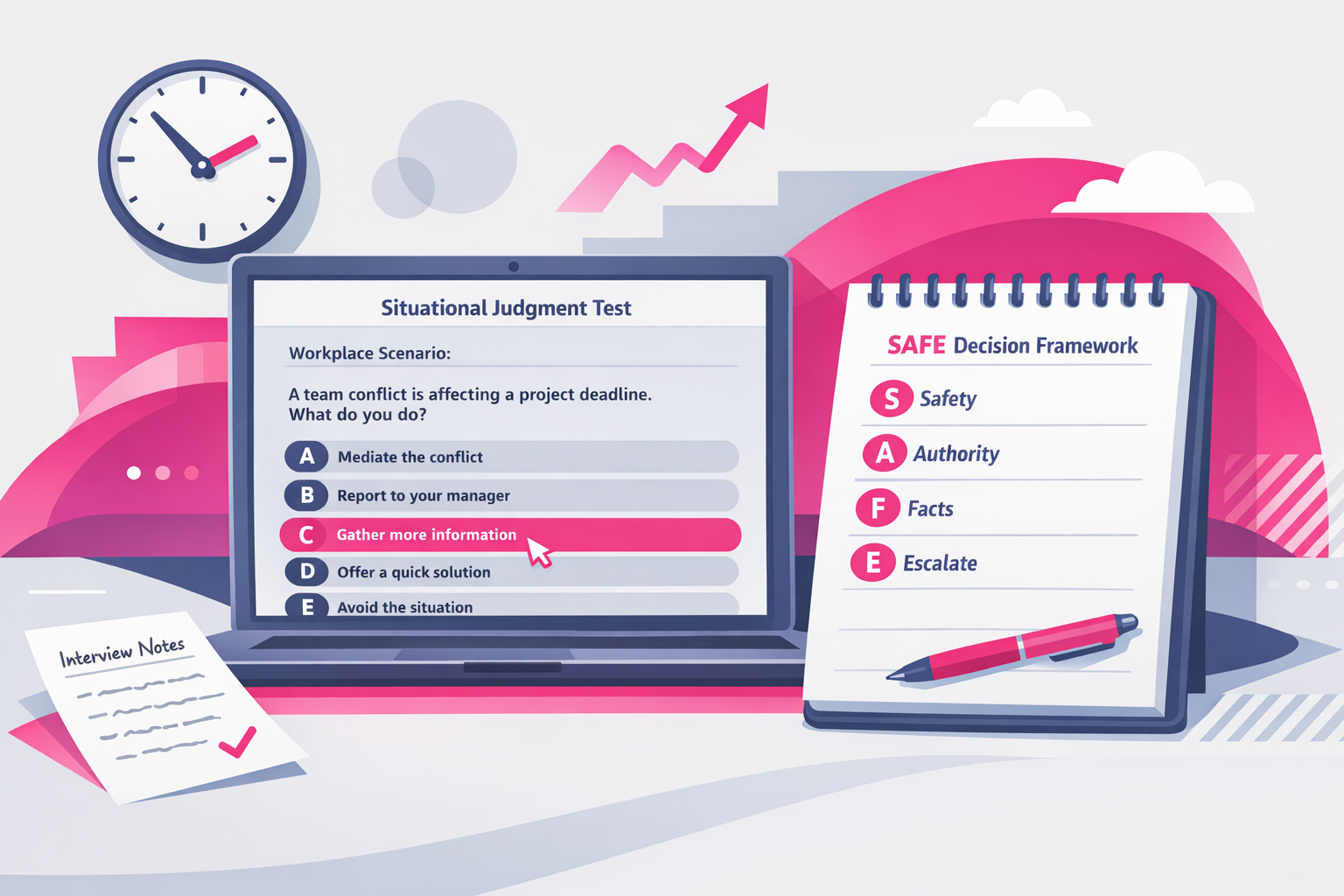
The SAFE framework
- S: Safety and harm
Is anyone at risk right now? Physical safety, safeguarding, harassment, fraud, data breaches, compliance. If yes, you act and escalate quickly. - A: Authority and role
What are you actually authorised to do? The best answer often includes you taking immediate steps within your control, then involving the right person. - F: Facts and fairness
What do you know versus what do you assume? Gather key facts. Treat people fairly. Avoid gossip. Keep records when appropriate. - E: Escalate and explain
If it is serious, persistent, or outside your authority, escalate. Communicate calmly, clearly, and privately. Propose a constructive next step.
This framework stops you doing what most candidates do: chasing the most emotionally satisfying option.
How to prepare properly in 7 steps
1) Identify the SJT format you will face
SJTs come in different formats. Preparation needs to match the format.
- Best answer (choose one)
- Best and worst answer
- Ranking (order responses from most to least effective)
- Rating (rate effectiveness of each option)
- Video SJT (scenario shown as a clip)
Before test day, check the employer’s instructions and search the invitation email for clues. If they do not say, assume ranking or best-and-worst, because those are common in graduate and high-volume hiring.
2) Extract the competencies from the job advert
This is where most candidates are lazy, then act surprised when they fail.
Print the job advert (or copy it into a document) and highlight the behaviour words. Common ones include:
- Customer focus
- Teamwork
- Integrity
- Resilience
- Communication
- Attention to detail
- Time management
- Problem solving
Then convert them into “what good looks like” statements. Example:
- Customer focus means: clarify needs, manage expectations, do not overpromise, follow through.
- Integrity means: tell the truth, report issues, follow rules, admit mistakes early.
This matters because SJT options are written to map to those competencies.
3) Learn the common scenario types and the “right” instinct
Most SJTs reuse the same scenario families. If you know them, you stop being surprised.
Scenario: Conflict with a colleague
High-scoring instinct: address privately, focus on behaviour not personality, listen, propose a fix, escalate if repeated or serious.
Usually wrong: confront publicly, retaliate, gossip, do nothing.
Scenario: You made a mistake
High-scoring instinct: own it, correct it, inform the right person if impact is significant, learn and prevent recurrence.
Usually wrong: hide it, blame someone else, “wait and see”.
Scenario: Unethical behaviour or policy breach
High-scoring instinct: take it seriously, document facts, escalate to manager/HR/compliance, protect confidentiality.
Usually wrong: investigate like a detective, share widely, “handle it yourself” if it is serious.
Scenario: Competing priorities and time pressure
High-scoring instinct: clarify deadlines and impact, prioritise based on risk and value, communicate early, ask for help if needed.
Usually wrong: promise everything, go silent, rush and create bigger problems.
Scenario: Customer complaint
High-scoring instinct: stay calm, acknowledge, gather facts, apologise for the experience (not necessarily admit liability), resolve within policy, escalate if required.
Usually wrong: argue, dismiss, blame the customer, bend rules in a way that creates risk.
4) Build your “default moves” for any scenario
In SJTs, speed matters. You need a set of reliable default actions you can apply in many contexts.
Memorise these default moves:
- Clarify: Ask questions to understand the issue before acting, when time allows.
- Contain: Stop harm getting worse (safety, data, money, reputation).
- Communicate: Inform the right person early, not after it becomes a disaster.
- Document: Keep a factual record when it involves conflict, complaints, safeguarding, or compliance.
- Follow policy: If unsure, consult guidance or escalate.
- Repair: Fix what you can, then prevent recurrence.
This is not about being robotic. It is about being dependable.
5) Practise with deliberate drills, not endless random questions
Doing 200 practice questions mindlessly is how people feel productive and stay average.
Do this instead:
- Take 12 to 20 practice scenarios (any reputable provider, or employer practice materials).
- For each one, write a one-sentence justification for why your chosen answer is best, using the SAFE framework.
- Identify the competency being tested (teamwork, integrity, customer focus, etc.).
- Review where you were wrong and classify the mistake:
- Missed a risk
- Overstepped authority
- Escalated too fast or too slow
- Chose confrontation over professionalism
- Ignored policy
- Create a personal “avoid list” of your top 3 recurring errors.
This is how you turn practice into improvement.
6) Learn the language traps in the answer options
SJT options are written with cues. Not always perfect, but often reliable.
Be cautious with options that include:
- Absolutes: “Always”, “Never”, “Immediately report without speaking to anyone”. Sometimes correct in safety-critical scenarios, often not.
- Public confrontation: “Call them out in the team meeting”. Usually poor judgement.
- Gossip framing: “Ask colleagues if they have noticed this too”. Often breaches professionalism and confidentiality.
- Hero solutions: “Fix it yourself overnight”, “Rewrite the process”. Often unrealistic and outside role.
- Passive avoidance: “Wait to see if it happens again”. Usually weak, unless it is truly minor and you have already addressed it.
Favour options that include:
- Private, respectful conversation
- Seeking guidance appropriately
- Clear prioritisation and communication
- Fact-finding before judgement
- Proportionate escalation
7) Do a test-day execution plan (so nerves do not sabotage you)
SJTs punish panic. You need a simple plan.
- Before you start: remove distractions, full-screen mode, stable internet, water ready, phone away.
- Time strategy: do not get stuck. If uncertain, choose the safest, most policy-aligned option and move on.
- Read the question twice: many errors come from missing one detail (for example, “You are a new starter” changes the authority you have).
- Watch for what they ask: “Most effective” versus “What would you do?” Choose what the role requires, not what flatters your identity.
- Use SAFE quickly: safety, authority, facts, escalate.
Worked examples: how to think, not what to memorise
Example 1: A teammate is consistently late, others are annoyed
Bad instinct: report them immediately or complain to the group.
Better judgement: speak to them privately, ask if anything is going on, explain impact on the team, agree expectations. If it continues, escalate to your manager with facts.
Why it scores: respectful, fair, proportionate, and uses escalation properly.
Example 2: You notice a minor error in a report just sent to a customer
Bad instinct: hide it and hope they do not notice.
Better judgement: assess impact. If it could mislead the customer or affect decisions, notify your manager and send a correction promptly. If it is genuinely trivial, still inform internally and fix the process.
Why it scores: integrity and risk management. No drama, no cover-up.
Example 3: A customer asks you to break a rule “just this once”
Bad instinct: bend the rule to look helpful.
Better judgement: explain the policy clearly, offer an alternative within policy, escalate if they insist or if you need authorisation for exceptions.
Why it scores: protects the organisation, stays professional, still tries to help.
What to do if you feel the answers are all bad
Welcome to the test. Sometimes every option has a drawback. Your job is to choose the least damaging option.
Use this hierarchy:
- Prevent harm (to people, customers, compliance, safety)
- Protect trust (integrity, confidentiality)
- Keep it professional (respectful, calm communication)
- Be effective (resolve, follow through, prevent repeat issues)
If two options look similar, the better one usually:
- Involves the right person
- Is more specific and actionable
- Balances action with escalation
- Does not overreact
High-level 10-day SJT preparation plan
If your test is soon, do this. It is simple. It works if you actually do it.
Days 1 to 2: Understand the target
- Analyse the job advert and employer values
- List the top 6 competencies likely being tested
- Learn the SAFE framework until it is automatic
Days 3 to 6: Deliberate practice
- Complete 5 scenarios per day under light time pressure
- Write one-sentence justifications for each answer
- Track your recurring mistake pattern
Days 7 to 8: Increase realism
- Do a timed set in one sitting
- Practise ranking and best-worst formats specifically
- Refine your “avoid list” and default moves
Days 9 to 10: Test-day execution
- Do one final timed set
- Stop heavy practice the day before
- Prepare your environment and schedule
The mindset shift that changes your score
The fastest way to improve at SJTs is to stop treating them like a morality quiz.
They are closer to a “workplace risk and judgement simulator”. The top performers do not try to be impressive. They try to be reliable.
Reliable people:
- See risk early
- Act within their role
- Communicate clearly
- Escalate appropriately
- Keep professionalism under pressure
Do that, and you will not just perform better on the test. You will be the kind of colleague employers actually want after the test is over.
Next Steps
Want to learn more? Check out these articles:
How to Answer Salary Expectations on Job Applications
Build a Data Entry Portfolio With No Experience [Step-by-Step]
Second Job Interview Prep: Prove Value, Not Potential
Check out our Advanced Employability Course for all the help you need to get your dream job, fast.