
How to Ask for Feedback After Job Rejection (Scripts)
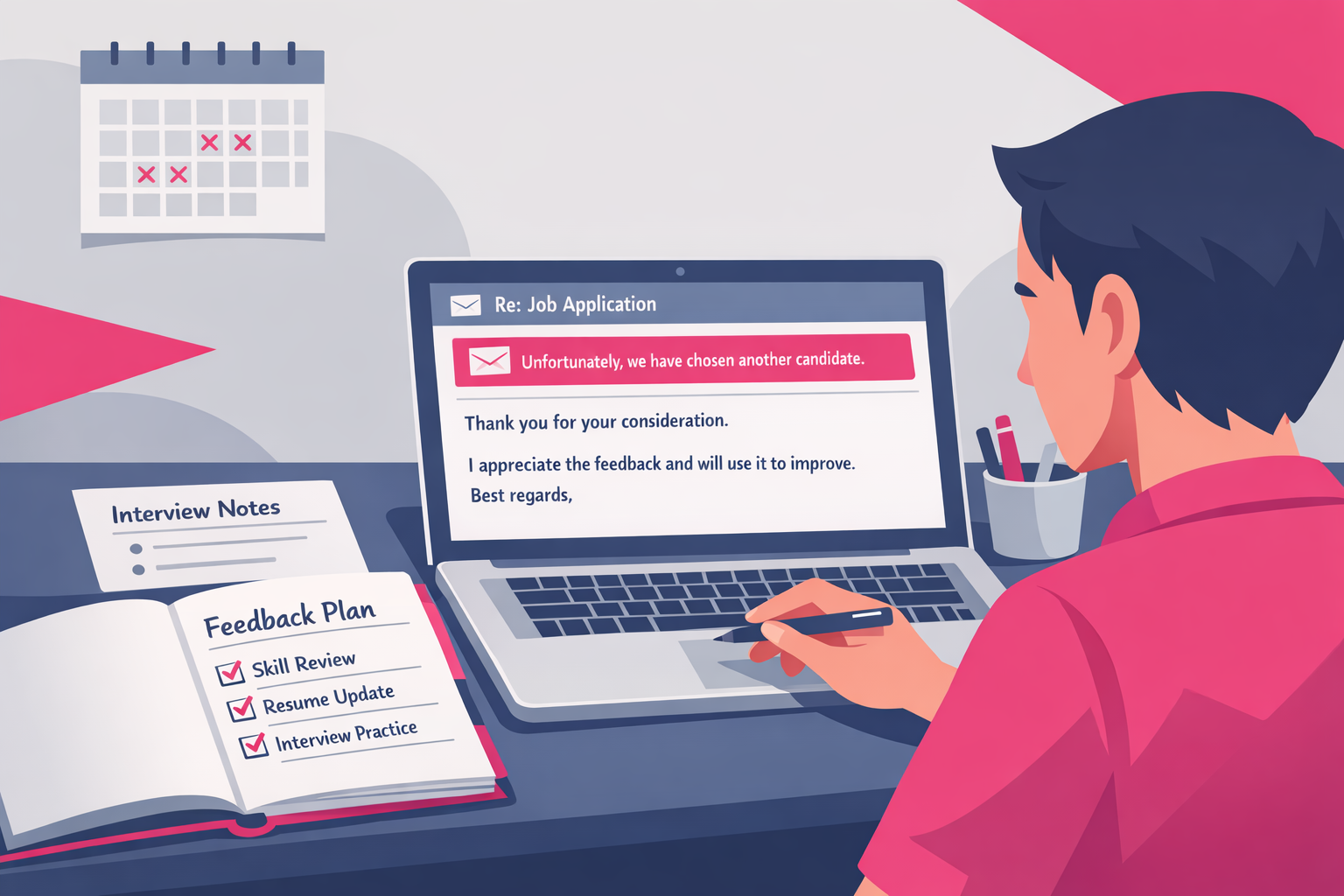
The rejection is not the worst part
The worst part is the silence.
You spend hours tailoring your CV. You rehearse answers. You show up. You do the forced smile and the “great question” dance. Then the email lands.
“Thanks for your time… we’ve decided to progress with other candidates.”
No reason. No detail. No clue what to fix.
Most people respond in one of two ways.
- They beg for feedback in a shaky, emotional message that makes the employer glad they said no.
- They say nothing, swallow it, and repeat the same mistakes in the next interview.
Both reactions are understandable. Both are useless.
If you want a job, especially your first job, you need to treat rejection as data. Not as a verdict.
This guide shows you exactly how to ask for feedback after a job rejection in a way that gets you an answer, keeps your reputation intact, and turns “no” into your next offer.
The brutal truth: most employers will not reply
You need to accept this upfront.
Many organisations:
- Do not have time
- Have policies that restrict what they can say
- Are scared of legal risk
- Are overwhelmed by candidate volume
- Simply do not care
That does not mean you should not ask.
It means you should ask in a way that is easy to answer, hard to misinterpret, and safe for them to respond to.
Your job is to reduce friction.
What good feedback actually looks like
Forget vague nonsense like “be more confident” or “we went with someone with more experience”.
Useful feedback is specific, observable, and actionable. It tells you what to change next time.
Strong feedback might include:
- Your examples did not match the competency being assessed
- You did not evidence impact, only tasks
- Your answers lacked structure
- You did not demonstrate knowledge of the role or company
- You failed a technical test threshold
- Another candidate had stronger stakeholder management examples
Your request must steer them towards this level of clarity.
When to ask for feedback (timing matters)
Ask too soon and you look desperate. Ask too late and you get forgotten.
Use this timing:
- If you were rejected after application screening: ask within 24 to 48 hours.
- If you were rejected after interview: ask within 24 hours.
- If you were rejected after final stage: ask the same day or the next morning.
If they gave you a phone call rejection, send the email within 2 hours, while you are still top-of-mind.
Who to ask (and who not to)
Ask the person who has the highest chance of knowing the truth and replying.
Best options:
- The recruiter who managed the process
- The hiring manager who interviewed you
- The HR contact who scheduled you
Do not:
- Message random employees on LinkedIn asking “why wasn’t I hired?”
- Email the CEO unless they personally interviewed you
- Add multiple people into one email thread
One person. One message. Clean.
The 5 rules that make employers actually respond
Rule 1: Keep it short
Your email is not a therapy session. It is a request for a small piece of professional help.
Aim for 80 to 140 words.
Rule 2: Make it safe for them to answer
Many recruiters fear saying the wrong thing.
So ask for “one or two areas to improve” rather than “why did you reject me”.
You are signalling that you want development, not an argument.
Rule 3: Ask specific questions
The easiest email to ignore is “Any feedback would be appreciated.”
The easiest email to reply to is:
- “Was it my interview answers, my experience fit, or my test performance?”
Give them categories.
Rule 4: Show maturity
You are being assessed even after rejection.
A composed, professional response can lead to:
- Future openings
- Referrals
- Fast-tracking
- A call-back when the first choice drops out
Yes, that happens.
Rule 5: Make the reply effortless
Offer a simple format.
Example:
- “If helpful, a reply with 2 bullets would be perfect.”
People love an easy win.
The best email template (copy and paste)
Use this after any interview.
Template 1: Standard feedback request
Subject: Feedback request following [Role Title] interview
Hi [Name],
Thank you for letting me know the outcome for the [Role Title] role. While I’m disappointed, I appreciate the opportunity to interview.
If you’re able to share it, I’d be grateful for 1 to 2 specific areas I could improve for similar roles. For example, was the gap mainly in my experience fit, the way I evidenced impact in my answers, or something else?
Even a couple of bullet points would really help.
Kind regards,
[ Your Name]
Why this works:
- No emotion dumping
- Clear request
- Gives them safe categories
- Sets a low effort response bar
Better templates for specific scenarios
Template 2: Rejected after application (no interview)
Subject: Quick feedback on my [Role Title] application
Hi [Name],
Thanks for the update on my application for [Role Title]. If you can share it, I’d appreciate one reason my application did not progress to interview.
Was it mainly:
- Lack of a specific requirement (for example X)
- Not enough evidence of relevant experience
- Something in the CV/cover letter that could be improved
A single line reply is enough. Thank you.
Kind regards,
[Your Name]
Key point: you are not asking for a full review. You are asking for one decisive reason.
Template 3: Rejected after final stage (you want the real reason)
Subject: Feedback request after final stage for [Role Title]
Hi [Name],
Thank you for the update on the [Role Title] process. I appreciated meeting the team and learning more about the role.
If you’re able to share it, what were the 2 to 3 factors that most influenced the final decision? I’m particularly keen to understand whether it came down to role-specific experience, interview examples, or something from the task/presentation.
I’d value any detail you can give.
Kind regards,
[Your Name]
This positions you as serious. It also nudges them to reveal the ranking criteria.
Template 4: You were rejected but want to stay on their radar
Subject: Thank you and feedback request, [Role Title]
Hi [Name],
Thanks for the update on the [Role Title] role. I appreciated the time you and the panel gave me.
If you can spare a moment, I’d be grateful for 1 to 2 areas I should strengthen before applying again. I’d also be happy to be considered for future roles that fit my profile.
Kind regards,
[Your Name]
Do not overdo this. You are not pleading. You are signalling future interest.
The best questions to ask (choose 2, not 10)
You want questions that produce usable data.
Pick two from this list.
Experience and fit
- Which requirement did I not evidence strongly enough?
- Was the decision mainly based on domain experience, or interview performance?
Interview quality
- In my answers, what would you have wanted to hear more of?
- Did my examples demonstrate impact clearly enough, or were they too task-focused?
Competencies
- Were there any competencies where I did not meet the expected level?
- Which competency was the differentiator between me and the successful candidate?
Tasks and assessments
- Was there a particular part of the task where I fell short of your expectations?
- What would have made my submission stronger?
Presentation and communication
- Was anything unclear or unconvincing in how I explained my thinking?
Do not ask:
- “Can you tell me exactly who got the job?”
- “What did they have that I didn’t?”
- “Was it because of my age/gender/background?”
Even if you suspect bias, that is a separate process. This email is for feedback you can act on.
What to do if they do not respond
No response does not mean you did something wrong.
It means they are busy, cautious, or indifferent.
Follow-up once, then stop
Wait 5 working days.
Send one follow-up.
Subject: Re: Feedback request following [Role Title]
Hi [Name],
Just following up in case this got buried. If you’re able to share one or two improvement points, I’d really appreciate it.
Kind regards,
[Your Name]
If there is still no reply, drop it.
Chasing beyond that makes you look like you cannot take a no.
Alternative routes to get feedback
If the employer stays silent, you still need data.
Use:
- A trusted professional to review your CV and interview answers
- Mock interviews with someone who will be brutally honest
- Recording yourself answering common questions, then reviewing for structure and clarity
- Comparing your examples against the job description line by line
You cannot control their reply. You can control your improvement.
How to handle feedback without self-sabotage
Feedback can sting because it often points to something you hoped was not true.
Here is how to turn it into progress.
1) Do not argue
Even if you think they are wrong, arguing achieves nothing.
They are not your coach. They are not your friend. They owe you nothing.
2) Say thank you, then extract detail
If they reply with something vague, you can ask one follow-up question.
Example:
“Thank you, that’s helpful. When you say my examples needed more impact, would you recommend I include more metrics, more stakeholder detail, or both?”
One question. Not a cross-examination.
3) Turn feedback into a fix list
Convert their message into:
- A skill to build
- A story to rewrite
- A proof point to gather
- A gap to close
Example conversion:
- Feedback: “We needed stronger evidence of customer focus.”
- Fix list:
- Rewrite two interview stories using a customer problem, action, measurable result
- Add a customer-facing project to your CV
- Prepare a 60-second customer-focused pitch
The simple structure that upgrades most interview answers
A lot of rejections come down to one issue: your answers did not land.
Use a structure that forces clarity.
Use STAR, but tighten it
Most people waste time on the “S” and “T” and rush the “R”.
Use this version:
- Situation: 1 sentence
- Task: 1 sentence
- Action: 3 to 5 specific actions
- Result: 1 to 2 measurable outcomes
- Reflection: 1 sentence on what you learned
That last line matters. It signals coachability. Employers hire people who improve.
A high-level implementation plan (do this after every rejection)
If you want rejection to stop being random, build a simple system.
Step 1: Log the rejection
Create a spreadsheet with:
- Company
- Role
- Stage reached
- Feedback received (paste exact words)
- Likely reason (your best guess if none)
Step 2: Tag patterns
After 5 to 10 applications, patterns emerge.
Common patterns:
- Same competency gap mentioned repeatedly
- Same CV weakness (unclear achievements)
- Same interview weakness (rambling, no structure)
Step 3: Fix one thing at a time
Do not try to improve everything.
Pick the highest impact item and ship the upgrade within 7 days.
Examples:
- Rewrite CV bullets to include outcomes
- Build 6 strong STAR stories
- Practise a crisp “Tell me about yourself” answer
- Research the company properly and prepare 3 intelligent questions
Step 4: Re-test in the market
Your next 3 interviews are the test. If you still get the same feedback, your fix did not work. Iterate.
The hidden advantage of asking for feedback
When you ask properly, you do two things at once.
- You get information to improve.
- You demonstrate maturity, professionalism, and coachability.
That second one is not fluffy.
Hiring decisions are risk decisions. A candidate who handles rejection well looks lower risk.
The line you must not cross
Never send an emotional message.
Never guilt-trip.
Never imply they owe you.
Never demand a call.
And never, ever write something you would not be comfortable seeing forwarded internally.
This is business.
You can be disappointed and still be disciplined.
Use rejection like a professional
If you treat rejection as shame, you will avoid it, and you will stay stuck.
If you treat rejection as feedback, you turn every “no” into sharper positioning, stronger stories, and clearer evidence.
Ask well. Follow up once. Extract patterns. Fix what matters.
Then apply again.
Most people never do this. That is why most people keep losing.
Next Steps
Want to learn more? Check out these articles:
Write a Personal Statement That Gets Interviews, Not Ignored
How to Use AI Tools in Your Job Search Without Losing Yourself
How to Prepare for Psychometric Tests and Beat the Cut
Check out our Advanced Employability Course for all the help you need to get your dream job, fast.