
Explain Caring Responsibilities on Your CV and Interviews
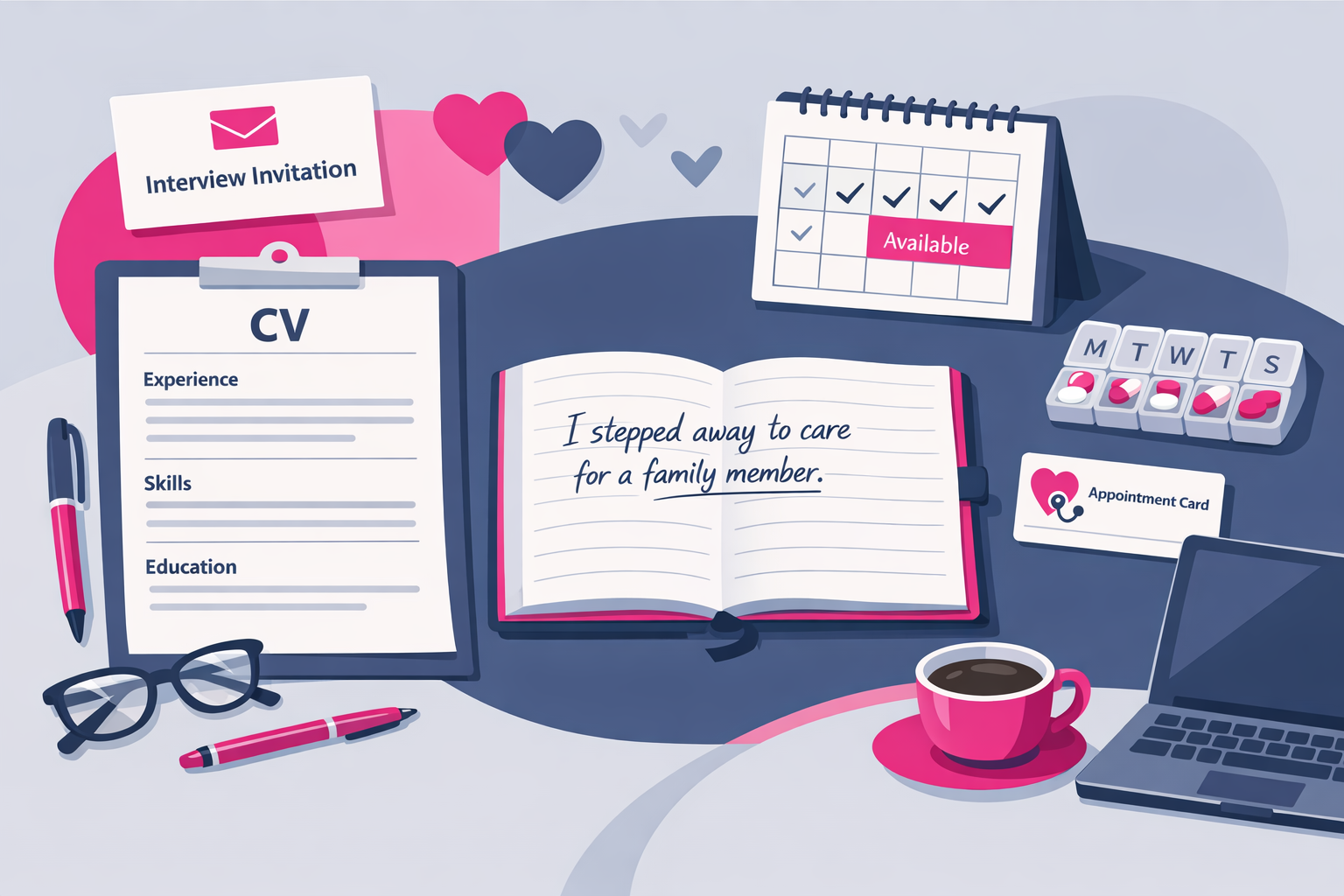
You are not “unemployed”. You are not “doing nothing”. And you do not owe anyone a confessional speech about your personal life.
But here is the harsh truth. If you leave a caring gap unexplained, many employers will fill in the blanks themselves. Not always fairly. Not always legally. Just instinctively.
Your job is not to apologise for caring responsibilities. Your job is to control the narrative. Make it simple, credible, and employer-relevant.
This article shows you how to explain caring responsibilities on your CV and in job interviews without oversharing, without sounding defensive, and without creating doubts you do not need to create. You will leave with clear templates, strong wording, and a practical approach that works whether you cared for children, elderly relatives, a disabled family member, or someone with long-term illness.
Category: Demonstration
The real problem: employers hate uncertainty
Most hiring decisions are risk decisions.
When a recruiter scans your CV, they are not looking for your life story. They are trying to answer three questions fast.
- Can you do the job?
- Will you show up and deliver consistently?
- Will hiring you create problems I will have to explain to my manager?
A gap with no explanation creates uncertainty. Uncertainty slows you down or filters you out.
Explaining caring responsibilities is not about asking for sympathy. It is about removing doubt.
In the UK, caring is common. According to Carers UK, millions of people provide unpaid care, and many combine it with work at some point. Employers know carers exist. What they want to know is whether you are work-ready now, and what boundaries and reliability look like in practice.
Brutal honesty: what not to do
If you want to tank your chances, do one of these.
1) Do not pretend the gap did not happen
Some people try to hide it by stretching dates or removing months. That is a bad idea.
- It can look like deception if the truth comes out later.
- It creates awkward follow-up questions you cannot answer cleanly.
- It makes you look disorganised when you could look responsible.
2) Do not write a novel on your CV
Your CV is not the place for sensitive medical details, family breakdown, court issues, or emotional context. Oversharing creates discomfort and invites bias.
3) Do not label it as “unemployment”
“Unemployed” is a status. Caring is a responsibility. Words matter.
4) Do not imply you are still unavailable
Employers will assume the care load continues unless you clarify your current availability. You must make “work-ready now” explicit.
What employers actually need to hear
A strong explanation of caring responsibilities does three things.
- States the reason briefly, without drama.
- Signals stability by showing the situation is managed now.
- Proves readiness with recent activity, skills, or structure.
That is it. Anything beyond that is usually noise.
How to explain caring responsibilities on your CV
Your CV needs to do two jobs at once: stay truthful and stay focused on the role.
You have three good options, depending on your situation and the type of role.
Option A: Add a short “Career break” entry in your work history
This is the cleanest approach when the break is visible and you want to control the wording.
Template (simple and strong):
- Career break | Family caring responsibilities (Month Year to Month Year)
- Full-time caring responsibilities. Now returning to work with stable arrangements in place.
- Maintained skills through: online learning, volunteering, freelance work, keeping current in the sector.
Example (admin role):
- Career break | Caring responsibilities (Apr 2023 to May 2025)
- Provided family care on a full-time basis. Care arrangements now stable and I am available for full-time work.
- Kept skills current through Microsoft Office refresher training and weekly volunteering handling scheduling and email enquiries.
Example (warehouse or retail role):
- Career break | Caring responsibilities (Jan 2024 to Jun 2025)
- Provided family care. Situation now managed and I am available for shifts including weekends.
- Stayed work-ready through consistent volunteering and maintaining physical fitness for manual work.
Option B: Use a short “Additional experience” section
If you do not want the caring break to sit inside your work history, you can include it lower down. This works well when you have plenty of prior employment and the gap is short.
Template:
- Additional experience
- Family caring responsibilities (Month Year to Month Year). Returning to work with reliable cover in place.
Option C: Address it in a brief profile line, then move on
This works well if you are early-career and your CV is short.
Template profile line:
- Recently completed a period of family caring responsibilities and now seeking to return to work in [field], available [full-time/part-time/shifts].
How to write it so it strengthens your CV, not weakens it
Most people make one mistake. They stop at “I was caring”. That explains the gap, but it does not build confidence.
To make it stronger, add one or two proof points of readiness. Choose from the list below based on what is true.
Pick 1 to 3 “readiness signals”
- Training: Completed [course] in [tool/skill] in [month/year].
- Volunteering: Supported [organisation] with [tasks] weekly.
- Freelance: Took on ad hoc work in [type], delivering [outcome].
- Keeping current: Followed industry updates, rebuilt portfolio, practised tools.
- Structure: Managed scheduling, budgeting, medication routines, liaison with professionals.
Do not exaggerate. Do not claim caring is “project management” unless you can map it to real tasks. But do not undersell it either. Caring requires planning, reliability, and resilience under pressure.
Should you list caring as a job title?
Sometimes people write “Full-time Carer” as if it is an employer role.
It can work, but use caution.
- If you label it as a job, some employers will treat it as a career change and ask for references or outcomes that do not exist.
- If you keep it as “Career break”, it stays in the right box: explanation, not distraction.
Recommendation: Use “Career break | Caring responsibilities” for most CVs. Use “Carer” only if it is directly relevant to the role you are applying for and you are comfortable with follow-up questions.
How to explain caring responsibilities in job interviews
In an interview, your goal is not to justify the past. It is to make the future feel safe.
You need a short, calm answer that covers:
- What happened
- What changed
- Why you are ready now
Then stop talking.
The 20-second script (use this as your baseline)
Script: “I took time out for family caring responsibilities. That situation is now stable and I have reliable cover in place. I am ready to return to work and I am looking for a role where I can contribute long-term, starting with strong delivery in the first few months.”
The 45-second script (add proof)
Script: “I took a career break for family caring responsibilities. The care arrangements are now stable, so I am fully available for [full-time/part-time/shifts]. During that time I kept my skills current by [training/volunteering/freelance]. I am now focused on returning to [type of role] and I am confident I can hit the ground running.”
If they push for details
You can be polite and firm.
Boundary script: “I prefer to keep the personal details private, but I can reassure you the situation is stable and it will not affect my availability for the hours we have discussed.”
If they keep probing, treat that as data about their culture.
How to handle the scary questions
These are the questions that make candidates ramble, apologise, or panic. Here is how to answer them cleanly.
“Why did you leave your last job?”
Answer: “I stepped away due to family caring responsibilities. It was the right decision at the time. I am now returning because the situation is stable and I am ready for work.”
“How do we know you will not need to leave again?”
They are asking about reliability. Answer that directly.
Answer: “I understand the concern. I have stable cover in place and I have planned around the hours of this role. If anything changes unexpectedly, I would communicate early, but I am applying because I can commit.”
“Can you do overtime or last-minute shifts?”
Do not guess. Be specific.
Answer: “I can do occasional overtime with notice. Same-day last-minute shifts are unlikely. If overtime is a core requirement, I would rather be upfront now.”
“Tell me about this gap on your CV”
Answer: “That was a planned career break for caring responsibilities. I am ready to return now and I have kept work habits in place through [one proof point].”
What to say if you are still caring now
This is where honesty matters most. If you are still caring, you can still get hired. You just need to match roles to reality.
Be explicit about availability
Script: “I have ongoing caring responsibilities, and I manage them with reliable support. I am available for [days/hours] consistently, and I am looking for a role that fits that pattern.”
Do not promise what you cannot deliver
If a role requires unpredictable travel, late nights, or emergency cover, it is not “being negative” to say no. It is being adult. The fastest way to lose a job is to accept a job built on a lie.
What to put in your cover letter (optional, but powerful)
If your CV gap is likely to raise questions, a cover letter can defuse it before the interview.
Keep it to one or two lines. Then move straight to what you offer.
Cover letter line: “After a period of family caring responsibilities, I am now returning to work with stable arrangements in place and am available for [hours].”
Then follow with evidence: results, skills, motivation for the role.
Turning caring into credible strengths (without sounding cheesy)
Yes, caring builds skills. No, you should not claim it makes you “a people person” and hope that lands.
Translate caring into workplace language only when it is relevant, and only when you can back it up with examples.
Workplace-relevant strengths you can credibly evidence
- Reliability: routines, consistency, zero room for “I forgot”.
- Planning: appointments, logistics, contingency cover.
- Communication: liaising with professionals, managing sensitive information.
- Problem solving: adapting under pressure, making decisions with incomplete info.
- Resilience: delivering despite stress, staying calm when it matters.
How to prove it with one tight example
Use a mini STAR structure (Situation, Task, Action, Result) in 30 seconds.
Example: “During my caring period I coordinated multiple weekly appointments and medication schedules. I built a simple tracking system, confirmed transport the day before, and created a backup plan for each appointment. The result was zero missed appointments for six months, and it freed up time for other family members to work.”
Legal and fairness basics (UK)
You do not need to be a lawyer, but you should know the basics.
- Employers should focus on your ability to do the role, not your personal circumstances.
- Questions that dig into protected characteristics or personal family details are risky and often inappropriate.
- Reasonable adjustments relate mainly to disability, but carers may also seek flexible working. In the UK, there is a statutory right to request flexible working.
Practical takeaway: keep your explanation work-focused. If an employer behaves badly, that is a warning sign, not a challenge to “win them over”.
Common scenarios and the best wording
If the gap is short (under 6 months)
- CV: “Career break | Caring responsibilities (Mar 2025 to Aug 2025). Now available full-time.”
- Interview: “Short period of caring responsibilities, now resolved and I am ready.”
If the gap is long (1 to 5 years)
- CV: include readiness signals. Training. Volunteering. Anything recent and verifiable.
- Interview: emphasise stability and re-entry plan. “I am re-entering with a clear routine and I have updated my skills in [x].”
If you are a first-time jobseeker with caring responsibilities
- CV: put skills, training, and volunteering first. Add a short line explaining availability.
- Interview: “I have been supporting family care, but I am ready to start work now and I can commit to [hours].”
If caring affected your education or grades
- Do not lead with it.
- Use it when asked, briefly. Then pivot to what you did despite it: projects, courses, practical skills.
High-level implementation plan (keep it simple)
Step 1: Decide your disclosure level
- Minimum: “Career break for caring responsibilities.”
- Medium: add “now stable and available for X hours.”
- Maximum: include proof points and a short example.
Step 2: Update CV with one clean entry
- Add a “Career break” line with dates.
- Add 1 to 3 readiness signals.
Step 3: Prepare two interview scripts
- 20-second version for first interviews.
- 45-second version with proof for deeper rounds.
Step 4: Rehearse boundaries
- Practise the “I prefer to keep personal details private” line.
- Practise a calm redirect to your skills and availability.
Step 5: Align job targets to real availability
- Apply where your hours match the role requirements.
- Stop trying to “make it work” with roles that depend on unpredictability.
The bottom line
Caring responsibilities do not make you less employable. But leaving them vague can make you look risky.
Be brief. Be truthful. Be specific about availability. Prove you are ready now.
That is how you turn a potential red flag into a signal of maturity, reliability, and control.
Next Steps
Want to learn more? Check out these articles:
Explain No Management Experience in Interviews Without Apologising
Answer ‘Working Under Pressure’ Interview Questions Like a Pro
How to Explain a Disciplinary Warning in Interviews
Check out our Advanced Employability Course for all the help you need to get your dream job, fast.