
CV MOT January: A Ruthless Checklist To Get Interviews Fast
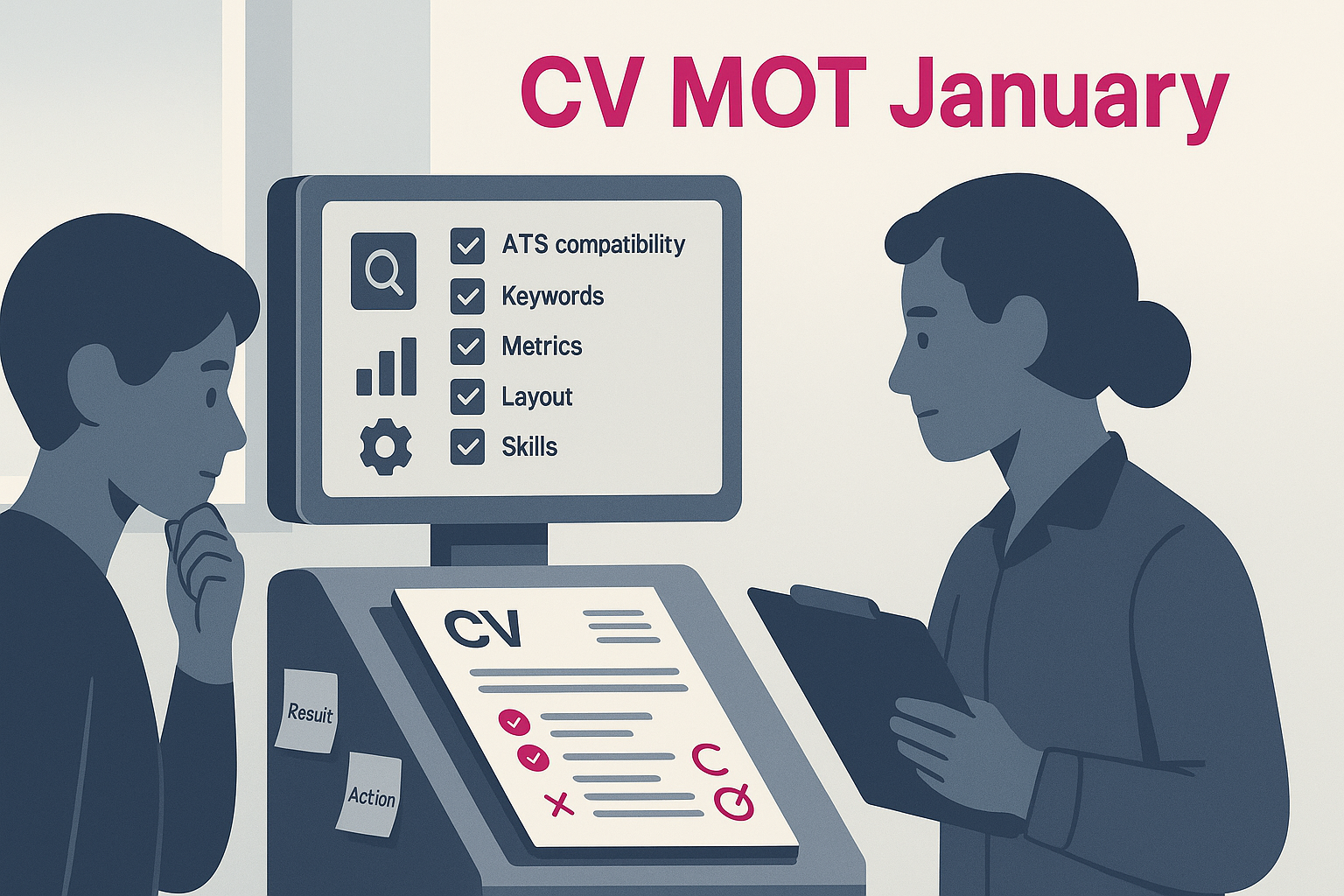
January CV MOT: tune your CV to win interviews
If your CV were a car, would it pass an MOT this January? Or would a recruiter take one look, hear the rattle, and fail it on the spot? If you are not getting interviews, your CV is not roadworthy. No excuses.
The good news: you can fix it fast. This is your January CV MOT. Precision tune-up. No fluff. Evidence over adjectives. Recruiter-first layout. ATS-compliant. Outcome-focused. Do this right and you will start getting calls.
The brutal truth: why your CV fails
Most CVs die in under 10 seconds. Eye-tracking studies consistently show recruiters skim, not read. They are scanning for risk and fit. If your value is buried, you are out.
The common failure points:
- Generic profile paragraphs that say nothing
- Duties listed, outcomes missing
- Dense formatting that hides the good bits
- No keywords from the job spec
- Typos and odd layouts that break ATS parsing
- No proof you can deliver value
Your fix is simple, not easy: strip noise, show proof, match the spec, and make the first half-page do 80% of the work.
The CV MOT framework
Safety checks: non-negotiables that stop instant rejection
- Contact: Name, city, mobile, professional email, LinkedIn URL. No photo, DOB, marital status or full address in the UK.
- File: Name it Firstname-Lastname-Role-CV.docx. Follow instructions. If the employer asks for PDF, send PDF. If unspecified, .docx is safest for ATS parsing.
- Spelling: UK English. Run a spellcheck plus a human proofread.
- Length: 1 page for graduates is fine, up to 2 pages if you have solid experience.
- Links: Make your LinkedIn URL clean. Add portfolio or GitHub if relevant.
- Readability: Minimum 11pt font. Strong hierarchy. No tiny margins.
Roadworthiness: can someone skim it and get your value in seconds?
- Headline under your name stating your target role and value: Marketing Graduate specialising in data-driven campaigns.
- Top-of-page evidence strip: three bullets with quantified wins aligned to the role.
- Skills cluster: 6 to 10 hard skills from the spec. Keep it honest and specific.
- Clean structure: standard headings. No text boxes or tables that confuse ATS parsers.
Performance: does it prove outcomes, not activities?
- Replace duties with achievements using numbers. Action + Result + Metric + Context.
- Prioritise impact in the first 3 bullets of each role or project.
- Add projects, placements, freelance or volunteer work if they show the required skills and outcomes.
- Show progression, initiative, problem-solving and customer impact.
Emissions: remove fluff that pollutes clarity
- Kill buzzwords that are not evidenced: motivated, hardworking, team player.
- Remove irrelevant modules, hobbies or coursework unless they prove role-relevant skills.
- Cut walls of text. Aim for short bullets, 1 to 2 lines each.
- Delete acronyms the target employer will not know.
Compliance: align with ATS and UK hiring norms
- Mirror language from the job description. Use the employer’s keywords naturally.
- Use standard headers: Summary, Skills, Experience, Projects, Education, Certifications.
- Use chronological dates in MMM YYYY format and left-align for ATS.
- Do not hide critical content in headers, footers or images.
Fuel economy: every line must earn its place
- If a bullet does not prove skill or impact relevant to the target role, cut or move it down.
- Lead with your strongest, most role-relevant evidence.
Build a recruiter-first CV layout
Use this structure. It is simple. It works.
Header
- Name, target role headline
- City, mobile, email, LinkedIn URL
- Optional: portfolio or GitHub if relevant
Summary (3 lines max)
Who you are, where you add value, and your proof. Example: Business and Economics graduate focused on turning messy data into clear answers. Built a forecasting model that improved inventory accuracy by 18% on a student consulting project. Now targeting analyst roles.
Evidence strip (3 bullets, quantified)
- Increased X by Y through Z
- Reduced A by B by doing C
- Delivered D ahead of time with E
Skills (6 to 10 hard skills from the spec)
- Data analysis, Excel, Power BI, SQL, Python (basic), A/B testing, Customer research, Stakeholder communication
Experience or Projects
- Job or project title | Organisation | City | Dates
- 3 to 5 bullets max
- Bullet formula: Action + Result + Metric + Context
Examples
- Designed and shipped a customer feedback survey for a student café, collected 312 responses and lifted repeat visits by 9% in 6 weeks.
- Built a Power BI dashboard for a charity’s donation data, cutting monthly reporting time from 6 hours to 45 minutes.
- Led rota redesign for a part-time retail role, improving weekend coverage by 25% and reducing customer complaints by 30%.
Education
- Degree | University | Dates
- 1 to 2 relevant modules or a dissertation title if directly aligned
- Awards, scholarships, notable grades if strong
Certifications and extras
- Google Analytics, Excel Associate, First Aid, full UK driving licence if relevant
Evidence over adjectives: replace fluff with proof
The sentence that gets you hired is the one that shows you delivered a result. Use these templates:
- Increased X by Y% by doing Z, which led to A.
- Reduced cost or time from A to B by implementing C.
- Delivered D two weeks early by coordinating E.
- Solved F by building G, which improved H by I%.
- Supported J by creating K, enabling L.
Examples by function
Marketing
- Launched a TikTok content series that grew followers from 0 to 3,400 in 8 weeks and drove 17% more sign-ups for an event.
Operations
- Mapped a broken returns process, cut refund time from 9 days to 3, increasing Trustpilot score from 3.2 to 4.1.
Sales
- Hit 132% of monthly target by building a simple objection-handling script and logging every call in HubSpot.
Data
- Cleaned 40k rows of sales data, automated weekly KPIs and reduced reporting errors to zero over 10 weeks.
Customer service
- Defused 15+ escalations by using a 2-minute triage script, raising CSAT from 78% to 92% in one quarter.
ATS diagnostics that actually matter
Ignore myths. Focus on what helps parsing and matching.
- Use .docx unless told otherwise. PDFs can be fine but some ATS parse them badly.
- Avoid tables, text boxes, headers and footers for critical content. Simple sections.
- Use standard job titles even if yours was unusual. Add the official title in brackets if needed.
- Mirror the employer’s language. If they say customer, not client, use customer.
- Put the most recent and relevant experience first.
- Use consistent date formats and hyphens: Jun 2023 - Aug 2024.
- Do not stuff keywords. Use them where they belong: summary, skills, bullets.
- Save a tailored version per application rather than one generic master.
January refresh prompts to extract your wins
If your mind goes blank when asked for achievements, use these prompts. For each role, project or course:
- Where did I save time, money or frustration for someone?
- What did I improve by a measurable amount? How do I know?
- What did I ship that others use now?
- Where did I step in without being asked and make something better?
- Which numbers moved because of me? How can I prove it?
- What feedback did I receive that I can quote or turn into a result?
- What bottleneck did I remove or process I simplified?
One-week CV MOT sprint
Do 45 to 60 minutes a day. No excuses.
Day 1 - Strip to chassis
- Gather job descriptions for 3 target roles.
- Highlight repeated skills and outcomes across them.
- Define your headline and 3 evidence bullets.
Day 2 - Structure and safety
- Build the clean layout: header, summary, evidence strip, skills, experience, education.
- Fix file name, contact details, links, and UK norms.
Day 3 - Performance rewrite
- Convert duties to results using the bullet templates.
- Prioritise the top 3 bullets per experience.
Day 4 - ATS alignment
- Map keywords from your target specs into your summary, skills and bullets.
- Standardise job titles and dates.
Day 5 - Projects and proof
- Add 1 to 3 projects that demonstrate the exact skills the role needs.
- Add tangible proof: links, portfolios, GitHub, slide decks.
Day 6 - Emissions and clarity
- Cut 20% of content that does not directly serve your target role.
- Tighten wording. Shorten long bullets. Check spelling.
Day 7 - Road test
- Ask 2 people to skim for 30 seconds and tell you what role you fit and why. If they cannot, fix the summary and evidence strip.
- Submit one tailored application and log the result.
Common scenarios and fixes
New graduate with little experience
- Put Projects above Experience.
- Use course projects, competitions, hackathons, societies and volunteer work to show outcomes with numbers.
- Add a Technical Skills or Tools section if relevant.
- Show initiative: self-led learning, micro-internships, certifications.
Career switcher
- Write a summary that makes the pivot explicit: Retail supervisor pivoting to operations coordination.
- Translate tasks into employer value: scheduling, stock control, customer escalations, team training.
- Build a projects section that proves the new capability.
International student or newcomer to the UK
- Follow UK norms: no photo, no personal details.
- Translate qualifications if the naming is different.
- Add any right-to-work note if relevant.
- Use a UK city and LinkedIn with a custom URL.
Creative roles
- Keep the CV tight. The portfolio does the heavy lifting. Link it clearly at the top.
- Bullet measurable outcomes even for creative work: engagement, conversion, turnaround time.
Tech and data roles
- Show the stack and scale: languages, tools, data sizes, version control.
- Link GitHub or notebooks. Add tests, readme, and a live demo if possible.
Administrative and operations roles
- Demonstrate throughput, accuracy and reliability.
- Use numbers that matter: cases per day, error rate, processing time, on-time completion.
Retail and hospitality
- Evidence customer impact, sales uplift, shrink reduction, team leadership and rota optimisation.
- Mention cash handling accuracy and complaint resolution.
Quick layout and wording rules
- Font: simple and readable. Calibri, Arial, or Helvetica.
- Size: 11 to 12pt body, 13 to 16pt headings.
- Colour: black text on white background. No graphics that add no value.
- Bullets: one idea per line, max two lines.
- Tense: past for completed work, present for current.
- Person: no pronouns. Start with the verb.
- Numbers: use them. If you cannot measure it, estimate conservatively and be ready to explain.
Final pre-submit checklist
- Does the top third prove you fit the target role?
- Is your headline specific, not vague?
- Do you have three quantified wins on page one?
- Are your skills aligned to the job spec?
- Do bullets start with strong verbs and end with metrics?
- Have you removed generic adjectives?
- Is everything ATS-readable with standard sections?
- Are there zero spelling mistakes in UK English?
- Is the file name professional and the link to LinkedIn clean?
- Did someone else skim it and understand your value?
What to measure next 30 days
You cannot improve what you do not measure. Track these.
- Applications submitted vs interviews secured. Target at least 20% interview rate for well-matched roles.
- Response time from application to first contact. Faster is usually better fit.
- Which evidence bullets get mentioned by recruiters. Keep and improve those.
- A or B versions of your summary and evidence strip. Keep the winner.
Frequently asked, quick answers
Q: One page or two? A: Graduates and early careers can fit on one page. If you have solid results, two pages is fine. Never pad.
Q: PDF or Word? A: If instructions are silent, .docx is safest for ATS parsing. If you email directly or want exact layout preservation, PDF is fine. Follow the employer’s instructions.
Q: Should I include a photo? A: Not in the UK. It adds bias risk and no value.
Q: Do hobbies matter? A: Only if they prove relevant skills or discipline. Marathon, open-source contributions, language study. Otherwise, cut.
Q: How many versions of my CV? A: Keep a master CV. Create a tailored version for each application. Save them with clear file names.
Q: How do I show AI skills without sounding fluffy? A: Evidence. Built a data-cleaning script in Python. Automated inbox triage with rules and prompts, saving 2 hours per week. Used ChatGPT to draft customer replies, then refined tone to meet policy.
Q: What if I have a gap? A: Own it. Show what you did: caregiving, courses, projects, freelance. Add outcomes.
Q: How do I stand out without experience? A: Ship something. Build a small project that solves a real problem. Show it with numbers and a link.
A tough-love close
January is the best time to reset. Your CV is not a memoir. It is a sales document. Every line must answer a simple question: can you help this employer win? Make it obvious. Strip the fluff, show the proof, and put it where a busy human can see it in five seconds.
Do your CV MOT this week. Then take it on the road. The only result that matters is the interview invite.
Next Steps
Want to learn more? Check out these articles:
Work-Ready Signals Employers Trust [Tactics That Prove It]
Evidence-Led Interview Answers That Secure Offers [Tactics]
Proof Over Buzzwords: 8 Practical Ways Graduates Prove Value
Check out our Advanced Employability Course for all the help you need to get your dream job, fast.