
Build an Evidence Bank That Makes Employers Say Yes
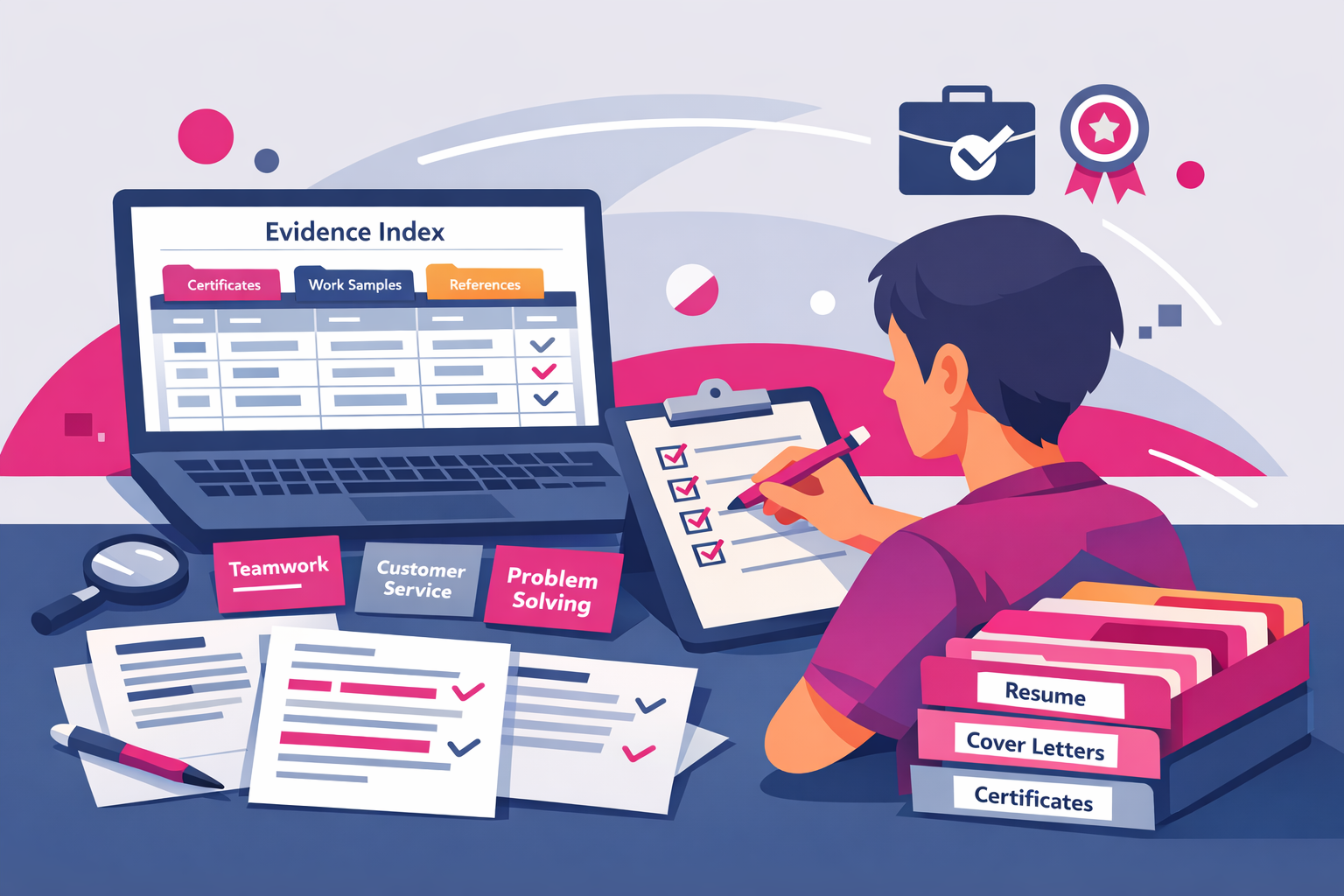
Your CV is not the problem. Your proof is.
Most job applications fail for one boring reason: you claim things you cannot prove.
“Hard-working.” “Great communicator.” “Team player.”
Employers have heard it a million times. And they have no incentive to believe you. Not because they are cynical, but because hiring is risk management. A bad hire is expensive, disruptive, and embarrassing.
An evidence bank fixes that.
It is a simple system that stores real proof of what you have done, how you did it, and what happened because you did it. Then, when an application asks for competencies, examples, or “tell us about a time when…”, you do not scramble. You select, tailor, and submit.
If you are applying for your first job, this matters even more. You do not have a long work history. So every bit of proof must work harder.
This article shows you exactly how to build an evidence bank that makes your applications sharper, faster, and far more credible.
What an evidence bank is (and what it is not)
An evidence bank is a personal library of mini case studies about you.
Each entry captures:
- Context (what was happening)
- Your responsibility (what you owned)
- Your actions (what you actually did)
- Outcome (what changed, improved, or got delivered)
- Proof (screenshots, links, feedback, numbers, artefacts)
It is not:
- A folder full of random certificates
- A diary of what you did each day
- A spreadsheet of skills with no examples
- A brag document with zero evidence
Think of it as your “receipts” file.
When an employer asks, “Show me”, you can.
Why employers reject “good candidates” without evidence
Many candidates are capable. Most cannot demonstrate it cleanly.
Here is what hiring managers are thinking:
- Anyone can say they are organised. Who has proof they delivered on time under pressure?
- Anyone can say they are customer-focused. Who can show they handled complaints, improved satisfaction, or reduced errors?
- Anyone can say they have leadership potential. Who can prove they influenced people without authority?
This is why structured interviews and competency-based applications exist. They are designed to force you to move from claims to evidence.
And yes, employers do this because it works. Structured interviews are consistently shown to be more predictive than unstructured chats. You win by playing the game properly, not by hoping they “see your potential”.
The core principle: evidence beats experience
Experience is time spent. Evidence is value created.
If you have limited work experience, you can still build an evidence bank from:
- School or college projects
- University assignments
- Volunteering
- Part-time work
- Care responsibilities
- Sports teams and clubs
- Community work
- Online courses where you built something real
- Personal projects (blog, design portfolio, coding, selling on Vinted, anything)
The rule is simple:
If it produced an outcome and you can prove it, it counts.
What to include in your evidence bank (the 6 evidence types)
A strong evidence bank is not just stories. It includes artefacts.
1) Outputs
Things you created.
- Reports, presentations, spreadsheets
- Designs, posters, social media content
- Code, prototypes, dashboards
- Meeting notes you wrote up and circulated
Tip: remove confidential data. Redact names and numbers if needed.
2) Outcomes
Measurable results.
- Time saved (minutes, hours)
- Money raised or saved
- Errors reduced
- Attendance increased
- Engagement improved
If you do not have numbers, get close. Use counts, percentages, or before-and-after comparisons.
3) Process evidence
Proof of how you worked.
- Plans, checklists, schedules
- Task boards (Trello screenshots)
- Research notes and sources
- Risk lists and mitigations
This is gold for entry-level roles. It shows professionalism.
4) Feedback
External validation.
- Emails or messages praising your work
- Performance feedback
- References and LinkedIn recommendations
Even one sentence helps. Screenshot it and store it.
5) Credentials (only the useful ones)
Certificates matter when they align with the role.
- First Aid for care roles
- Food hygiene for hospitality
- Microsoft Excel for admin roles
- Safeguarding for youth work
Do not pad your application with irrelevant badges. It signals poor judgement.
6) Reflection notes
This is where most people fail. They do not extract learnings.
Add a short note to every entry:
- What would I do differently next time?
- What did I learn about working with others?
- What skill did I improve?
This makes interview answers sharper because you are not just describing. You are thinking.
The evidence bank structure that actually works
You need a structure you will maintain. If it is complicated, you will stop.
Use this setup:
Step 1: Create one folder and one spreadsheet
- Folder: “Evidence Bank” in Google Drive or OneDrive
- Spreadsheet: “Evidence Index” that points to everything
Why both?
- The folder stores the artefacts.
- The spreadsheet makes them searchable and usable under pressure.
Step 2: Use consistent folders
Create folders like:
- 01 Work
- 02 Education
- 03 Volunteering
- 04 Projects
- 05 Feedback
- 06 Certificates
Inside each, create one folder per example.
Name them like this:
- YYYY-MM ProjectName Outcome
- Example: 2026-02 Fundraiser Raised £1,200
This naming convention forces clarity.
Step 3: The Evidence Index (copy this template)
Create these columns:
- Evidence ID (EB01, EB02, EB03)
- Title (short, specific)
- Situation (one line)
- Task (what you owned)
- Actions (3 to 5 bullets)
- Result (numbers where possible)
- Skills demonstrated (pick 3 to 6)
- Role fit (admin, retail, customer service, etc.)
- Proof link (link to file or folder)
- Confidentiality (OK, redact, do not share)
If you do nothing else, do this. This is the engine.
How to write evidence entries that employers trust
Your evidence needs to read like reality, not marketing.
Use this format for each entry.
The 30-second STAR+P entry
- Situation: what was happening?
- Task: what were you responsible for?
- Action: what did you do, specifically?
- Result: what changed?
- Proof: what can you show?
Example (entry-level friendly):
- Situation: College group project was behind schedule and roles were unclear.
- Task: I took ownership of organising the work and making sure we submitted on time.
- Action: Set up a shared task list, assigned owners, created a deadline plan, and ran two 15-minute check-ins per week.
- Result: Submitted 24 hours early, scored 68%, and reduced last-minute rework.
- Proof: Screenshot of task board, version history, final submission.
This is the difference between “I am organised” and “I deliver”.
Map your evidence to what applications actually ask for
Most applications ask for one of these:
- Competencies (teamwork, communication, problem solving)
- Behaviours (customer focus, resilience)
- Values (integrity, respect, inclusion)
- Experience requirements (handled cash, used Excel, managed stakeholders)
Your evidence bank must be searchable by these categories.
Create a “skills tag list” and stick to it
Do not invent new labels every time. Choose a standard list of 15 to 25 tags. Example:
- Customer service
- Teamwork
- Written communication
- Verbal communication
- Planning and organisation
- Attention to detail
- Problem solving
- Taking initiative
- Working under pressure
- Handling conflict
- Data and Excel
- Reliability
- Leadership
- Learning quickly
- Time management
Then tag every evidence entry with 3 to 6 of these.
When an application asks for “attention to detail”, you filter your spreadsheet and pick the best proof.
Brutal truth: most people pick weak examples
They pick the example that is easiest to explain, not the one that is most convincing.
Use this scoring test. Rate each evidence entry from 1 to 5 on:
- Relevance to the role
- Specificity of your actions
- Outcome strength (clear impact)
- Proof strength (artefacts, feedback, numbers)
- Personal ownership (what you did, not “we”)
Your best entries score 18+ out of 25.
Those are your go-to stories for applications and interviews.
How to build an evidence bank fast (without lying)
You might be thinking, “I do not have enough examples.”
You can fix that in four weeks with deliberate action.
Week 1: Audit what you already have
- Search your email for praise, feedback, “thanks”, “great job”
- Collect assignments, project files, presentations
- List every responsibility you have had that involved trust
Goal: 10 evidence entries drafted, even if rough.
Week 2: Create 2 new pieces of proof
Pick one:
- Build an Excel tracker that solves a real problem (budget, revision planner, rota)
- Volunteer for a one-off event and ask for feedback afterwards
- Run a mini project: organise a study group, improve a club process, plan a fundraiser
Goal: 2 strong entries with artefacts.
Week 3: Convert evidence into application-ready bullets
For your top 8 entries, write:
- One CV bullet (action + outcome)
- One 150-word competency answer
- One interview version (60 to 90 seconds)
Now your evidence bank becomes reusable content, not just storage.
Week 4: Pressure test with real job descriptions
- Choose 5 roles you genuinely want
- Highlight repeated requirements
- Check you have at least 2 evidence entries per requirement
If you do not, create a small project to close the gap.
How to use your evidence bank in real applications
Here is the workflow that stops applications from draining your life.
1) Extract requirements
Copy the job description into a document. Highlight:
- Must-haves
- Nice-to-haves
- Competencies and behaviours
2) Match evidence IDs
Next to each requirement, write the Evidence ID that proves it.
Example:
- Customer service: EB03, EB09
- Working under pressure: EB05
- Excel: EB07
3) Build answers from proof
Use the best matching evidence entry and tailor the wording to their language.
Do not invent new stories for every application. That is a rookie move.
4) Keep a submission record
Add one more sheet tab:
- Company
- Role
- Date applied
- Evidence IDs used
- Outcome
- Notes for next time
This turns rejection into data, not drama.
Common mistakes that quietly kill your credibility
Storing evidence with no context
A random screenshot is useless in six months. Add the STAR+P notes immediately.
Over-claiming
If you say you “led” when you actually “helped”, employers will feel the gap. Precise language builds trust.
Using confidential employer information
Do not share customer data, internal documents, or financials. Redact and generalise. Good judgement is part of employability.
Having only one type of evidence
If all your proof is certificates, you look passive. Employers want doers.
Never updating it
An evidence bank is not a one-off task. It is a habit.
A brief implementation plan you can start today
- Set up a Drive folder and an Evidence Index spreadsheet (30 minutes).
- Create your skills tag list (15 minutes).
- Draft 10 evidence entries from school, volunteering, or part-time work (2 hours).
- Add proof to each entry: files, screenshots, feedback (1 to 2 hours).
- Write 8 CV bullets from your strongest entries (45 minutes).
- Maintain the bank weekly: add one new entry or upgrade an old one (15 minutes).
That is it. No fancy tools. No complicated frameworks.
Just proof, organised properly.
The payoff: you stop hoping and start demonstrating
When you have an evidence bank, you apply with a different posture.
You are not begging to be noticed.
You are presenting a case.
And when the employer compares you to candidates who only have adjectives and ambition, you win because you have something rare.
You have evidence.
Next Steps
Want to learn more? Check out these articles:
Build a Professional Network Before You Need a Job Now
Graduate Scheme Interview Prep That Actually Gets You Hired
Answer Competency Interview Questions Like a Pro [UK Guide]
Check out our Advanced Employability Course for all the help you need to get your dream job, fast.