
Graduate Scheme Interview Prep That Actually Gets You Hired
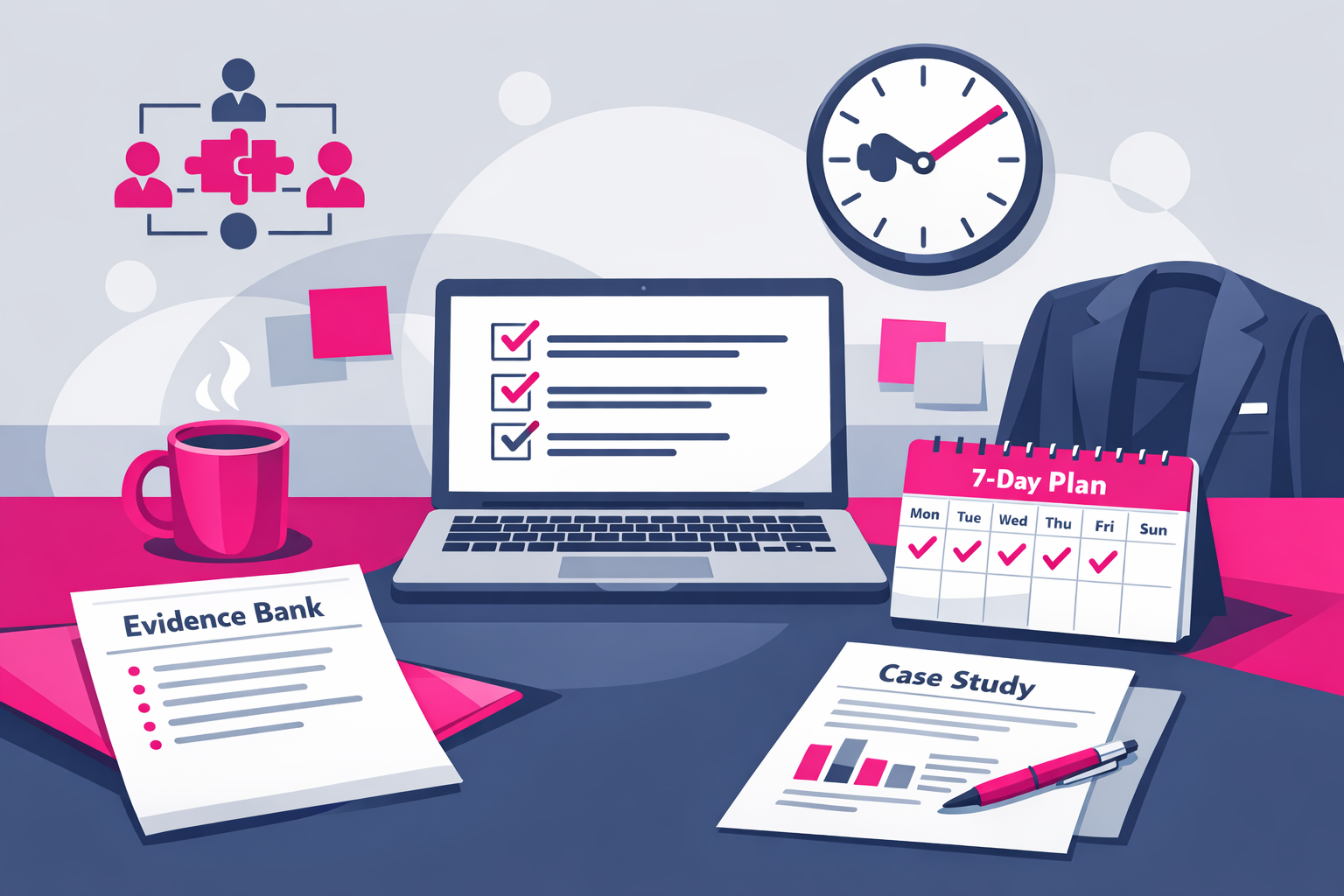
The brutal truth about graduate scheme interviews
Most graduate scheme interview advice is theatre.
It tells you to “be yourself”, “show passion”, and “research the company”. Then you walk into a competency interview, an assessment centre, a case study, and a strength-based grilling and realise you are underprepared in the only way that matters.
You did not build evidence.
You memorised answers.
Graduate recruiters can smell that from the first sentence.
They are not looking for the most confident graduate. They are looking for the lowest-risk hire who will perform in a real team, under real pressure, with real ambiguity, and still deliver.
This article shows you how to prepare properly. Not hype. Not vibes. A practical system that turns your experiences into proof, and your proof into offers.
What a graduate scheme interview is really testing
Graduate scheme interviews are not “a chat”. They are a risk assessment.
Every question is trying to answer one of these:
- Can you do the work? Problem solving, learning speed, attention to detail, judgement.
- Will you do the work? Work ethic, resilience, ownership, drive.
- Can you work with people? Communication, teamwork, conflict handling, influence.
- Will you fit the environment? Values, pace, ambiguity tolerance, maturity.
- Can we trust you? Integrity, self-awareness, accountability.
If you prepare around those five, you stop guessing what they want and start controlling the room.
Step 1: Build your “evidence bank” (this is 80% of the win)
If you take one thing from this article, take this:
Graduate interviews are won before the interview, by building an evidence bank.
Your evidence bank is a set of prepared stories you can deploy across competency, strengths, motivation, and case questions. Not generic “teamwork” anecdotes. Proof of impact.
What your evidence bank must contain
A strong evidence bank has:
- 10 to 12 stories you can adapt to different questions.
- Range across university, work, volunteering, societies, sport, caring responsibilities, side projects.
- Depth with numbers, constraints, decisions, trade-offs, and outcomes.
- Failures where you took responsibility and improved.
Graduate recruiters do not penalise you for lacking a corporate job. They penalise you for lacking examples of responsibility and results.
The only story structure you should use (because it forces proof)
Use this structure. It is STAR, but engineered to be sharper.
- Context: What was happening, and why did it matter?
- Task: What were you accountable for, specifically?
- Actions: What did you do, step by step? What did you decide? What did you prioritise?
- Result: What changed? Use numbers where possible.
- Reflection: What did you learn, and what would you do differently?
Most candidates stop at “Result”. The best candidates add “Reflection” because it demonstrates judgement and growth, which is what graduate schemes are buying.
Your evidence bank template (copy this)
Create a document and write each story like this:
- Title: Short label (for recall under pressure)
- Skills demonstrated: 3 to 5 (for mapping)
- Context: 2 sentences
- Task: 1 sentence
- Actions: 5 to 7 bullet points, in order
- Result: 1 to 3 bullets with metrics
- Reflection: 2 bullets
- Proof: Link or artefact (report, slide deck, GitHub, portfolio, reference)
Yes, this takes time. That is the point. Most people will not do it. That is why most people lose.
Step 2: Decode the role and map your evidence to it
“Tell me about yourself” is not an invitation to talk about your childhood. It is a test of relevance.
Your job is to understand what the scheme is actually hiring for, then show matching proof.
How to decode a graduate scheme job description in 20 minutes
Print it or paste it into a document. Then:
- Highlight verbs (analyse, deliver, influence, build, manage, communicate).
- Circle outcomes (improve process, support clients, drive growth, reduce risk).
- Underline behaviours (ownership, collaboration, resilience, curiosity).
- List tools and domains (Excel, Python, financial modelling, stakeholder management, regulation).
Then write a one-paragraph “role hypothesis”:
This scheme needs someone who can [key outcomes] by doing [key activities] with [key behaviours], in an environment that is [pace, ambiguity, client exposure].
Now you prepare like a professional, not like a hopeful.
Create a simple mapping table
Make a two-column table:
- Left: competency or requirement from the role
- Right: your best evidence bank story
If any requirement has no story, you have found your preparation gap. Fill it by:
- Creating a mini-project this week
- Taking on responsibility in a society or volunteering role
- Building a small portfolio artefact (analysis, write-up, presentation)
Graduate schemes reward proactive builders.
Step 3: Master the four interview formats you are likely to face
Most schemes use a mix. Prepare for all four, because you do not get to choose the exam.
1) Competency interviews
These test past behaviour as a predictor of future behaviour. It is not perfect, but it is widely used because it works reasonably well at scale (and many large employers structure it to reduce bias).
Common questions include:
- Tell me about a time you led something.
- Tell me about a time you handled conflict.
- Tell me about a time you analysed data and made a recommendation.
- Tell me about a time you failed.
How to answer properly:
- Lead with the outcome in the first 10 seconds.
- Make your actions the longest part.
- Quantify results (time saved, money raised, engagement increased, error rate reduced).
- End with reflection and what you would do differently.
Do not:
- Give a team story where you did nothing specific.
- Talk in generalities like “we communicated well”.
- Blame others in conflict stories.
2) Strengths-based interviews
These are faster, more instinctive, and often feel “casual”. They are not casual.
They test what energises you and what you are naturally likely to do repeatedly. The questions are often short:
- What do you enjoy about working with data?
- Do you prefer starting tasks or finishing them?
- What does good teamwork look like to you?
How to prepare:
- Identify your top 5 energisers (what you do even when nobody is watching).
- Link each energiser to one piece of evidence.
- Keep answers tight: 20 to 40 seconds, then stop.
Strengths interviews punish over-rehearsed scripts. Prepare points, not paragraphs.
3) Case interviews and exercises
Not every scheme uses consulting-style cases, but many use some form of scenario, inbox exercise, commercial problem, or data interpretation task.
This is where candidates collapse because they confuse “fast” with “smart”.
Your case framework (simple and reliable):
- Clarify the goal: “What does success look like? Are we optimising for revenue, cost, risk, customer experience?”
- Ask constraints: time, budget, team, data quality.
- Structure the problem: 3 to 5 buckets (no more).
- Prioritise: what matters most and why.
- Work through with numbers: show assumptions, sanity-check.
- Recommend: decision, rationale, risks, next steps.
What interviewers want to hear:
- Clear thinking under uncertainty
- Comfort with imperfect data
- Trade-offs and judgement
- Communication that a manager could use immediately
4) Assessment centres and group tasks
Group tasks are not about dominating. They are about making the group effective.
The behaviours that score highly:
- Structure: propose a plan and keep time
- Inclusion: pull quieter people in
- Progress: summarise and move forward
- Quality: challenge weak logic politely
- Delivery: land a decision and assign next steps
A simple group task playbook:
- In the first 60 seconds, suggest: goal, time split, roles.
- Ask one quiet person for their view early.
- Every 5 minutes, summarise where you are and what is next.
- When the group drifts, bring it back with a question: “Which option best fits the criteria we agreed?”
If you do this, you look employable immediately.
Step 4: Nail the questions that decide the outcome
These questions have disproportionate weight. Treat them like critical infrastructure.
“Tell me about yourself” (your 90-second positioning statement)
Your answer must do three things: direction, evidence, fit.
Use this structure:
- Present: who you are academically or professionally now
- Proof: 2 to 3 highlights with outcomes
- Direction: what you want next and why
- Fit: why this scheme and what you will bring
Example outline (adapt it, do not copy it):
“I am a final-year economics student who has focused on data-driven decision making. In my dissertation I built a model using X and produced Y insight, and in my part-time role I improved Z process which reduced errors by A. I am now looking for a graduate role where I can combine analysis with stakeholder communication, and this scheme stands out because it offers rotation exposure and early responsibility. I will bring strong analytical discipline, calm execution under pressure, and a track record of turning messy problems into clear actions.”
“Why this company?” (stop saying you love the values)
Everyone says they love the values. That is meaningless without proof.
Use this three-part answer:
- Business reason: something specific about their strategy, market, or model
- Role reason: how the scheme’s structure develops the skills you want
- Personal reason: your experience that makes this a credible match
What to research to make this real:
- Annual report highlights and strategic priorities
- Recent press releases and investor updates
- CEO or senior leader interviews (pattern of priorities)
- Customer reviews and market positioning
- LinkedIn profiles of current graduates (what they actually do)
This takes one evening. It separates you from 90% of applicants.
“Why this role?” (prove you understand the day job)
Graduate candidates often talk about “learning” and “growth”. That is not a role. That is a desire.
Say what you want to do, in operational terms:
- What problems you want to solve
- What stakeholders you want to work with
- What outputs you want to deliver
- What pace and environment you thrive in
Then connect it to evidence from your bank.
“Tell me about a failure” (the accountability test)
This is where image-managers get exposed.
Pick a real failure with manageable stakes. Then:
- State your role clearly
- Own your contribution without excuses
- Explain the fix
- Show what changed in your behaviour afterwards
Do not say “I work too hard”. Nobody believes you, and it signals low self-awareness.
Step 5: Prepare questions that make you sound like a hire, not a tourist
The questions you ask at the end are not a formality. They show how you think.
Ask questions that reveal execution, expectations, and reality.
High-impact questions to ask
- “What does a graduate who is performing well do differently in the first 90 days?”
- “What are the most common reasons graduates struggle here?”
- “Which teams do graduates typically rotate through, and what outputs are expected in each?”
- “How is feedback given day-to-day, not just in formal reviews?”
- “What is changing in the business this year that will affect this role?”
These questions force a detailed answer. Detailed answers create trust.
Step 6: Rehearse like an athlete, not like a parrot
Rehearsal is not reading your answers out loud until you are bored. That creates robotic delivery.
Rehearsal is pressure training.
The only rehearsal method that works
- Write bullet-point answers for the 15 most likely questions.
- Record yourself answering in one take. Phone is fine.
- Review for three things: clarity, structure, evidence.
- Cut filler (“like”, “sort of”, “I guess”). Replace with silence.
- Repeat under time limits: 60 seconds, then 45 seconds.
If you cannot answer clearly in 60 seconds, you do not understand your own story yet.
Make your delivery interview-proof
Use these rules:
- Pause before you answer. Two seconds is fine. It reads as thoughtfulness.
- Signpost. “I will cover context, what I did, and the result.”
- Speak in steps. “First… then… because…”
- Land the plane. Stop talking when you have answered.
Confidence is often just controlled pacing.
Step 7: Handle the logistics like a professional
Great answers can be undermined by sloppy execution. Do not give them easy reasons to reject you.
Video interview checklist
- Camera at eye level, neutral background
- Face well lit from the front, not behind
- Stable internet or hotspot backup
- Notifications off, laptop plugged in
- Notes allowed: 5 bullet prompts only, not a script
In-person interview checklist
- Arrive 15 minutes early, not 45
- Bring a notebook, pen, printed CV
- Know the names of interviewers if possible
- Plan your route with buffer time
This is not about being polished. It is about being reliable.
A high-level 7-day preparation plan
If your interview is in a week, do this. It is intense, but it works.
Day 1: Role decode and evidence bank build
- Decode the job description
- Draft 10 stories using the template
Day 2: Evidence mapping and gap filling
- Map each competency to a story
- Create one mini-project or artefact to cover a gap
Day 3: Company research and motivation answers
- Annual report, press releases, strategy
- Write “Why company” and “Why role” bullet answers
Day 4: Competency interview practice
- Record 10 questions, one take each
- Tighten stories to 60 to 90 seconds
Day 5: Case and exercise practice
- Do 2 case exercises with a timer
- Practise recommendation and next steps
Day 6: Mock interview with a real person
- Ask for brutal feedback on clarity and evidence
- Fix your weakest three answers
Day 7: Polish and recovery
- Prepare your questions for them
- Final logistics check
- Sleep properly
Do not cram until 2am. Fatigue turns good candidates into mediocre communicators.
What to do immediately after the interview
Most candidates waste this moment. Use it.
Send a tight follow-up
If you have an email contact, send a brief message within 24 hours:
- Thank them
- Reinforce one relevant point you discussed
- Confirm your interest
Keep it short. Professional, not needy.
Run a post-interview review while it is fresh
Write down:
- The questions you were asked
- Where you hesitated
- What evidence landed well
- What you will improve
This turns every interview into training data. That is how people win multiple offers.
The standard you should hold yourself to
You are not preparing to “do well”. You are preparing to be employable under scrutiny.
That means:
- You can explain your impact with numbers.
- You can show how you think, not just what you did.
- You can communicate clearly, under time pressure.
- You can work with others without ego.
- You take responsibility when things go wrong.
Do this properly and you will feel a shift. Not motivational fluff. A real shift.
Because you will walk into the interview with something most candidates do not have.
Proof.
Next Steps
Want to learn more? Check out these articles:
Answer Competency Interview Questions Like a Pro [UK Guide]
Tailor Your CV for Every Job: The Fast, Brutal Method
Explain Employment Gaps in Interviews Without Losing Credibility
Check out our Advanced Employability Course for all the help you need to get your dream job, fast.