Answer Failure Interview Questions Without Sounding Defensive
The failure question is not a trap. Your answer is.
Most people hear “Tell me about a time you failed” and panic for one of two reasons.
- You tell a “fake failure” that is really a humblebrag, and the interviewer clocks it instantly.
- You tell a real failure, but you tell it like a confession, and you accidentally prove you are risky, reactive, or hard to manage.
Here is the brutal truth. Employers do not ask about failure to see whether you have failed. They ask because failure is guaranteed in any job that involves deadlines, people, customers, or reality. They are testing how you think when things go wrong, how you take responsibility, and whether you can learn without needing to be rescued.
If you are going for your first job, this question can feel unfair. You think you have “nothing professional” to use. Wrong. Failure shows up in school, part-time work, volunteering, sport, group projects, caring responsibilities, and self-directed learning. What matters is not the setting. What matters is the pattern of behaviour you reveal.
This article gives you a tactical system to answer failure questions with credibility, calm, and proof. No waffle. No therapy session. No excuses.
What interviewers are really measuring
When an employer asks about failure, they are scoring you on these criteria, whether they say so or not.
1) Ownership
Do you take responsibility for your part, or do you outsource blame to “the team”, “unclear instructions”, “the system”, or “bad luck”?
2) Judgement
Do you understand why the failure happened? Can you separate root cause from symptoms?
3) Learning speed
Did you change what you do next time, or did you simply “feel bad and move on”?
4) Professionalism under pressure
Did you communicate early, ask for help appropriately, and protect outcomes? Or did you hide, hope, and crash into the deadline?
5) Repeat risk
Are you likely to repeat the failure in their environment? The employer is trying to predict the future with limited data.
Notice what is not on the list. They are not looking for a dramatic story. They are not looking for perfection. They are looking for a reliable operator.
The three failure answers that kill offers
1) The humblebrag
“I care too much.” “I’m a perfectionist.” “I worked too hard.”
This is not a failure. It tells them you will dodge accountability and manufacture a story when you feel judged. That is a trust problem.
2) The blame-shift
“My group did not pull their weight.” “My manager did not explain it.”
Even if it is true, it makes you sound like a passenger. Employers hire drivers.
3) The open wound
Long emotional detail. Lots of context. No clear takeaway. No changed behaviour.
This signals the failure still owns you. Employers do not want to become your rehab programme.
The only structure you need: LENS
Most interview frameworks encourage long storytelling. That is a mistake for failure questions. You want controlled honesty and clear learning.
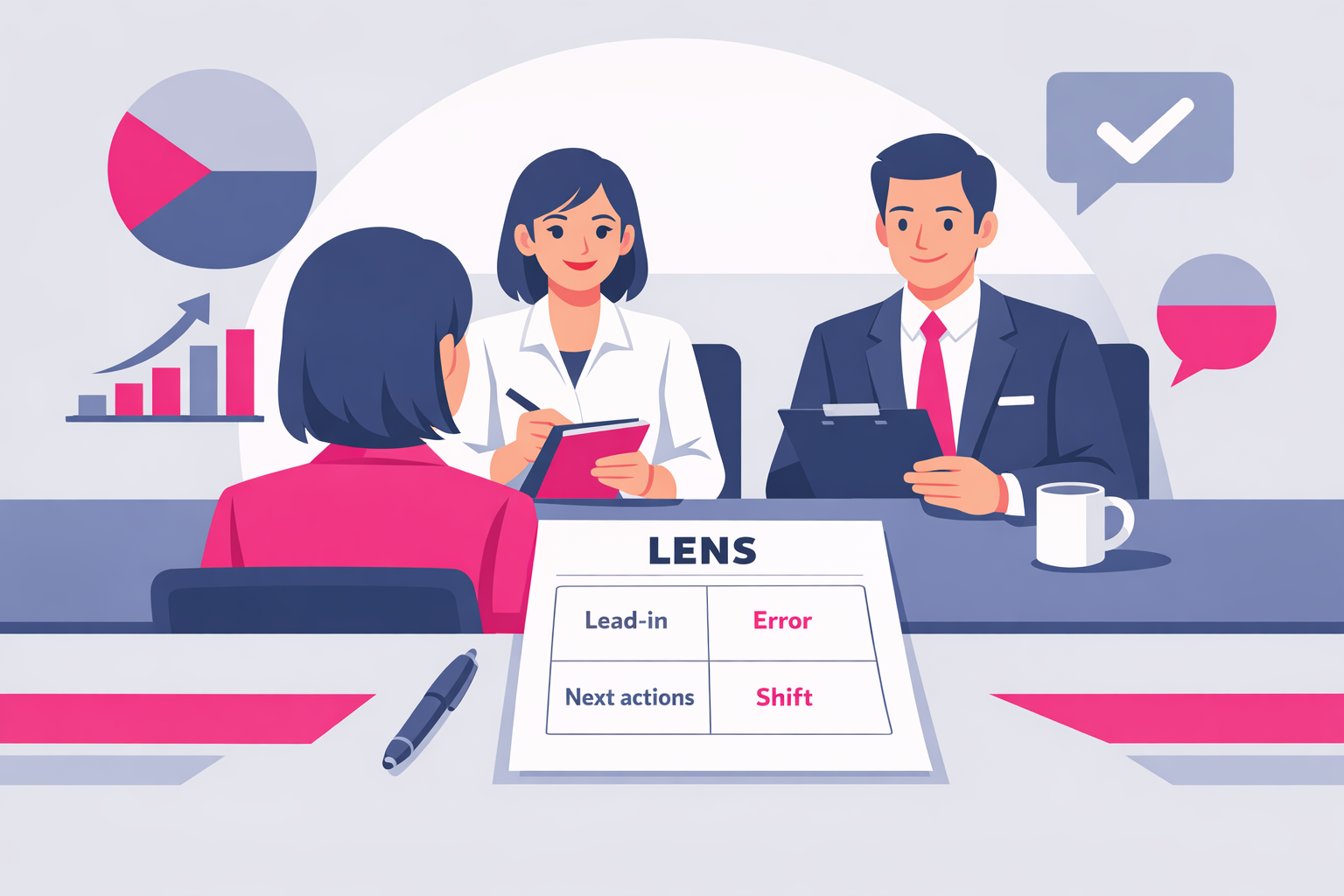
Use LENS. Four short sections.
- Lead-in: what you were trying to achieve, and your role
- Error: what went wrong, specifically, and your contribution
- Next actions: what you did immediately to limit damage
- Shift: what you changed so it would not happen again
LENS keeps you out of therapy mode. It forces accountability. It ends with proof of growth.
How long should it be?
60 to 90 seconds. If they want more, they will ask. Your job is to land the plane, not to circle the airport.
How to pick the right failure story (use this checklist)
Choosing the example is half the battle. Pick badly and you either look incompetent or dishonest.
Choose a failure that meets these rules.
Rule 1: It is real, but not disqualifying
Do not choose a failure that directly contradicts the role’s core safety and ethics.
- Applying for a finance role: do not talk about “I mishandled cash and it went missing”.
- Applying for a care role: do not talk about ignoring safeguarding procedure.
- Applying for a driving role: do not talk about reckless behaviour.
Pick something credible and fixable: planning, communication, prioritisation, assumptions, quality control, stakeholder management.
Rule 2: You can show a measurable consequence
“It did not go well” is weak. Give the impact in plain terms.
- “We missed the deadline by two days.”
- “The customer had to be re-contacted.”
- “My grade dropped from X to Y.”
- “The event had 30% fewer sign-ups than forecast.”
Rule 3: The fix is specific and repeatable
“I learned to communicate better” is meaningless. You need a behavioural change that can be repeated under pressure.
- “I now send a 3-point progress update every Friday.”
- “I break tasks into a checklist and set a mid-point review.”
- “I confirm requirements in writing before I start.”
Rule 4: It ends with improved performance
If you cannot show what improved afterwards, it is not a learning story, it is a scar.
Five failure themes employers respect (and how to frame them)
If you are unsure what story to use, pick one of these common, safe themes. Each one signals maturity when told properly.
1) Underestimating time and complexity
What it signals: You can learn planning discipline.
What to say you changed:
- Started estimating with buffers (for example 20%)
- Built milestones and interim checks
- Escalated earlier when risk appeared
2) Not clarifying requirements
What it signals: You understand that assumptions create rework.
What to say you changed:
- Ask “What does success look like?” upfront
- Confirm scope in a short written summary
- Check priorities when requirements change
3) Poor prioritisation
What it signals: You can learn to manage workload, not just work hard.
What to say you changed:
- Use a daily top 3 list
- Timebox low-value tasks
- Flag conflicts early rather than hiding them
4) Communication that was too late
What it signals: You understand risk and stakeholder management.
What to say you changed:
- Raise issues when you first see them, not when they explode
- Share options, not just problems
- Agree next steps and owners after every discussion
5) Trying to do it alone
What it signals: You can collaborate without being dependent.
What to say you changed:
- Ask for a 10-minute check-in early
- Use feedback loops before final submission
- Learn the difference between initiative and isolation
Word choices that make you sound employable
Small language changes create a big credibility shift. You want to sound like a person who operates in a professional environment.
Use this vocabulary
- “I took responsibility for…”
- “The impact was…”
- “The root cause was…”
- “To mitigate the impact, I…”
- “What I changed going forward was…”
- “Since then, I have applied this by…”
Avoid this vocabulary
- “To be honest…” (sounds like you are usually not)
- “It was not really my fault…”
- “I was just…” (minimises your role and your control)
- “I guess…” (signals uncertainty about your own story)
- “I learned a lot” (without specifying what changed)
Three plug-and-play examples (first-job friendly)
Do not memorise these word-for-word. Steal the structure and adapt the details to your reality.
Example 1: Missed deadline in a group project
Lead-in: In my final term, I led the timeline for a group presentation worth 40% of the module grade.
Error: I underestimated how long the research and slide integration would take, and I did not set an interim review. We finished late and the final edit was rushed.
Next actions: I called a quick meeting, assigned slide owners, and created a single master deck with a strict cut-off time for changes so we could still practise.
Shift: Since then, I plan backwards from the deadline with a mid-point review and a final “freeze” period. On the next project we finished two days early and had time to rehearse properly.
Example 2: Customer issue in a part-time job
Lead-in: In a retail weekend role, I was responsible for handling click-and-collect orders during busy periods.
Error: I assumed an order was ready without checking the system status. The customer arrived and it was not prepared, which created a complaint and delayed the queue.
Next actions: I apologised, prioritised getting the order picked, and updated my supervisor so we could manage the queue and expectations.
Shift: I changed my process to verify status before confirming to customers, and I used a simple checklist during peak times. After that, I reduced avoidable handover errors and my supervisor relied on me for busy shifts.
Example 3: Failing an exam or assessment
Lead-in: I failed a timed assessment early in my course that tested applied problem solving, not memory.
Error: I revised by re-reading notes instead of practising under exam conditions, so I froze when questions were unfamiliar.
Next actions: I spoke to the tutor, reviewed the feedback, and identified that my weakness was method and pace, not understanding.
Shift: I switched to active practice, created a weekly set of timed questions, and reviewed mistakes in a log. I passed the resit comfortably and used the same method in later modules.
How to handle follow-up questions without crumbling
Good interviewers will probe. That is a good sign. It means your story was believable.
Prepare for these common follow-ups.
“What would you do differently now?”
Give a specific process change, not a personality change.
- Good: “I would confirm scope in writing and set a mid-point review.”
- Weak: “I would try harder.”
“What did you learn about yourself?”
Keep it professional. Tie it to how you work.
- Good: “I learned I need a visible plan to manage multiple tasks, not mental tracking.”
- Risky: “I learned I have anxiety and it was really hard.”
“Was anyone else involved?”
Do not throw people under the bus. You can mention context without blaming.
- Good: “Others were involved, but my responsibility was the timeline and I did not manage it well.”
“How do we know it will not happen here?”
Translate your lesson into their workplace.
Example: “In this role, I would use the same approach: confirm requirements early, track work with milestones, and escalate risks before they become emergencies.”
The hardest part for first-time job seekers: choosing a ‘real’ failure
If you have never had a full-time job, you can still answer with credibility. What you cannot do is pretend you have never failed. That is the fastest way to look naive.
Use these sources to find a genuine example:
- A time you missed a deadline or submitted lower-quality work than expected
- A time you misunderstood instructions and had to redo work
- A time you overcommitted and let someone down
- A time you handled conflict badly and learned a better approach
- A time you made an avoidable mistake because you rushed
One rule: pick something you have fully processed. If you still feel defensive, you will sound defensive.
A brief implementation plan (do this before your next interview)
Step 1: Write two LENS stories
Create two different examples. One from education or training, one from work or life responsibility. Keep each to 6 to 8 sentences.
Step 2: Add proof
For each story, add one measurable detail:
- Time saved
- Grade change
- Reduction in errors
- Earlier completion
- Customer outcome
Step 3: Practise out loud, timed
Record yourself. If it is over 90 seconds, cut context. If you sound like you are excusing yourself, rewrite the “Error” section with clearer ownership.
Step 4: Prepare one sentence that connects to the role
Finish with a forward-looking line: “That is why I now do X, which is how I would operate in this role as well.”
Failure answers that win trust, not sympathy
Employers do not hire the person with the cleanest past. They hire the person with the clearest head.
Your job is to show:
- You see reality
- You own your part
- You fix problems fast
- You change your system, not just your feelings
Do that, and the failure question becomes one of the easiest opportunities in the interview. Because most candidates are still telling stories that make them look either perfect or powerless. You will be neither.
Next Steps
Want to learn more? Check out these articles:
How to Prepare for an Informal Job Interview (Win It Fast)
How to Explain Being Overqualified in a Job Interview
Write a LinkedIn Headline That Gets Recruiters to Click
Check out our Advanced Employability Course for all the help you need to get your dream job, fast.