Write a Thank-You Email After an Interview That Wins
Category: Demonstration
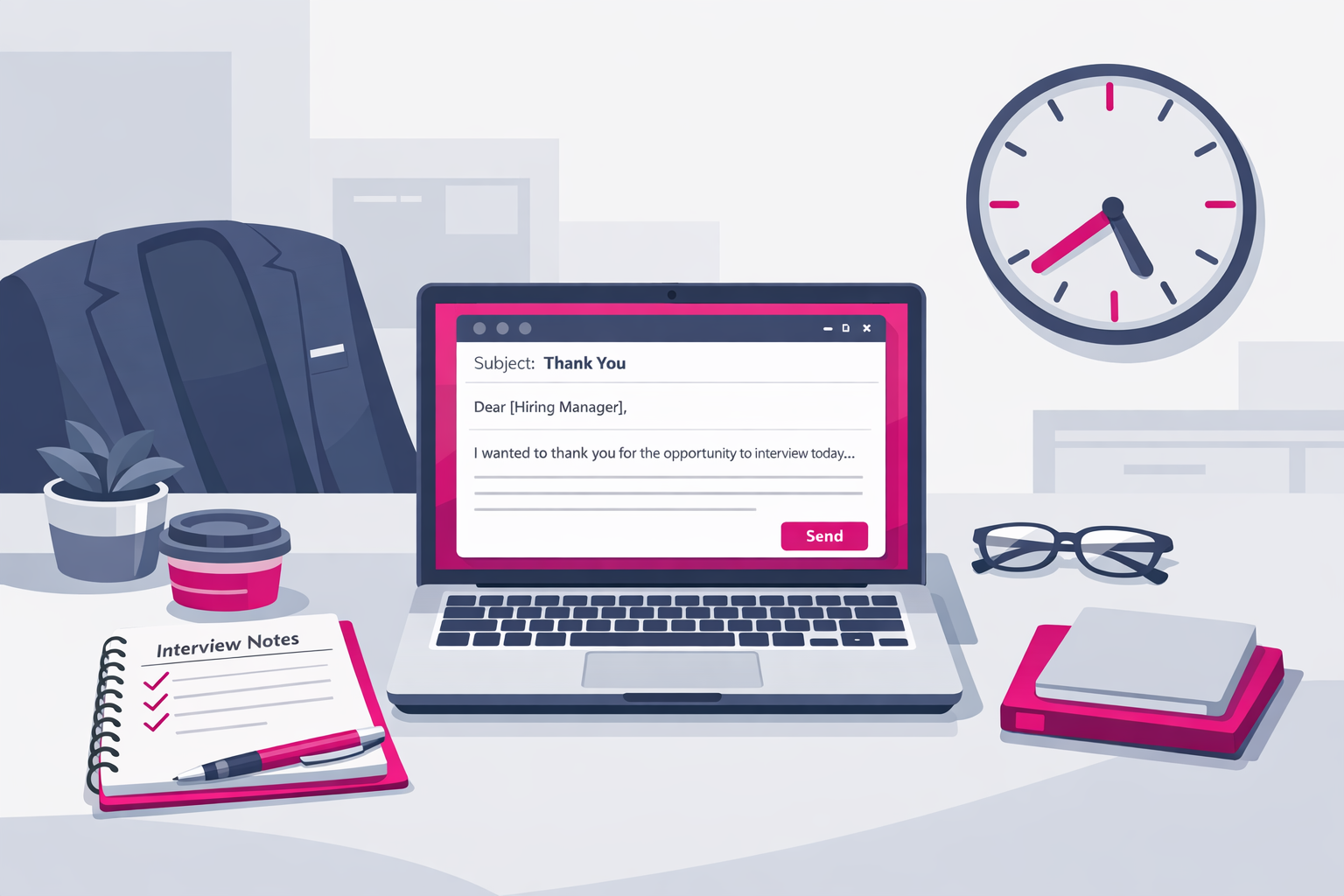
If you think the interview ends when you leave the room, you are already behind.
Most candidates walk out, exhale, and wait. They treat the post interview thank-you email like a polite formality. A quick “Thanks for your time” and a smiley sign-off, then they wonder why the offer never comes.
Here is the brutal truth. Your thank-you email is not manners. It is positioning.
It is your fastest, cheapest chance to:
- Prove you were listening
- Reinforce the exact reasons they should hire you
- Reduce the risk they feel about choosing you
- Fix what you fumbled in the interview
- Make it easy for them to say yes
Done right, it is a strategic follow-up that nudges a decision in your favour. Done wrong, it is noise.
This guide shows you exactly how to write a thank-you email after an interview, with subject lines, templates, and a tight process you can repeat every time.
What a thank-you email is really for
The hiring manager is not hiring the “best person”. They are hiring the “least risky” person who can do the job.
Your thank-you email should reduce perceived risk by answering three silent questions:
- Do you actually understand what we need?
- Can you deliver results here, with our constraints?
- Will you be a low-drama, high-output colleague?
A good thank-you email is short, specific, and evidence-based. It is not gushy. It is not generic. It is not a second CV.
When to send it (timing rules that actually matter)
Send your thank-you email the same day, ideally within 2 to 6 hours of the interview.
Why?
- You are still fresh in their mind.
- Their notes are still open.
- Your competitors are probably procrastinating.
If your interview is late afternoon, send it that evening. If it is extremely late, send it early next morning.
If you had multiple interviewers, send one email to each person. If you only have a recruiter’s details, send it to the recruiter and ask them to forward it.
Do not wait for “the right time”
The right time is: before they decide.
How long it should be (and why most people fail)
Aim for 120 to 200 words.
Most candidates either:
- Write 40 words of fluff that says nothing, or
- Write 500 words that feels needy and self-obsessed
Your target is a tight message that does four things:
- Thanks
- Specific recall
- Value reinforcement
- Clear next step
That is it.
The structure: a simple 6-sentence formula
Use this framework. It works because it is disciplined.
- Thank them and name the role.
- Reference one specific part of the conversation.
- Tie that to a business outcome they care about.
- Give one proof point that you can deliver.
- Offer something useful (optional but powerful).
- Close with a confident line about next steps.
If you can do this, you instantly sound sharper than 90% of candidates.
Subject lines that get opened (without sounding cringe)
Choose one. Keep it boring and clear.
- Thank you, [Name] | [Role Title]
- Thanks for your time today, [Name]
- Great speaking today about [Role Title]
- Following up | [Role Title] interview
Avoid:
- “Thank you!!!”
- “Amazing interview”
- “I really want this job”
- Anything with jokes or emojis
Hiring is not a group chat.
What to say (the details that prove you are serious)
Specificity is your weapon.
Mention:
- A metric they care about (time to resolution, conversion, backlog, accuracy, customer satisfaction)
- A challenge they mentioned (handover issues, stakeholder pressure, scaling, process gaps)
- A tool, system, or workflow relevant to the role
- A priority that will matter in the first 90 days
Then connect it to what you bring.
Bad: “I am a hard worker and a fast learner.”
Better: “Your point about reducing ticket backlog is exactly where I have been most effective. In my last project I helped cut open tickets by 18% by tightening triage and building simple response templates.”
Even if you are early career, you can still provide proof. Use:
- A university project with a real outcome
- A volunteering role with measurable impact
- A part-time job where you improved something
- A portfolio piece you can link
Evidence beats adjectives.
How to fix a weak answer (without sounding desperate)
Most interviews have at least one moment you wish you could redo.
You can repair it in your thank-you email if you do it cleanly:
- Name the topic briefly
- Give the better answer in 1 to 2 sentences
- Anchor it to evidence
Example:
“I have been thinking about your question on handling competing deadlines. A practical approach I use is to agree the priority order in writing, then time-box deep work blocks for the top two tasks. In my last term I used this to deliver two group deliverables on the same week without missing either deadline.”
No apologies. No self-criticism. Just a stronger answer.
Templates you can use today (copy, then customise)
These templates are designed for UK English and professional tone. Replace the brackets with real details.
Template 1: Standard thank-you email (best default)
Subject: Thank you, [Name] | [Role Title]
Hi [Name],
Thank you for your time today to discuss the [Role Title] role. I appreciated the detail you shared on [specific topic discussed], especially the focus on [business priority].
From what you described, the key need is [one core need]. That is exactly where I can add value by [your capability], as shown when I [proof point with outcome].
If helpful, I am happy to share [a relevant example, link, or short document] that shows how I approach [relevant task].
Thanks again, and I look forward to hearing about next steps.
Kind regards,
[Full Name]
[Mobile]
[LinkedIn or portfolio link if relevant]
Template 2: Panel interview (multiple interviewers)
Subject: Thank you | [Role Title] interview
Hi [Name],
Thank you for speaking with me today about the [Role Title] role. I valued the conversation around [specific challenge] and how the team is approaching [initiative].
It is clear that success in this role depends on [two priorities]. My experience with [relevant experience] would let me contribute quickly, particularly by [practical contribution].
Please pass on my thanks to the panel. If useful, I can send a short summary of how I would approach the first 30 days based on what I learned today.
Kind regards,
[Full Name]
[Mobile]
Template 3: Graduate or first job (limited experience, still credible)
Subject: Thanks for today, [Name] | [Role Title]
Hi [Name],
Thank you for taking the time to meet today about the [Role Title] role. I enjoyed learning more about [specific element] and the way the team measures success through [metric or outcome].
What stood out is that you need someone who can [need] and communicate clearly with [stakeholders]. In my [degree/placement/part-time role], I built this by [specific example], which resulted in [outcome].
I am excited about the opportunity to contribute and I am happy to provide any further information you need.
Kind regards,
[Full Name]
[Mobile]
[Portfolio link]
Template 4: You want to stand out (without being annoying)
Subject: Follow-up | [Role Title]
Hi [Name],
Thank you again for today. Your point about [pain point] stuck with me.
Based on what you shared, one quick win could be [practical idea]. The goal would be to improve [metric] by [mechanism]. I have used a similar approach when [proof].
If you would like, I can outline this in a one-page plan.
Kind regards,
[Full Name]
Use this template carefully. Only suggest an idea if you understand the problem.
What to include (and what to leave out)
Include:
- Their name spelt correctly
- The role title
- One specific detail from the interview
- One evidence-backed capability
- A link only if it strengthens your case
- Your mobile number
Leave out:
- Salary questions (save it for later stages)
- Personal stories unrelated to the job
- “Just checking in” energy
- Long paragraphs
- Attachments unless requested
Links are usually better than attachments. Attachments can get blocked by security filters.
Common mistakes that quietly kill your chances
These are the errors that make you look junior, even if you are capable.
- Making it all about you (“I want”, “I need”, “I feel”) instead of outcomes
- Repeating your CV instead of reinforcing the decision
- Over-thanking (it reads as insecurity)
- Trying to be funny
- Writing a novel
- Using the wrong company name or role title
- Misspelling the interviewer’s name
- Sending the same generic email to everyone
One mistake is all it takes to be remembered for the wrong reason.
After you send it: a simple follow-up plan
Most candidates either chase too soon or disappear for weeks. Use a clean process.
High-level implementation plan
- Day 0: Send your thank-you email within 2 to 6 hours.
- Day 3 to 5 (if no response): Send a short follow-up.
- After the decision timeline they gave you passes: Follow up again with one useful line, then stop.
Follow-up email (short and professional)
Subject: Following up | [Role Title]
Hi [Name],
I hope you are well. I wanted to follow up on the [Role Title] interview and check whether there is any update on next steps. I remain very interested, especially given the focus on [priority].
Kind regards,
[Full Name]
That is enough. Do not send daily nudges.
Quick checklist before you hit send
Read this out loud. If it sounds needy, fix it.
- [ ] Is the email under 200 words?
- [ ] Did I include one specific detail from the interview?
- [ ] Did I connect my capability to their outcome?
- [ ] Did I prove it with a result, not adjectives?
- [ ] Is the tone calm and confident?
- [ ] Are names, company, and role title correct?
- [ ] Did I include my mobile number?
The bottom line
A thank-you email after an interview is not about politeness.
It is a final proof point.
It tells the employer: you listened, you understand the job, you can deliver, and you are professional enough to follow through.
Most people will not do this properly. That is good news for you.
Write the email today. Keep it tight. Make it specific. Make it about outcomes. Then let your competitors keep sending fluff.
Next Steps
Want to learn more? Check out these articles:
Panel Interview Preparation: The Only Checklist You Need
Build a Job Portfolio With No Experience [Step-by-Step]
Answer “Tell Me About Yourself” With a 90-Second Pitch
Check out our Advanced Employability Course for all the help you need to get your dream job, fast.