
New Year Job Reset: A Brutal, Practical Plan to Get Hired
The uncomfortable truth: your job search needs a reset
If you charged into January with good intentions and a vague plan to “apply more,” stop. You don’t need a resolution. You need a reset. Resets are different. They are ruthless. They strip your job search to what works, kill what doesn’t, and replace hope with systems. If last year felt like sending CVs into a black hole, this is your turning point. Let’s turn a messy hunt into a disciplined operating system for getting hired, faster and with less drama.
Here’s the truth you might not want to hear. If you don’t change your process, your outcomes won’t change either. But if you do a New Year job reset correctly, you can create compounding momentum within four weeks. Not theory. Practice.
Why New Year resolutions fail in job search
Resolutions fail because they focus on feeling busy, not getting results. You set a target number of applications instead of a target number of interviews. You say “I’ll network more” instead of “I’ll secure three 15‑minute calls with hiring managers this week.” You stick to the channels you know, even if they don’t work.
If you want a different outcome this year, rebuild your search around leading indicators you control. Fix inputs, and your outputs will follow.
Define the target: a job hypothesis, not a wish
Stop aiming at “anything in marketing” or “entry-level operations.” That vagueness kills traction. Replace the wish with a job hypothesis: a precise, testable bet on role, industry, and value you can deliver. Then pressure-test it.
Role–market fit: the clarity check
Run your target through five filters:
- Role clarity. Can you describe the job in one sentence, with top three deliverables?
- Market demand. Are there at least 50 live roles in your geography in the last 30 days?
- Value match. Can you show proof you’ve done 60–70% of the tasks, even in projects or volunteer work?
- Skill gap realism. Can you close the gaps within 30 days with focused learning and 2–3 mini-projects?
- Compensation sanity. Does the salary range match your needs and level?
If you fail two or more, refine your hypothesis. Narrow the role. Adjust the industry. Align the value.
Build assets that sell you, not just tell
You don’t get interviews by describing yourself. You get them by proving you can do the job. Your assets are your product pages. Make them convert.
CV as a product sheet: rewrite using proof
Your CV is not a diary. It’s a sales document. Use impact statements, not duties. Convert tasks into outcomes.
Example:
Before: “Managed social media posts for the society.”
After: “Increased event attendance by 37% in 6 weeks by launching a TikTok content series; grew mailing list by 420 subscribers; reduced per-attendee cost by 22% through targeted ads.”
- Use the 3:1 rule. Three proof points for every role: problem, action, measurable result.
- Prioritise what the job spec asks for. Mirror the language, but back it with evidence.
- Front-load credibility. Top third of your CV should answer “Why you?” with 3–5 sharp proof points.
- Keep it ATS-friendly. Simple layout, clear section headings, no graphics. Use UK job titles and spelling.
- Optimise keywords without fluff. Extract 10–15 hard and soft skills from 5 job ads. Use exact phrasing. Place them naturally in experience and skills sections. Don’t dump a keyword list.
Evidence bank: a portfolio that shortens doubt
Create a proof library you can attach, link, or show fast:
- A one-page value sheet. A simple page showing 5–7 proof bullets, 3 mini case studies, and 3 endorsements or quotes.
- A portfolio or GitHub/Notion page. Host 2–4 projects relevant to your target role. Include context, your contribution, metrics, and files or screenshots. Be specific.
- A reference kit. Two people who can vouch for you. Provide contact, context, and 3 bullets on what they’ll say.
- Social proof. Curate your LinkedIn About and Featured sections to mirror your target role, with links to 2–3 proof items.
Employers trust evidence. Give it to them without making them dig.
Ruthless pipeline: replace hope with a system
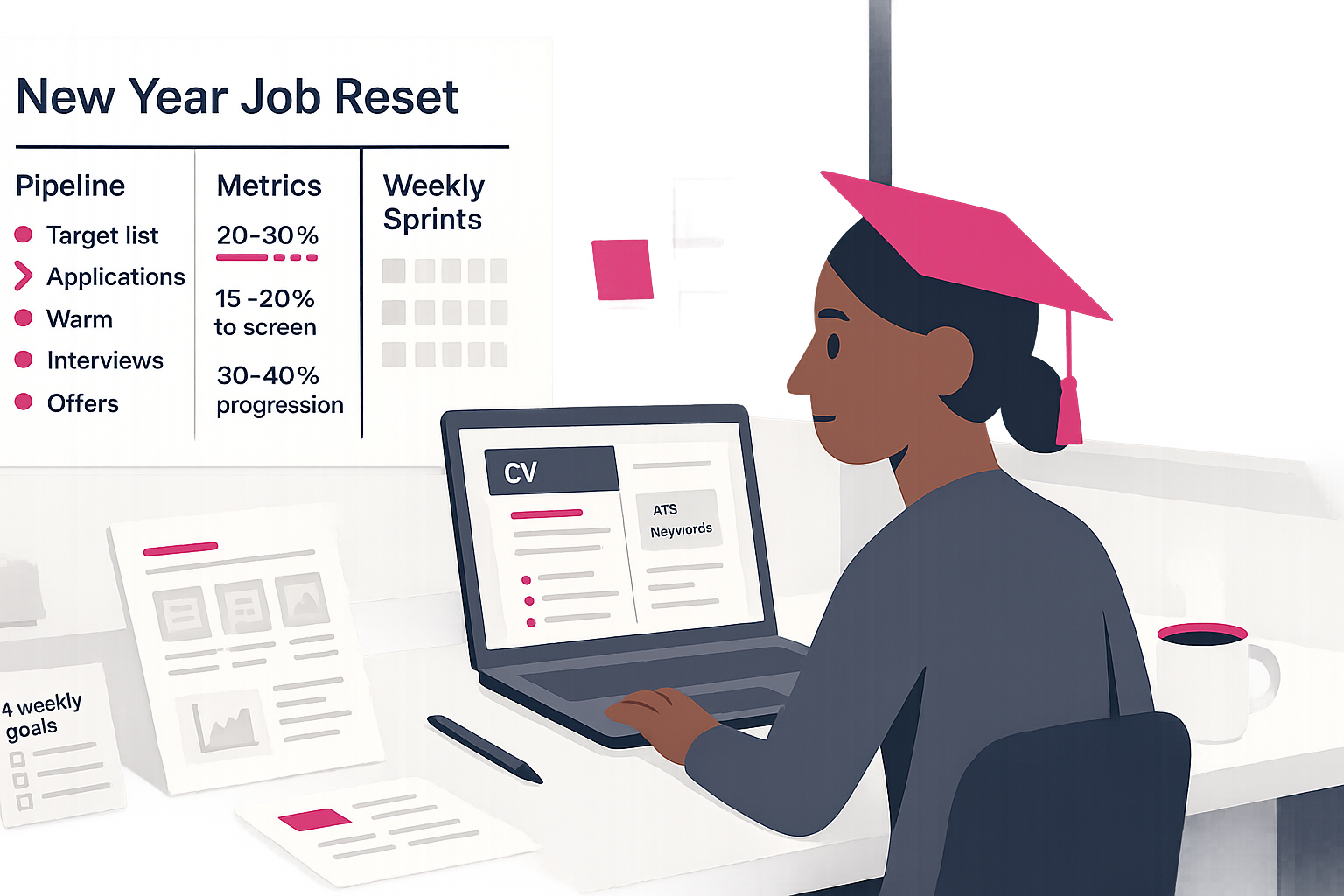
You need a deal flow, not a scattergun. Build a pipeline with stages you can track weekly. Keep it simple and visible.
Pipeline stages that make sense for first-time job seekers
- Target list. 30–50 companies, filtered for fit and hiring likelihood.
- Active roles. 15–25 live applications in motion.
- Warm conversations. 5–10 ongoing chats with insiders, alumni, or hiring managers.
- Interviewing. 3–5 live interview processes.
- Offers. 1–2 shortlists you’re moving to close.
Keep it moving. Each Friday, move every opportunity forward one step or kill it. Stale is dead.
Pipeline metrics that matter
Measure leading indicators. These create interviews:
- Daily target. 10 high-quality touches per day: tailored applications, warm intros, follow-ups, or value drops.
- Response rate. Aim for 20–30% responses on warm outreach, 10–15% for cold.
- Interview conversion. 15–20% of tailored applications should convert to screens. If not, fix your assets.
- First-round to final. Target 30–40% progression. If you’re losing here, fix your stories and homework.
- Offers per month. Aim for 1–2 within 6–8 weeks of consistent execution.
Weekly operating rhythm: the job search sprint
Stop winging it. Run your search like a product sprint.
- Monday. Pick five roles to target. Research hiring managers. Draft value notes. Update your asset for one role type.
- Tuesday. Submit 3–5 high-quality applications. Book two informational calls.
- Wednesday. Build one proof artefact or case study. Share on LinkedIn.
- Thursday. Mock interview. Fix one weak story. Send follow-ups and value drops.
- Friday. Pipeline review. Kill stale roles. Plan next sprint.
- Saturday optional. Two hours on skills or portfolio build.
- Sunday. Reset mindset, prep messages, rest.
ATS and keywords without fluff
You don’t beat ATS with gimmicks. You align language with reality. Here’s a fast tactical pass:
- Extract keywords. Open 5 role ads in your niche. List repeated phrases under skills, tools, and outcomes.
- Prioritise outcomes. Tools help, outcomes win. “Improved conversion by 15%” beats “Used Excel.”
- Place keywords in context. Integrate into bullet points that show proof. Use exact phrasing 2–3 times naturally.
- Keep format clean. Standard fonts, simple headings, no columns. Submit as PDF if allowed or Word if specified.
- Follow the spec. The ATS is simple. Don’t outsmart it. Just be clear.
Networking for people with “no network”
Everyone starts at zero. Networking is not begging. It’s offering value and asking smart questions. Use this 3-step approach:
- Build a small list. Target 25 relevant people: hiring managers, recent grads, alumni, people one level ahead.
- Message with value. Subject: “Quick question on [role] at [company].” Body: “I’m applying for [role]. Built [mini-project] that might save [X] time. Could I ask 2 focused questions? Will keep it to 10 minutes.”
- Follow-up sequence. Day 0 message. Day 3 bump with a short insight or resource. Day 7 second bump with a one-line case study you built. Then move on.
Be concise. Make it easy to say yes. Always show you’ve done the work.
Interview readiness: practice like a sport
You don’t rise to the occasion. You fall to your level of practice. Build a repeatable interview engine:
- Core story library. Prepare 12 stories: 3 wins, 3 failures, 3 team conflicts, 3 learning/initiative moments. Use STAR, but compress. 30 seconds Situation, 30 Task, 60 Action, 30 Result.
- Scoring sheet. Record yourself answering 10 common questions. Score clarity, structure, and proof. Fix the worst one each week.
- Business case prep. For each interview, draft a one-pager: 3 key problems you see, 3 actions you’d take in 30 days, 3 risks to monitor. Bring it to the interview. You’ll stand out.
- Closing cadence. At the end of the interview: “Based on what we discussed, I believe I can deliver [X result] in [Y timeframe]. Is there anything that makes you hesitate about my fit?” Then address it directly.
Fix the three bottlenecks killing your momentum
No replies to applications
Your problem is fit or evidence.
- Tighten role fit. Narrow to one or two role types. Tailor the top third of your CV to the spec.
- Use proof bullets. Swap duties for impact.
- Change channels. Stop relying on cold applications. Add insider referrals and value-led outreach.
Interviews but no offers
Your problem is story and business understanding.
- Diagnose the job. Identify revenue, cost, risk, and customer drivers. Speak their language.
- Do mock interviews weekly. Get objective feedback.
- Bring a mini business case. Propose 30–60–90 day actions aligned to their KPIs.
Final rounds but rejected
Your problem is edge. Build a stronger close.
- Ask for feedback in the room. Surface objections early.
- Provide a follow-up value drop. Send a 48-hour thank-you with refined plan.
- Be specific about logistics. Start date, availability, and impact.
Build credibility fast with micro-experiences
If you lack formal experience, manufacture momentum. Create undeniable proof in weeks, not years:
- Project-for-proof. Offer to solve a tiny pain for a small business, charity, or society. 2–3 weeks. Ship a result. Document before-and-after.
- Skill sprint. Pick one skill the market rewards now. Complete a short course. Build a mini-project that uses it. Publish it.
- Shadow-to-ship. Shadow someone for a day or two, then propose one small improvement you can implement. Capture a testimonial.
- Public build. Share weekly learnings and outputs on LinkedIn. Specific. Short. Useful.
Employers care about outcomes. Show them you can create them.
Mindset and energy management: consistency wins
Job search is emotional. You need durable routines to protect momentum:
- Time box. 4–6 hours of focused work daily beats 12 hours of panic. Work in 50-minute blocks.
- Non-negotiables. Each weekday: 2 tailored applications, 2 outreach messages, 1 follow-up, 1 proof improvement. That alone compounds.
- Protect your mornings. Do deep work before checking feeds. Close loops by 3 pm.
- Health basics. Sleep 7–8 hours. Move daily. Eat like an athlete, not a student during exams. It matters more than you think.
- Score the day. At 5 pm, rate your day 1–5 on focus, output, and pipeline health. Adjust tomorrow.
A 30-day New Year job reset plan
Week 1: clarity and assets
- Define your job hypothesis. Filter it using the 5-fit test.
- Write a sharp positioning line: “I help [type of team] achieve [result] by [skill].”
- Rebuild the top third of your CV to mirror your target role.
- Draft 12 stories. Build a one-page value sheet and one mini-case study.
- Identify 50 companies and 25 people to contact.
Week 2: pipeline and outreach
- Submit 10 tailored applications for high-fit roles.
- Send 15 value-led outreach messages. Book 3 informational calls.
- Publish one LinkedIn post showing a mini-project or insight from your research.
- Start one micro-experience project for proof.
Week 3: interview engine
- Run two mock interviews with a friend or mentor. Fix your weakest story.
- Draft a generic 30–60–90 day plan template you can customise in 20 minutes.
- Complete your micro-experience. Collect one testimonial or metric.
Week 4: compounding and close
- Push 3–5 live processes forward. Send thoughtful follow-ups with proof.
- Ask for feedback after calls. Refine your business case for each live opportunity.
- Publish a second LinkedIn post proving a result.
- Prepare to negotiate basic terms.
Tools and templates you can copy today
Messaging template for value-led outreach.
Subject: Quick question on [Role] at [Company]
Body: Hi [Name] — I’m applying for [Role] at [Company]. Noticed [specific observation]. I built [mini-project] that could help with [problem]. Could I ask 2 focused questions about [role] and [team]? Happy to share my one-pager. Ten minutes is plenty.
30–60–90 plan outline. 30 days: learn systems, map stakeholders, ship quick wins. 60 days: standardise one process, deliver one measurable improvement. 90 days: design a roadmap with metrics aligned to KPIs.
Proof bullet formula. Did X to achieve Y so that Z. Make Y a number, Z a business outcome. Keep to one line where possible.
Pipeline tracker headings. Company, role, contact, stage, date, next action, risk, notes. Review every Friday. Kill stalled items.
Interview close. “From what we discussed, [problem] is costing [impact]. In 30 days I can [action]. In 60, [second action]. In 90, [third action tied to KPI]. What would you need to see to feel fully confident?”
Optimise for the UK market: details that matter
- Use the right spellings and terms. CV not resume. Programme, prioritise, organisation.
- Be salary-savvy. Know typical UK ranges for entry roles in your area.
- Be location clear. State where you can commute to or if you’re setup for hybrid. Avoid vague “open to anything” lines.
- Understand right to work. If applicable, be upfront in your summary. Clarity speeds decisions.
- Respect application instructions. If they ask for a covering letter, send one. Tailored. Not generic.
What if you’re genuinely stuck?
If you have applied to more than 30 suitable roles in 30 days and have zero interviews, pause. You have an upstream problem.
- Tighten to one role type. Rebuild the first third of your CV.
- Add one micro-experience with a real metric.
- Switch your channel mix to 50% warm outreach, 30% targeted applications, 20% content-led proof.
Do that for two weeks. Then re-evaluate.
Common myths that waste your time
- “My CV must be one page.” If you can prove value on two pages, do it. Clarity beats arbitrary rules.
- “I need more certificates.” Certificates without proof are weak. One certificate plus one real project beats five badges.
- “I have no experience.” You have experiences that can be translated. Projects, societies, volunteering, freelance. Package them as outcomes.
Decision criteria: should you apply?
Use a strict four-point filter:
- Role match: 70% alignment with your skills and projects.
- Evidence: You can write 3 proof bullets that match the key duties.
- Access: You can find a hiring manager or team member to contact.
- Energy: The role excites you enough to do the work to prepare.
If you fail two, don’t apply. Reallocate time to higher-likelihood opportunities.
The New Year is not a mood. It’s a moment to reset the system
This is not about blind positivity. It’s about control. You control your inputs: targeting, assets, outreach, practice. Those inputs drive interviews. Interviews drive offers. Offers create options. Options change your life.
Meaningful work matters. It puts money in your pocket and dignity in your day. It lifts families and strengthens communities. Talent is widely distributed. Opportunity is not. That’s why your system matters. A precise, disciplined job search is how you beat randomness.
Brief implementation plan
- Define. Write a one-sentence role hypothesis and a one-line value statement.
- Build. Rebuild the first third of your CV, one proof artefact, and a 30–60–90 template.
- Pipeline. Create a 50-company target list and a tracker.
- Execute. Run 5-day sprints with daily outreach, tailored applications, and mock interviews.
- Review. Every Friday, kill stale items, fix the weakest link, plan next week.
Final word: make it inevitable
If you run this New Year job reset with discipline for four weeks, interviews become inevitable. Not overnight. Not by magic. By stacking advantages: sharper targeting, stronger proof, better practice, and a pipeline that never goes stale. That is how professionals get hired. Make this year the moment you move from hoping to hiring.
Start today. Do the first three actions now. Draft your role hypothesis. Rebuild the top third of your CV. Send two value-led messages. Momentum beats anxiety. Every time.
Next Steps
Want to learn more? Check out these articles:
Cracking the Code: Employer Expectations for New UK Entrants
Time-to-Value: Adding Impact in Your First 90 Days [Strategies Unpacked]
Skills Needed to Land a Job in 2025 [Expert Insights]
Check out our Advanced Employability Course for all the help you need to get your dream job, fast.