Demonstrate Adaptability in Interviews: Proof, Not Promises
Category: Demonstration
You do not “have adaptability”. You prove it.
Most candidates say the same thing in interviews.
“I’m adaptable.”
Hiring managers hear it all day, every day. It is meaningless because it is cost-free to claim and hard to verify.
Adaptability only matters when things go wrong. When priorities change. When a customer escalates. When a system breaks. When a colleague leaves. When you realise the plan was wrong.
So here is the brutal truth.
If you cannot show adaptability with specific evidence, you will be judged as risky. Not because you are not capable, but because you did not make it easy to believe you.
This article gives you a practical way to demonstrate adaptability in a job interview, even if you are applying for your first job. You will walk in with a tight definition, a repeatable story structure, and ready-to-use answers that sound like a professional, not a hopeful beginner.
What interviewers actually mean by “adaptable”
Interviewers are rarely asking if you are “chilled” or “open-minded”. They are testing if you can stay useful when the environment stops cooperating.
Adaptability, in hiring terms, is the ability to:
- Notice a change early
- Re-prioritise fast
- Learn what you need quickly
- Communicate clearly under pressure
- Deliver a sensible outcome without drama
It is operational, not emotional.
It also has levels.
The four levels of adaptability employers look for
- Task adaptability
- New tool, new process, new instructions. You adjust without needing hand-holding.
- People adaptability
- Different personalities, working styles, feedback, conflict. You do not melt down or go passive.
- Priority adaptability
- The goal changes mid-flight. You re-plan, renegotiate scope, and protect the important work.
- Crisis adaptability
- Something breaks. You contain damage, make decisions with imperfect info, and escalate properly.
Most interview questions are trying to sniff out levels 3 and 4.
The core mistake: talking about personality instead of behaviour
Candidates often answer adaptability questions like this:
- “I’m easy-going.”
- “I work well under pressure.”
- “I’m a fast learner.”
That is not proof. It is self-description.
The hiring manager needs behavioural evidence. Ideally, evidence with trade-offs, constraints, and a measurable outcome.
If you want to sound employable, your answer must include:
- A specific change you did not control
- The decision you made after the change
- The cost of that decision (time, scope, effort)
- The result and what you learned
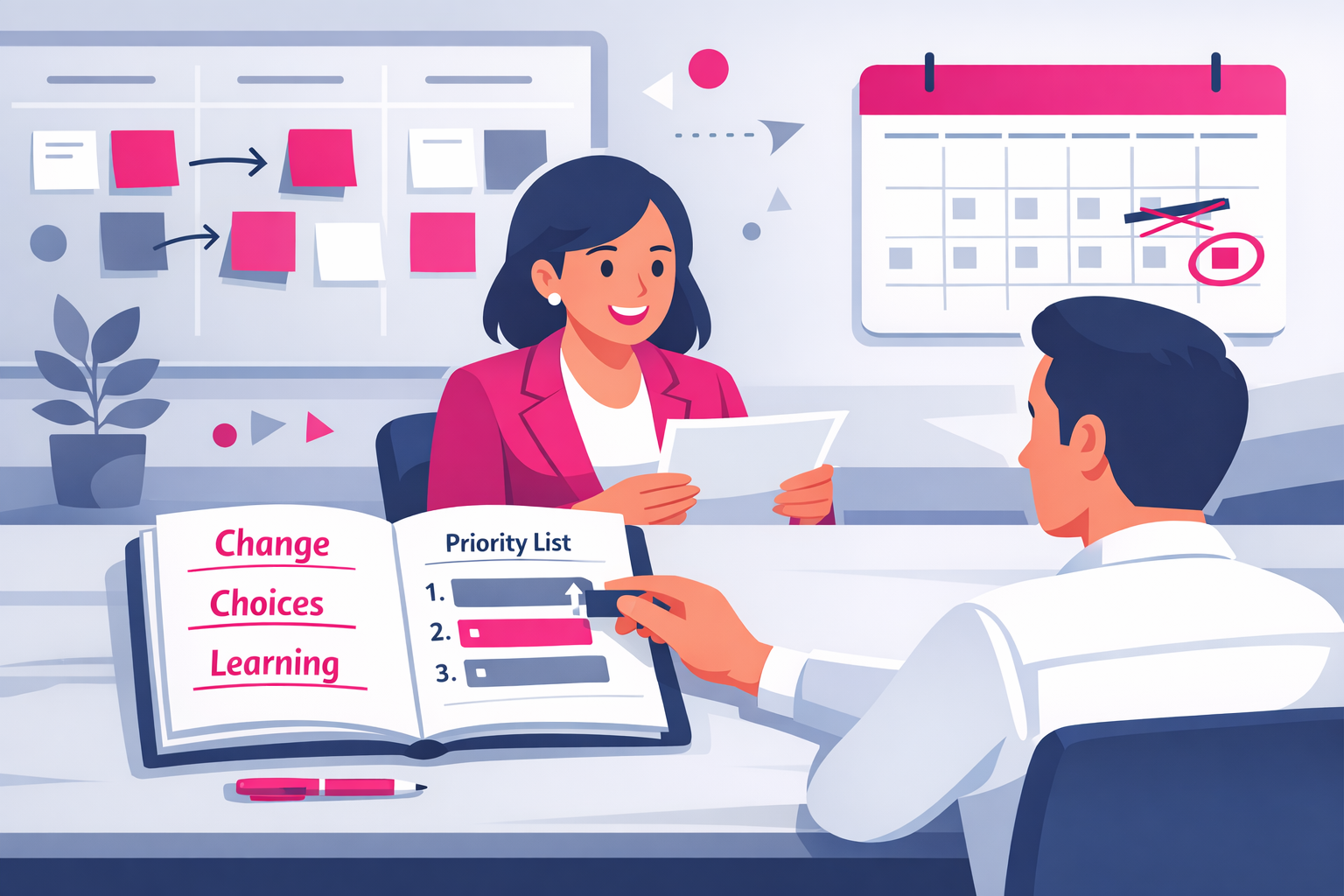
The best structure: CCL (Change, Choices, Learning)
Forget complicated frameworks. Use this.
CCL answer structure
- Change: What shifted, unexpectedly?
- Choices: What options did you have and what did you choose?
- Learning: What did you learn and what do you do differently now?
This works because it shows judgement, not just effort.
Make it interview-tight in 60 to 90 seconds
- 1 sentence: context
- 2 sentences: the change and the constraint
- 2 sentences: what you did and why
- 1 sentence: the outcome
- 1 sentence: learning
If you cannot say it in 90 seconds, you do not own the story yet.
Your adaptability evidence checklist (use before every interview)
Before your interview, build a small bank of evidence. You need three stories. Not ten.
Story 1: A plan changed late
Use when they ask:
- “Tell me about a time you had to adapt to change.”
- “How do you handle shifting priorities?”
Story 2: You had to learn something fast
Use when they ask:
- “Describe a time you had to pick up a new skill quickly.”
- “How do you deal with unfamiliar tasks?”
Story 3: Something went wrong and you stabilised it
Use when they ask:
- “Tell me about a time you made a mistake.”
- “Describe a time things did not go to plan.”
Each story must include at least one measurable outcome:
- Time saved
- Errors reduced
- Result achieved (grade, revenue, delivery date)
- Customer or stakeholder satisfaction
- Rework avoided
If you have no numbers, use concrete indicators:
- “We delivered on the original deadline by cutting non-essential features.”
- “The event ran without delays after we changed the running order.”
- “We reduced confusion by introducing a single shared tracker.”
“I’m applying for my first job. What experience can I use?”
Adaptability is not owned by people with job titles. It is owned by people who have handled real constraints.
You can use:
- College or university group projects
- Part-time work, volunteering, caring responsibilities
- Sports teams and leadership roles
- Personal projects (building, coding, content, fundraising)
- Any situation where someone depended on you and conditions changed
The rule is simple.
If the stakes were real, it counts.
High-impact examples you can copy (and customise)
These are not scripts to memorise. They are models to build your own answers.
Example 1: Priorities changed late (group project)
Change: “In a group assignment, two days before the deadline, we realised our data was flawed and the conclusion would not hold up.”
Choices: “We could submit something weak and hope for the best, or rebuild the analysis fast. I suggested we cut two non-essential sections, reassign tasks, and focus on one strong argument supported by clean data. I took ownership of rebuilding the dataset and documenting assumptions so everyone could trust it.”
Learning: “We submitted on time and improved the mark compared to our previous work. I learned that adapting is not doing more, it is choosing what matters and communicating the trade-off early.”
Example 2: Learning fast (retail or hospitality)
Change: “A new till system was introduced during a busy week and the usual shortcuts no longer worked.”
Choices: “I could have slowed down and waited for a manager each time, but that would have created queues. I asked for 15 minutes before my shift to practise the most common transactions, wrote a one-page cheat sheet, and shared it with two new starters.”
Learning: “Queue times dropped and we made fewer errors. I learned to learn in small loops: practise the top 20 per cent of tasks that drive 80 per cent of outcomes, then expand.”
Example 3: Something broke (volunteering or event)
Change: “At a community event, our speaker cancelled on the day and the schedule had a 45-minute gap.”
Choices: “We could panic, or redesign quickly. I called two backup contacts, but also prepared a short Q&A session with the audience so we had a guaranteed option. We updated signage and announced the change clearly so people were not confused.”
Learning: “The session ran smoothly and feedback stayed positive. I learned that adaptability is mainly about preserving trust by communicating early and offering a clear plan.”
The questions you will get, and how to answer them
“Tell me about a time you had to adapt to change.”
What they are really asking:
- Did you notice the change quickly?
- Did you make decisions or just react?
- Did you keep people informed?
Your answer must include the trigger and the trade-off.
Use CCL. Keep it tight.
“How do you handle changing priorities?”
Do not say: “I just go with the flow.”
Say what you actually do:
- Clarify the new priority and why it matters
- Reconfirm deadlines and constraints
- Identify what must be paused, cut, or delegated
- Communicate the new plan
A strong line you can use:
- “When priorities change, I do not just start new work. I confirm what success looks like now, what drops off the list, and I communicate the trade-off so expectations stay realistic.”
“Describe a time you failed, and what you did next.”
This is adaptability under pressure.
Choose a failure where:
- You took responsibility
- You corrected course quickly
- You improved the system so it did not repeat
Avoid:
- Blaming others
- A failure with no lesson
- A failure that shows poor integrity
“How do you respond to feedback?”
Adaptability is not only reacting to events. It is adapting your own behaviour.
Use a mini-CCL:
- Change: you received specific feedback
- Choices: you asked clarifying questions and changed one behaviour
- Learning: measurable improvement
The language that makes you sound adaptable instantly
Adaptability is communicated through the words you choose.
Replace weak phrases with decision language.
Say this, not that
- Not: “I just did what needed doing.”
- Say: “I assessed the options, chose the quickest path to a safe outcome, and communicated the trade-off.”
- Not: “We were under pressure.”
- Say: “The deadline stayed fixed but our inputs changed, so I cut scope and protected the critical path.”
- Not: “I’m a quick learner.”
- Say: “I learned the minimum viable skill first, applied it immediately, then improved with feedback.”
These phrases signal you can operate in the real world.
Your interview prep: the 30-minute adaptability drill
If you do nothing else, do this the day before.
- Pick three stories using the checklist above.
- Write 6 bullet points per story (context, change, constraint, action, result, learning).
- Add one metric or indicator per story.
- Practise out loud until each story fits in 90 seconds.
- Prepare one follow-up detail per story (what tool you used, how you communicated, what you would do differently).
This is the difference between “I think I’m adaptable” and “Here is the evidence.”
What not to do (it will cost you the job)
Do not brag about chaos
Some candidates think adaptability means:
- “I thrive in chaos.”
- “I love last-minute changes.”
That signals poor planning and low standards.
Employers do not want chaos. They want stability when chaos appears.
Do not tell a story where you were passive
Adaptability is not:
- “They changed everything, so I just did what I was told.”
That shows you can follow instructions. It does not show judgement.
Do not hide the learning
If your story ends with “and it all worked out”, you missed the point.
They want to know how you think now.
How to prove adaptability without saying the word “adaptable”
This is the ultimate move.
Instead of labelling yourself, show your operating system:
- How you notice change
- How you decide
- How you communicate
- How you learn
A compact closing line that works:
- “I cannot control change, but I can control my response. I clarify the goal, pick a sensible plan fast, keep stakeholders informed, and learn so the next time is easier.”
That is what employable adaptability sounds like.
Brief implementation plan (use this for every interview)
- Week before: build three CCL stories, each with one measurable outcome.
- Two days before: practise out loud, tighten to 60 to 90 seconds.
- Day before: predict 3 follow-up questions per story and prepare one extra detail.
- Interview day: listen for the real intent of the question, then deliver one story cleanly.
Adaptability is not a personality trait you claim. It is a capability you demonstrate.
Walk in with proof. Leave them with certainty.
Next Steps
Want to learn more? Check out these articles:
Demonstrate Commercial Awareness in Interviews Without Sounding Fake
How to Demonstrate Teamwork in a Job Interview (Fast)
Explaining a Demotion on Your CV and in Interviews
Check out our Advanced Employability Course for all the help you need to get your dream job, fast.